THE ADVENTURE COLLECTIVE® · Independent discovery and booking for outdoor travel

Walk Frankfurt on your own terms: an interactive, smartphone-based tour that links the Liebieghaus to the Römer and riverbank in a compact 2½-hour loop. Learn local history, spot Goethe’s birthplace and cross the love-locked Eiserner Steg—no guide required.
Walk Frankfurt on your own terms: an interactive, smartphone-based tour that links the Liebieghaus to the Römer and riverbank in a compact 2½-hour loop. Learn local history, spot Goethe’s birthplace and cross the love-locked Eiserner Steg—no guide required.
You step off the tram at the Liebieghaus and the city eases into a walking rhythm: the river Main pulls your line of sight toward sleek towers, the iron bridge hums with footsteps, and cobbled squares hold the echo of centuries.
Verified experiences and guided adventures in the surrounding area.
Operated by Ciceru · Frankfurt am Main, Hesse
You step off the tram at the Liebieghaus and the city eases into a walking rhythm: the river Main pulls your line of sight toward sleek towers, the iron bridge hums with footsteps, and cobbled squares hold the echo of centuries.
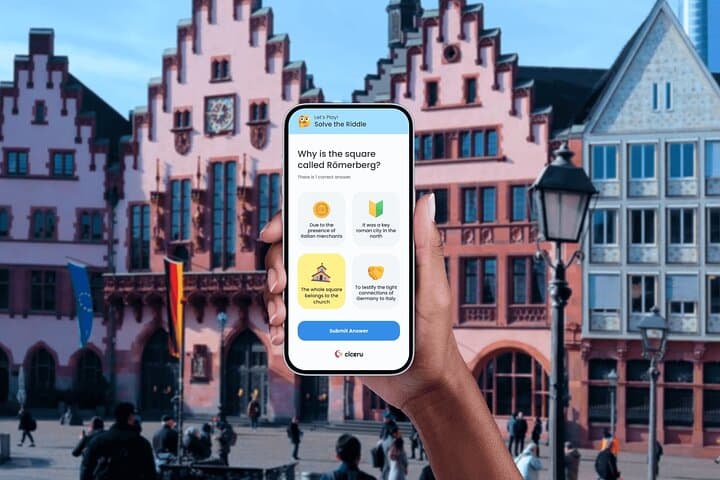
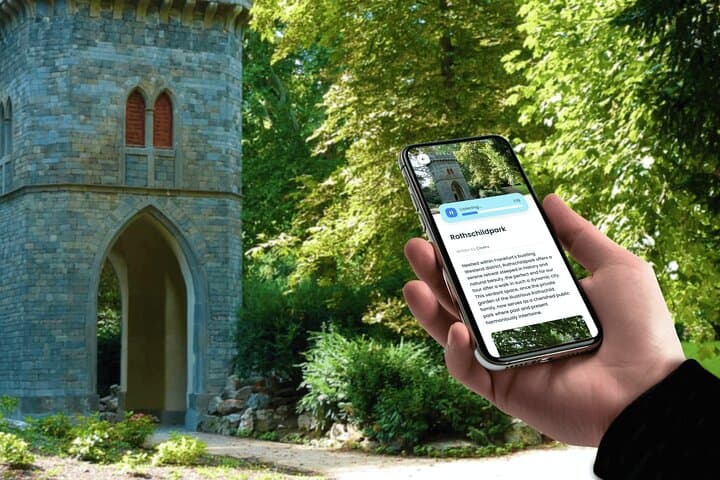
This self-guided audio and text tour stitches eight signature stops across central Frankfurt—Liebieghaus, Eiserner Steg, Römerberg, the Cathedral, Goethe Haus, Willy-Brandt-Platz, the Old Opera and Rothschildpark—into a roughly 2½-hour loop. Architecturally, the route moves from 19th-century villa and Baroque city hall to Gothic stone and postwar reconstructions; beneath your feet are reclaimed riverbanks and streets shaped by trade and imperial ceremonies. Cultural notes thread in Goethe’s early life, Frankfurt’s role as a coronation and banking center, and the rebuilding after WWII that gave the Old Opera its present facade.
Expect paved surfaces, short stair sections and flat city gradients—total distance ~3–4 km and minimal elevation. The Main acts like a companion, offering birds and water reflections that change with light; early morning brings quieter bridges and cleaner photos, late afternoon gives warmer stone tones in the old town.
Practically: bring a charged phone (no app required, just the tour link), good walking shoes and a rain layer if forecasts call for showers. Start near public transit, follow the audio prompts, and allow extra time for museum detours or a market stop at Kleinmarkthalle. The experience suits curious travelers who want historical context without a guide—listening, looking and walking at your pace.
easy.
2–2.5 hours.
Suitable for casual walkers who can comfortably cover 3–4 km on flat, paved ground.
No app is required; the tour plays via your phone’s browser and includes audio and text in seven languages.
The experience is about 150 minutes and covers roughly 3–4 km on flat, paved surfaces with short stair sections.
Yes—start points like Liebieghaus and nearby tram and S-Bahn stops make the route easy to reach by public transit.
Yes, the self-guided format allows you to pause to enter museums or markets; plan extra time if you want to go inside attractions.
Frankfurt’s old town dates to medieval trade routes; the Römer was the city hall where imperial coronations were celebrated, and Goethe’s birthplace anchors the city to Germany’s literary history.
High foot traffic in historic zones encourages responsible behavior—stick to marked paths, avoid leaning on fragile façades, and dispose of waste to protect these urban heritage sites.
Ciceru operates guided outdoor trips and adventures with an emphasis on safety, stewardship, and memorable experiences.

You step off the tram at the Liebieghaus and the city eases into a walking rhythm: the river Main pulls your line of sight toward sleek towers, the iron bridge hums with footsteps, and cobbled squares hold the echo of centuries.
You step off the tram at the Liebieghaus and the city eases into a walking rhythm: the river Main pulls your line of sight toward sleek towers, the iron bridge hums with footsteps, and cobbled squares hold the echo of centuries.
This self-guided audio and text tour stitches eight signature stops across central Frankfurt—Liebieghaus, Eiserner Steg, Römerberg, the Cathedral, Goethe Haus, Willy-Brandt-Platz, the Old Opera and Rothschildpark—into a roughly 2½-hour loop. Architecturally, the route moves from 19th-century villa and Baroque city hall to Gothic stone and postwar reconstructions; beneath your feet are reclaimed riverbanks and streets shaped by trade and imperial ceremonies. Cultural notes thread in Goethe’s early life, Frankfurt’s role as a coronation and banking center, and the rebuilding after WWII that gave the Old Opera its present facade.
Expect paved surfaces, short stair sections and flat city gradients—total distance ~3–4 km and minimal elevation. The Main acts like a companion, offering birds and water reflections that change with light; early morning brings quieter bridges and cleaner photos, late afternoon gives warmer stone tones in the old town.
Practically: bring a charged phone (no app required, just the tour link), good walking shoes and a rain layer if forecasts call for showers. Start near public transit, follow the audio prompts, and allow extra time for museum detours or a market stop at Kleinmarkthalle. The experience suits curious travelers who want historical context without a guide—listening, looking and walking at your pace.