THE ADVENTURE COLLECTIVE® · Independent discovery and booking for outdoor travel

A 40-minute helicopter flight from Fox Glacier that lands on alpine snow and follows the Main Divide past Tasman Glacier and Aoraki / Mount Cook. Expect dramatic aerial views, a short snow landing at ~2,134 m, and strict weather and weight checks.
A 40-minute helicopter flight from Fox Glacier that lands on alpine snow and follows the Main Divide past Tasman Glacier and Aoraki / Mount Cook. Expect dramatic aerial views, a short snow landing at ~2,134 m, and strict weather and weight checks.
You lift off from the small airstrip at Fox Glacier and the rainforest below shrinks into a quilt of greens while the Southern Alps thrust up ahead, sharp and weathered.
Verified experiences and guided adventures in the surrounding area.
Operated by Totally Tourism - The Helicopter Line · Fox Glacier, West Coast
You lift off from the small airstrip at Fox Glacier and the rainforest below shrinks into a quilt of greens while the Southern Alps thrust up ahead, sharp and weathered.
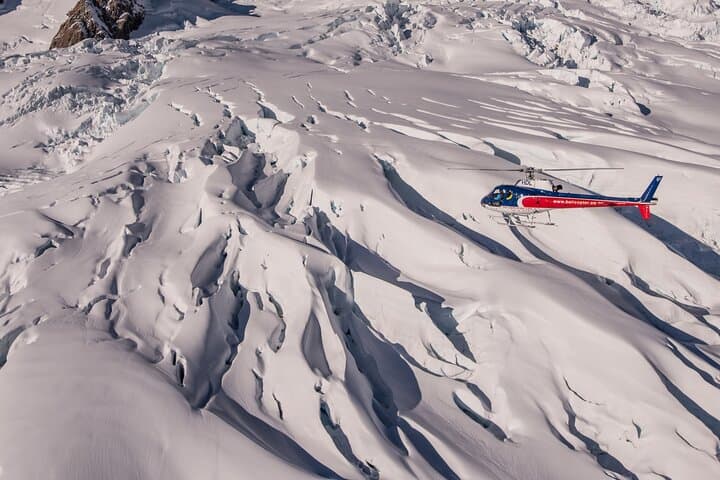
In forty minutes the helicopter threads a corridor between Franz Josef and Fox Glacier, the air cold and clear as you approach a planned snow landing at roughly 2,134 meters (7,000 ft). Stepping onto the compacted snow, the world feels kinetic — ice creaks like an old ship and light bounces off seracs. The pilot follows the Main Divide, giving sweeping perspectives of the massive Tasman Glacier and a close pass by Aoraki / Mount Cook before descending toward the damp coastal forests that meet the Tasman Sea.
Geology here is active: the Pacific and Australian plates raise the Southern Alps, and glaciers carve deep U-shaped valleys that still move and retreat. Culturally, the area sits on Ngāi Tahu rohe; Aoraki holds deep Māori significance. The route juxtaposes meteorological extremes — alpine ice above temperate rainforest — in a compact landscape.
Practical guidance: book for morning windows when winds are often lighter, expect a mandatory weather check and a 30-minute check-in close time. Declare accurate weight — operators enforce limits for balance. Dress in windproof layers and sturdy footwear for the snow landing; sunglasses and a camera with a strap are useful. If you get airsick, choose a front seat and focus on the horizon.
This is a high-adrenaline, low-effort way to experience active glaciers and alpine giants for travellers of most abilities, but flights are weather-dependent and refundable within the operator’s policy.
easy.
40 minutes.
Suitable for most fitness levels; minimal physical exertion required beyond a short snow walk.
The advertised flight duration is 40 minutes, including a planned snow landing of around 10 minutes.
Flights are subject to weather; if your flight is cancelled you can usually rebook a similar scenic flight at another Helicopter Line operation.
Yes — you must declare passenger weights at booking; differences of 15 kg (33 lb) or more at check-in may require rescheduling.
The landing is short and physically easy, but children must be accompanied by an adult and everyone should have suitable footwear and warm clothing.
The Fox and Franz Josef glaciers have been important travel routes and landmarks for Māori for centuries; European naming reflects 19th-century exploration. The Southern Alps are actively uplifted by plate collision.
Glaciers in this region are retreating with climate change — stick to marked landing and walking zones and follow operator guidance to minimize ecological disturbance.
Totally Tourism - The Helicopter Line operates guided outdoor trips and adventures with an emphasis on safety, stewardship, and memorable experiences.



You lift off from the small airstrip at Fox Glacier and the rainforest below shrinks into a quilt of greens while the Southern Alps thrust up ahead, sharp and weathered.
You lift off from the small airstrip at Fox Glacier and the rainforest below shrinks into a quilt of greens while the Southern Alps thrust up ahead, sharp and weathered.
In forty minutes the helicopter threads a corridor between Franz Josef and Fox Glacier, the air cold and clear as you approach a planned snow landing at roughly 2,134 meters (7,000 ft). Stepping onto the compacted snow, the world feels kinetic — ice creaks like an old ship and light bounces off seracs. The pilot follows the Main Divide, giving sweeping perspectives of the massive Tasman Glacier and a close pass by Aoraki / Mount Cook before descending toward the damp coastal forests that meet the Tasman Sea.
Geology here is active: the Pacific and Australian plates raise the Southern Alps, and glaciers carve deep U-shaped valleys that still move and retreat. Culturally, the area sits on Ngāi Tahu rohe; Aoraki holds deep Māori significance. The route juxtaposes meteorological extremes — alpine ice above temperate rainforest — in a compact landscape.
Practical guidance: book for morning windows when winds are often lighter, expect a mandatory weather check and a 30-minute check-in close time. Declare accurate weight — operators enforce limits for balance. Dress in windproof layers and sturdy footwear for the snow landing; sunglasses and a camera with a strap are useful. If you get airsick, choose a front seat and focus on the horizon.
This is a high-adrenaline, low-effort way to experience active glaciers and alpine giants for travellers of most abilities, but flights are weather-dependent and refundable within the operator’s policy.