THE ADVENTURE COLLECTIVE® · Independent discovery and booking for outdoor travel

A compact, private four-day circuit from Aqaba that pairs Petra’s rock-cut city with Wadi Rum’s desert panoramas, a Bedouin camp overnight and a float on the Dead Sea—ideal for travelers who want Jordan’s highlights in one well-paced trip.
A compact, private four-day circuit from Aqaba that pairs Petra’s rock-cut city with Wadi Rum’s desert panoramas, a Bedouin camp overnight and a float on the Dead Sea—ideal for travelers who want Jordan’s highlights in one well-paced trip.
The day begins on the red-black asphalt of Aqaba’s coastal road, where the Gulf of Aqaba keeps its slow, stubborn blue and the air smells faintly of salt and diesel. A private driver eases a modern van out of the city and the landscape changes with every kilometer: scrubby wadis give way to wind-carved sandstone and finally, the broad, silent bowls of Wadi Rum. By late afternoon the desert is a living instrument—sand and rock taking on the copper tones of sunset—and a Bedouin camp rises from the flat like a human answer to the horizon.
Verified experiences and guided adventures in the surrounding area.
Operated by Bridge Travel · Aqaba, Aqaba Governorate
The day begins on the red-black asphalt of Aqaba’s coastal road, where the Gulf of Aqaba keeps its slow, stubborn blue and the air smells faintly of salt and diesel. A private driver eases a modern van out of the city and the landscape changes with every kilometer: scrubby wadis give way to wind-carved sandstone and finally, the broad, silent bowls of Wadi Rum. By late afternoon the desert is a living instrument—sand and rock taking on the copper tones of sunset—and a Bedouin camp rises from the flat like a human answer to the horizon.
This is a four-day study in contrasts: the carved facades of Petra’s Nabatean city, the geological theatre of Wadi Rum, the Roman columns of Jerash and the impossible buoyancy of the Dead Sea. Petra, reached after a roughly 100 km drive from Wadi Rum, centers on the Siq—a 1.2 km gorge that funnels you into the Treasury, a 140-foot-high rock carving that still commands a quiet awe. The Nabateans, who engineered water channels and carved whole cities into cliffs, turned sandstone into architecture; geologically, that same sandstone is soft and stratified, prone to erosion that sculpts unexpected shapes and hidden niches.
Wadi Rum reads differently: massive granite and sandstone outcrops that once inspired Lawrence of Arabia’s accounts now host short jeep safaris, led by Bedouin drivers who know the desert’s rock language—arches, faces and ribs of stone named after animals and legends. A two-hour jeep tour samples dunes, narrow canyons and vistas; at night the camp’s small fire is the only light, and the desert sky dares you to remember constellations.
Practicalities are simple but essential. The itinerary packs four days of driving and walking; expect several hours on paved and unpaved roads and at least moderate walking at Petra and Jerash. The tour includes hotel pickups in Aqaba, one night in a Wadi Rum Bedouin tent (one tent per up to three people), two nights in a 3-star Amman hotel and entrance fees if selected at booking.
Stay sun-smart: long sleeves, a wide-brim hat and SPF are non-negotiable. Sturdy shoes make Petra’s uneven carved steps and Wadi Rum’s rocky traverses far more comfortable. Water is scarce—carry a refillable bottle—and pace yourself at the Dead Sea: its mineral-rich waters are miraculous for floating but sting open cuts and shouldn’t be splashed into eyes.
This private loop is best for travelers who want a curated, active introduction to Jordan’s iconic sites in a short window. It balances culture and geology with Bedouin hospitality, and rewards anyone who shows up with curiosity, a good pair of shoes and respect for fragile desert landscapes.
moderate.
4 days.
Suitable for travelers with moderate fitness: expect several hours of walking at archaeological sites and short hikes in desert terrain.
Yes—hotel pickup and drop-off in Aqaba are included; the driver will hold a sign with client names and pick up approximately 10 minutes before departure.
Entrance fees are included only if the option was selected at booking—confirm during reservation or with your local guide on arrival.
Yes—one night in a Wadi Rum Bedouin tent is provided (one tent per up to three people); basic amenities vary by camp, so check in advance for private facilities.
Infants must sit on a lap; specialized infant seats are available but the itinerary involves long drives and uneven walking so consider age and mobility.
The Dead Sea’s salt concentration makes you float easily but will sting any open wounds—wear water shoes, avoid splashing, and rinse off afterward.
Visa requirements depend on nationality; some travelers can obtain visas on arrival at Aqaba’s port, but confirm with your embassy before travel.
Petra was the Nabatean capital and a crossroads of trade routes; Bedouin tribes have inhabited and guided in Wadi Rum for centuries, preserving desert knowledge.
Water scarcity and fragile sandstone demand low-impact travel—use refillable bottles, stick to trails in Petra and avoid touching fragile rock reliefs.
Bridge Travel operates guided outdoor trips and adventures with an emphasis on safety, stewardship, and memorable experiences.

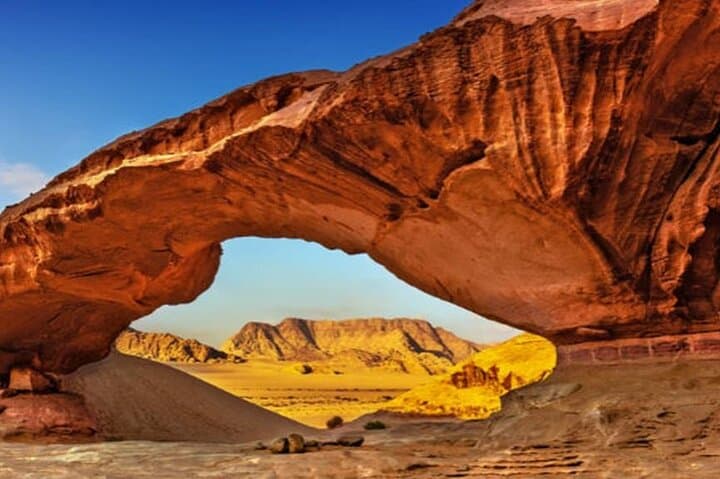


The day begins on the red-black asphalt of Aqaba’s coastal road, where the Gulf of Aqaba keeps its slow, stubborn blue and the air smells faintly of salt and diesel. A private driver eases a modern van out of the city and the landscape changes with every kilometer: scrubby wadis give way to wind-carved sandstone and finally, the broad, silent bowls of Wadi Rum. By late afternoon the desert is a living instrument—sand and rock taking on the copper tones of sunset—and a Bedouin camp rises from the flat like a human answer to the horizon.
The day begins on the red-black asphalt of Aqaba’s coastal road, where the Gulf of Aqaba keeps its slow, stubborn blue and the air smells faintly of salt and diesel. A private driver eases a modern van out of the city and the landscape changes with every kilometer: scrubby wadis give way to wind-carved sandstone and finally, the broad, silent bowls of Wadi Rum. By late afternoon the desert is a living instrument—sand and rock taking on the copper tones of sunset—and a Bedouin camp rises from the flat like a human answer to the horizon.
This is a four-day study in contrasts: the carved facades of Petra’s Nabatean city, the geological theatre of Wadi Rum, the Roman columns of Jerash and the impossible buoyancy of the Dead Sea. Petra, reached after a roughly 100 km drive from Wadi Rum, centers on the Siq—a 1.2 km gorge that funnels you into the Treasury, a 140-foot-high rock carving that still commands a quiet awe. The Nabateans, who engineered water channels and carved whole cities into cliffs, turned sandstone into architecture; geologically, that same sandstone is soft and stratified, prone to erosion that sculpts unexpected shapes and hidden niches.
Wadi Rum reads differently: massive granite and sandstone outcrops that once inspired Lawrence of Arabia’s accounts now host short jeep safaris, led by Bedouin drivers who know the desert’s rock language—arches, faces and ribs of stone named after animals and legends. A two-hour jeep tour samples dunes, narrow canyons and vistas; at night the camp’s small fire is the only light, and the desert sky dares you to remember constellations.
Practicalities are simple but essential. The itinerary packs four days of driving and walking; expect several hours on paved and unpaved roads and at least moderate walking at Petra and Jerash. The tour includes hotel pickups in Aqaba, one night in a Wadi Rum Bedouin tent (one tent per up to three people), two nights in a 3-star Amman hotel and entrance fees if selected at booking.
Stay sun-smart: long sleeves, a wide-brim hat and SPF are non-negotiable. Sturdy shoes make Petra’s uneven carved steps and Wadi Rum’s rocky traverses far more comfortable. Water is scarce—carry a refillable bottle—and pace yourself at the Dead Sea: its mineral-rich waters are miraculous for floating but sting open cuts and shouldn’t be splashed into eyes.
This private loop is best for travelers who want a curated, active introduction to Jordan’s iconic sites in a short window. It balances culture and geology with Bedouin hospitality, and rewards anyone who shows up with curiosity, a good pair of shoes and respect for fragile desert landscapes.