THE ADVENTURE COLLECTIVE® · Independent discovery and booking for outdoor travel

Join an expert forager to hunt edible plants along the Serra da Bocaina trails near Paraty. This six-hour experience blends botany, local history and a freshwater swim, finishing with a salad made from what you collected.
Join an expert forager to hunt edible plants along the Serra da Bocaina trails near Paraty. This six-hour experience blends botany, local history and a freshwater swim, finishing with a salad made from what you collected.
You step off the minivan and the air changes—damp, green, threaded with citrus and earth. A narrow trail climbs into the Serra da Bocaina’s folds; ferns brush your calves and the forest seems to watch as Jorge, the forager, crouches to show a cluster of edible flowers.
Verified experiences and guided adventures in the surrounding area.
Operated by Paraty Explorer · Paraty, Rio de Janeiro
You step off the minivan and the air changes—damp, green, threaded with citrus and earth. A narrow trail climbs into the Serra da Bocaina’s folds; ferns brush your calves and the forest seems to watch as Jorge, the forager, crouches to show a cluster of edible flowers.
This walk threads history and ecology. You move along parts of the old Caminho do Ouro (Gold Path), the colonial route that linked Paraty’s port to inland mines. Geologically the coast here is a band of older crystalline mountains meeting the Atlantic, producing steep streams and natural pools. Culturally, the route is still shaped by small-scale agroforestry and local knowledge—Jorge pairs ethnobotany with culinary tips, explaining why a leaf was used as a poultice or how fruit was preserved by earlier generations.
Expect a pragmatic, sensory day: identification of fruits, leaves, mushrooms and flowers, talk of nutrition and herbal medicine, and a modest swim in a clear plunge pool when the trail allows. The walk is moderate—uneven trails, occasional wet roots, and short climbs—and capped by a light lunch where many harvested plants appear on the plate.
Practical notes: wear closed trail shoes, bring a refillable water bottle and insect repellent, and pack swimwear if you want to jump in. The guide emphasizes responsible foraging—sample, don’t strip—and follows trails to minimize impact. Tours run about six hours, often departing from Paraty; check cancellation windows and bring sun protection in warmer months.
moderate.
6 hours.
Moderate fitness—comfortable walking on uneven forest trails and short climbs; ability to stand and walk for several hours.
The tour includes a salad prepared from foraged ingredients; a full lunch at a local restaurant may be available but is usually not included.
It’s rated moderate—expect uneven trails, short steep sections and up to six hours on your feet; basic fitness is required.
The guide will identify edible species and model responsible harvesting; participants should not remove large quantities or protected species.
Families are often welcome, but the operator recommends children be old enough to hike for several hours and follow safety instructions.
The route follows parts of the Caminho do Ouro linked to colonial gold and coffee transport; Paraty’s port was a historic export point for the region.
The Atlantic Forest is highly fragmented; tours follow established trails and emphasize minimal impact and sustainable, selective foraging to protect plant populations.
Paraty Explorer operates guided outdoor trips and adventures with an emphasis on safety, stewardship, and memorable experiences.
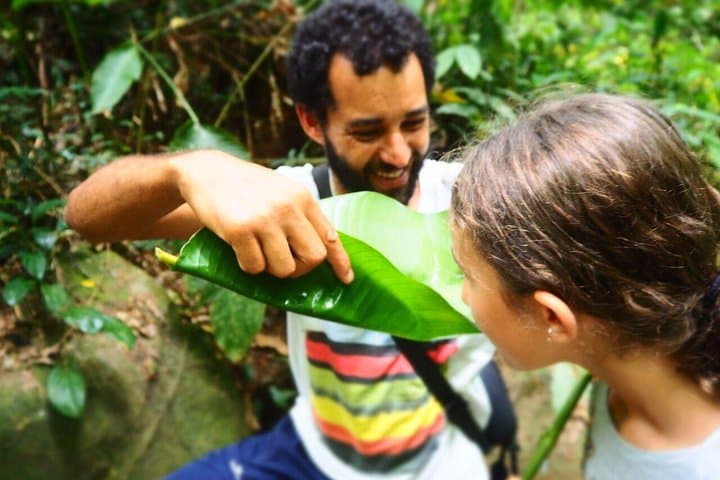


You step off the minivan and the air changes—damp, green, threaded with citrus and earth. A narrow trail climbs into the Serra da Bocaina’s folds; ferns brush your calves and the forest seems to watch as Jorge, the forager, crouches to show a cluster of edible flowers.
You step off the minivan and the air changes—damp, green, threaded with citrus and earth. A narrow trail climbs into the Serra da Bocaina’s folds; ferns brush your calves and the forest seems to watch as Jorge, the forager, crouches to show a cluster of edible flowers.
This walk threads history and ecology. You move along parts of the old Caminho do Ouro (Gold Path), the colonial route that linked Paraty’s port to inland mines. Geologically the coast here is a band of older crystalline mountains meeting the Atlantic, producing steep streams and natural pools. Culturally, the route is still shaped by small-scale agroforestry and local knowledge—Jorge pairs ethnobotany with culinary tips, explaining why a leaf was used as a poultice or how fruit was preserved by earlier generations.
Expect a pragmatic, sensory day: identification of fruits, leaves, mushrooms and flowers, talk of nutrition and herbal medicine, and a modest swim in a clear plunge pool when the trail allows. The walk is moderate—uneven trails, occasional wet roots, and short climbs—and capped by a light lunch where many harvested plants appear on the plate.
Practical notes: wear closed trail shoes, bring a refillable water bottle and insect repellent, and pack swimwear if you want to jump in. The guide emphasizes responsible foraging—sample, don’t strip—and follows trails to minimize impact. Tours run about six hours, often departing from Paraty; check cancellation windows and bring sun protection in warmer months.