THE ADVENTURE COLLECTIVE® · Independent discovery and booking for outdoor travel

Short domestic flights deliver you to Luxor’s temples and tombs for a concentrated, guided day of archaeology and history. Expect long sunlit courtyards, carved tomb passages, and expert context from an Egyptologist.
Short domestic flights deliver you to Luxor’s temples and tombs for a concentrated, guided day of archaeology and history. Expect long sunlit courtyards, carved tomb passages, and expert context from an Egyptologist.
You step off the short domestic flight into Luxor’s dry sunlight and the day opens like a map: sandstone avenues, towering pylons, and the Nile slipping by with the easy inevitability of years. Your Egyptologist meets you at the terminal, and within an hour you’re tracing carved corridors where pharaohs once planned for the afterlife.
Verified experiences and guided adventures in the surrounding area.
Operated by Narmer Tours · Luxor, Luxor Governorate
You step off the short domestic flight into Luxor’s dry sunlight and the day opens like a map: sandstone avenues, towering pylons, and the Nile slipping by with the easy inevitability of years. Your Egyptologist meets you at the terminal, and within an hour you’re tracing carved corridors where pharaohs once planned for the afterlife.
Luxor sits on the site of ancient Thebes, the political and religious heart of Egypt’s New Kingdom. The valley’s limestone hills hide burial chambers cut deep into rock; the East Bank hosts Karnak and Luxor Temples built for Amun-Re, where columns still stand like a deliberate forest. Cultural layers are visible everywhere—from Ramesses III’s battle reliefs at Madinat Habu to Hatshepsut’s colonnaded mortuary temple at Deir el-Bahri.
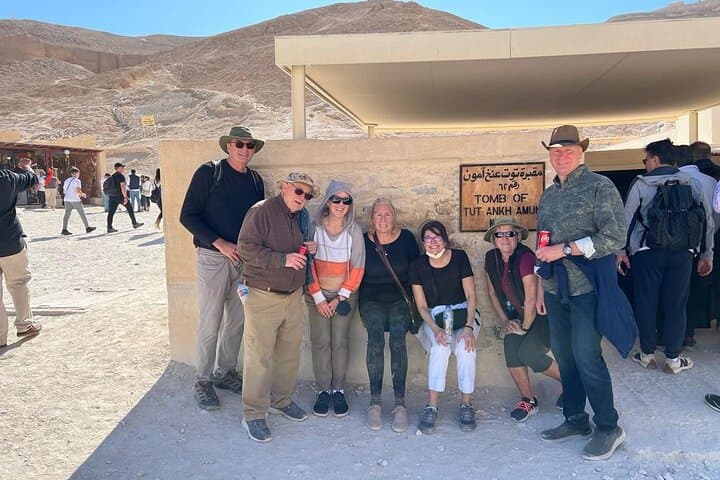
This full-day itinerary moves quickly: Valley of the Kings (tomb access rotates), the small but world-famous tomb of Tutankhamun when included, Hatshepsut’s terraces, Madinat Habu, the Colossi of Memnon, and Karnak. Expect paved and uneven surfaces, short climbs and long open courtyards that intensify the sun.
Practical guidance: start early; domestic flight schedules commonly dictate a 5:00–6:00 a.m. departure from Cairo and return in the evening. Carry sunscreen, a brimmed hat, and at least 1.5–2 liters of water; breathable layers help with dramatic temperature swings between sun and shade. Buy tickets for special tombs in advance when possible. Respect local customs: modest dress in religious areas, and small bills for entrance fees and tips make logistics smoother. With an informed guide, the day becomes both efficient and richly contextual—history explained on site, not only described in a brochure.
moderate.
8–10 hours.
Suitable for travelers in average fitness; involves walking on uneven ground, short climbs and extended standing periods.
Domestic flights are included only if the flight option is selected during booking; prices and exact times depend on availability and season.
No—tomb access rotates to protect fragile interiors; the guide will confirm which tombs are open the day of your visit and which require separate tickets.
Transportation and many East Bank sites are wheelchair accessible, but several tombs and temple areas have steps or narrow passages that limit access to parts of the itinerary.
Travelers must hold a valid passport; visa requirements depend on nationality—check Egypt’s current entry rules well before travel and carry passport details when booking.
Luxor occupies ancient Thebes, New Kingdom capital where pharaonic power concentrated around the cult of Amun; monuments date primarily from the 16th–11th centuries BC.
Authorities limit visitor access to sensitive tombs and rotate openings to prevent humidity and foot-traffic damage; stick to marked paths, avoid flash photography where prohibited, and minimize plastic waste.
Narmer Tours operates guided outdoor trips and adventures with an emphasis on safety, stewardship, and memorable experiences.


You step off the short domestic flight into Luxor’s dry sunlight and the day opens like a map: sandstone avenues, towering pylons, and the Nile slipping by with the easy inevitability of years. Your Egyptologist meets you at the terminal, and within an hour you’re tracing carved corridors where pharaohs once planned for the afterlife.
You step off the short domestic flight into Luxor’s dry sunlight and the day opens like a map: sandstone avenues, towering pylons, and the Nile slipping by with the easy inevitability of years. Your Egyptologist meets you at the terminal, and within an hour you’re tracing carved corridors where pharaohs once planned for the afterlife.
Luxor sits on the site of ancient Thebes, the political and religious heart of Egypt’s New Kingdom. The valley’s limestone hills hide burial chambers cut deep into rock; the East Bank hosts Karnak and Luxor Temples built for Amun-Re, where columns still stand like a deliberate forest. Cultural layers are visible everywhere—from Ramesses III’s battle reliefs at Madinat Habu to Hatshepsut’s colonnaded mortuary temple at Deir el-Bahri.
This full-day itinerary moves quickly: Valley of the Kings (tomb access rotates), the small but world-famous tomb of Tutankhamun when included, Hatshepsut’s terraces, Madinat Habu, the Colossi of Memnon, and Karnak. Expect paved and uneven surfaces, short climbs and long open courtyards that intensify the sun.
Practical guidance: start early; domestic flight schedules commonly dictate a 5:00–6:00 a.m. departure from Cairo and return in the evening. Carry sunscreen, a brimmed hat, and at least 1.5–2 liters of water; breathable layers help with dramatic temperature swings between sun and shade. Buy tickets for special tombs in advance when possible. Respect local customs: modest dress in religious areas, and small bills for entrance fees and tips make logistics smoother. With an informed guide, the day becomes both efficient and richly contextual—history explained on site, not only described in a brochure.