THE ADVENTURE COLLECTIVE® · Independent discovery and booking for outdoor travel

Strap in at Cuenca’s Castle Quarter and fly 445 meters over the Hoz del Huécar on Europe’s longest urban double zipline. The short, intense ride pairs full-throttle adrenaline with unbeatable panoramas of the Hanging Houses, St. Paul’s Bridge and the World Heritage old town.
Strap in at Cuenca’s Castle Quarter and fly 445 meters over the Hoz del Huécar on Europe’s longest urban double zipline. The short, intense ride pairs full-throttle adrenaline with unbeatable panoramas of the Hanging Houses, St. Paul’s Bridge and the World Heritage old town.
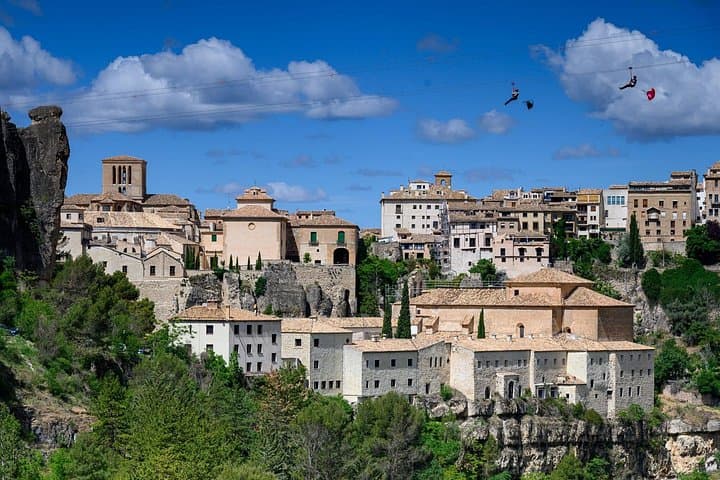
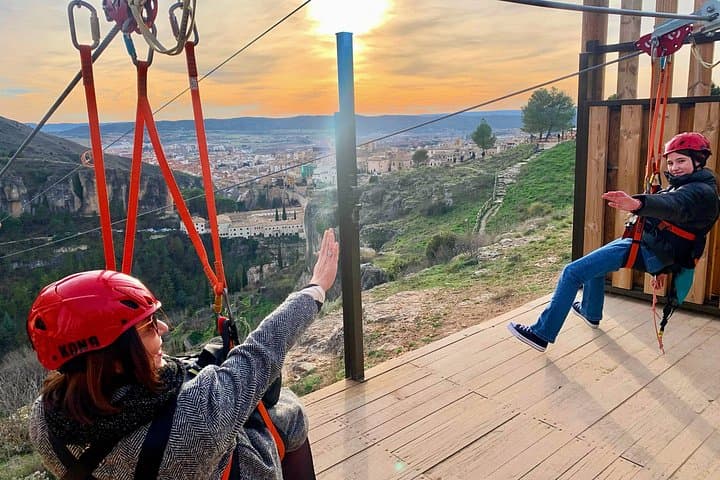
You step into the caravan at the top of Cuenca’s Castle Quarter, the city’s stone teeth rising around you. Harness snug, helmet clicked, the old town below seems to hold its breath. When you push off, the world opens: 445 meters of wire, the Hoz del Huécar gorge daring you to cross it, and the Hanging Houses, St. Paul’s Bridge and the terracotta roofs of a World Heritage city sliding under your feet.
Verified experiences and guided adventures in the surrounding area.
Operated by Tirolina Las Hoces Cuenca · Cuenca, Castilla-La Mancha
You step into the caravan at the top of Cuenca’s Castle Quarter, the city’s stone teeth rising around you. Harness snug, helmet clicked, the old town below seems to hold its breath. When you push off, the world opens: 445 meters of wire, the Hoz del Huécar gorge daring you to cross it, and the Hanging Houses, St. Paul’s Bridge and the terracotta roofs of a World Heritage city sliding under your feet.
This is not a theme-park zipline transplanted to a tourist district. The line follows the raw geology of the river gorge carved by the Huécar over millennia, where limestone cliffs drop sharply and griffon vultures still ride the thermals. Cuenca’s medieval core—declared UNESCO World Heritage for its exceptional urban planning and Casas Colgadas—was built on these cliffs; flying the zipline positions you in the same vertical conversation that shaped the town’s history.
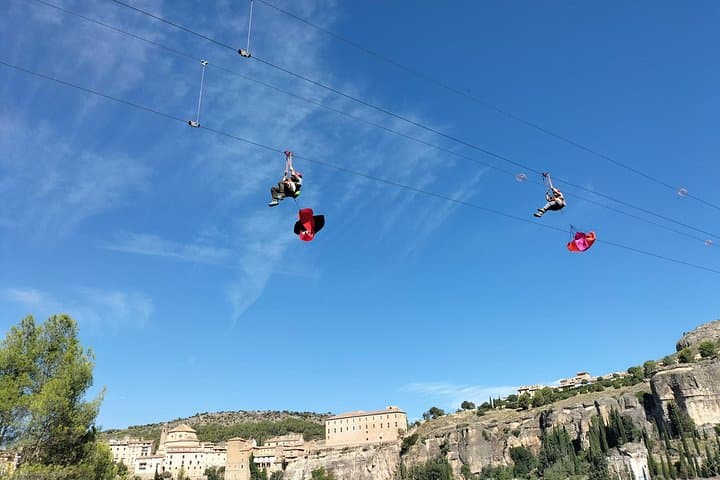
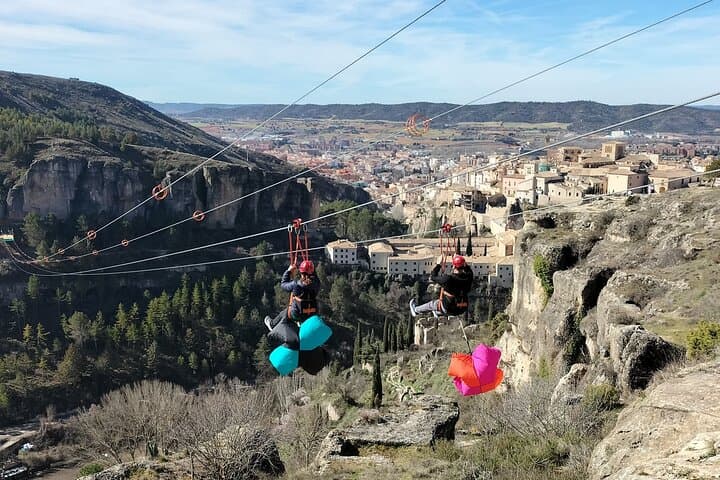
Local guides run the operation out of a caravan in the public parking area of the Castle Quarter. Participants are secured in tested harnesses and a parachute-style drag device moderates speed to keep the view front-and-center: the Parador Nacional de Turismo near the arrival station, the narrow ribbon of the Huécar below, and a panorama that compresses Roman, Moorish and Gothic layers into one glance.
The technical stats are simple and thrilling: 445 m length, maximum 120 m above ground at the highest point, an estimated top speed around 70 km/h, and a transit time of roughly 35–40 seconds. The activity is private and brief—plan on 15–30 minutes total for briefing, gearing up and the ride itself. Weight limits are firm: minimum 35 kg, maximum 120 kg. The route is wheelchair-accessible at the meeting point, but the zipline itself is not suitable for people with spinal injuries, heart conditions, or pregnancy.
For planning: arrive early in the Castle Quarter to secure parking and time to admire the viewpoint before you fly. Wear closed-toe shoes and a windbreaker—air at speed feels cooler than on the ground. Bring a small camera with a wrist strap or use a phone tether; operators usually allow passengers to carry a small backpack. The best window for light is late afternoon when the sun hits the western facades of the Hanging Houses.
If you want to pair thrills with culture, combine the zipline with a slow walk across St. Paul’s Bridge and a visit to the Museum of Spanish Abstract Art. Be mindful of the fragile cliff-side environment: stay on paths, respect barriers and pack out any trash so Cuenca’s vertical city stays intact for the next person to fly over it.
easy.
15–30 minutes.
Requires basic mobility: able to walk a short distance, stand for briefing, and follow safety instructions.
The flight covers 445 meters and typically takes about 35–40 seconds; allow 15–30 minutes total including briefing and gearing.
Yes—minimum weight 35 kg and maximum 120 kg. The activity is suitable for most adults and children who meet the weight requirement.
The meeting and box office area are wheelchair accessible, but the zipline itself requires transferring into a harness and is not suitable for wheelchair users during the flight.
Small cameras and phones are usually allowed if secured with a tether; follow staff instructions to avoid dropping items.
The provider may cancel for safety; full refunds are available if you cancel at least 24 hours beforehand or if the operator cancels due to weather.
No technical skills are needed—staff provide all equipment and a safety briefing, and the line uses a drag device to moderate speed.
Cuenca’s old town grew on the steep limestone of the Hoz del Huécar; the Hanging Houses are a distinctive medieval feature that helped secure its UNESCO World Heritage status.
Operators emphasize minimal infrastructure and controlled access to protect the cliff faces and historic fabric—stick to paths, avoid climbing on ruins, and pack out trash.
Tirolina Las Hoces Cuenca operates guided outdoor trips and adventures with an emphasis on safety, stewardship, and memorable experiences.
You step into the caravan at the top of Cuenca’s Castle Quarter, the city’s stone teeth rising around you. Harness snug, helmet clicked, the old town below seems to hold its breath. When you push off, the world opens: 445 meters of wire, the Hoz del Huécar gorge daring you to cross it, and the Hanging Houses, St. Paul’s Bridge and the terracotta roofs of a World Heritage city sliding under your feet.
You step into the caravan at the top of Cuenca’s Castle Quarter, the city’s stone teeth rising around you. Harness snug, helmet clicked, the old town below seems to hold its breath. When you push off, the world opens: 445 meters of wire, the Hoz del Huécar gorge daring you to cross it, and the Hanging Houses, St. Paul’s Bridge and the terracotta roofs of a World Heritage city sliding under your feet.
This is not a theme-park zipline transplanted to a tourist district. The line follows the raw geology of the river gorge carved by the Huécar over millennia, where limestone cliffs drop sharply and griffon vultures still ride the thermals. Cuenca’s medieval core—declared UNESCO World Heritage for its exceptional urban planning and Casas Colgadas—was built on these cliffs; flying the zipline positions you in the same vertical conversation that shaped the town’s history.
Local guides run the operation out of a caravan in the public parking area of the Castle Quarter. Participants are secured in tested harnesses and a parachute-style drag device moderates speed to keep the view front-and-center: the Parador Nacional de Turismo near the arrival station, the narrow ribbon of the Huécar below, and a panorama that compresses Roman, Moorish and Gothic layers into one glance.
The technical stats are simple and thrilling: 445 m length, maximum 120 m above ground at the highest point, an estimated top speed around 70 km/h, and a transit time of roughly 35–40 seconds. The activity is private and brief—plan on 15–30 minutes total for briefing, gearing up and the ride itself. Weight limits are firm: minimum 35 kg, maximum 120 kg. The route is wheelchair-accessible at the meeting point, but the zipline itself is not suitable for people with spinal injuries, heart conditions, or pregnancy.
For planning: arrive early in the Castle Quarter to secure parking and time to admire the viewpoint before you fly. Wear closed-toe shoes and a windbreaker—air at speed feels cooler than on the ground. Bring a small camera with a wrist strap or use a phone tether; operators usually allow passengers to carry a small backpack. The best window for light is late afternoon when the sun hits the western facades of the Hanging Houses.
If you want to pair thrills with culture, combine the zipline with a slow walk across St. Paul’s Bridge and a visit to the Museum of Spanish Abstract Art. Be mindful of the fragile cliff-side environment: stay on paths, respect barriers and pack out any trash so Cuenca’s vertical city stays intact for the next person to fly over it.