THE ADVENTURE COLLECTIVE® · Independent discovery and booking for outdoor travel

Skip the long road journey and fly from Aswan to Abu Simbel for a private morning at Ramses II's monumental temples. This half-day flight tour pairs quick travel with extended time at one of Egypt’s most dramatic archaeological sites.
Skip the long road journey and fly from Aswan to Abu Simbel for a private morning at Ramses II's monumental temples. This half-day flight tour pairs quick travel with extended time at one of Egypt’s most dramatic archaeological sites.
You lift off from Aswan just after dawn and the Nile falls away beneath the plane like a black ribbon. In under an hour the desert flattens into the broad blue of Lake Nasser, and then the colossal façade of Ramses II appears, four seated kings carved from living rock, staring down the plain.
Verified experiences and guided adventures in the surrounding area.
Operated by Egypt Sunrise · Abu Simbel, Aswan Governorate
You lift off from Aswan just after dawn and the Nile falls away beneath the plane like a black ribbon. In under an hour the desert flattens into the broad blue of Lake Nasser, and then the colossal façade of Ramses II appears, four seated kings carved from living rock, staring down the plain.
The twin temples at Abu Simbel were carved in the 13th century BCE and famously moved block-by-block in the 1960s to escape the rising waters behind the Aswan High Dam. Geology here is exposed Nubian sandstone capped by compacted desert crust; the stone’s grain and patina absorb heat and light, making reliefs read differently as the sun climbs.
Culturally, Abu Simbel is both royal propaganda and a modern conservation milestone: Ramses II’s iconography asserts power, while the UNESCO relocation tells a story of international stewardship. Local guides will place the temples in the sweep of Egyptian history and the mid-20th-century engineering triumph that saved them.
Practically, the trip is a half-day loop: hotel pickup in Aswan, a short flight, guided exploration on relatively level surfaces, then return. Expect 1–2 hours on-site, strong sun, and limited shade. Bring water, a hat, and shoes suitable for short walks over stone and compacted sand. Photography is generous but be respectful of signage and restricted areas.
This private flight tour compresses distance and time—replacing a long road transfer with aerial convenience—so you get maximum temple time without an exhausting commute. Plan for early departures, and book in advance during peak season to secure preferred times.
easy.
5–6 hours.
Light fitness required—short periods of standing and walking on even to mildly uneven stone surfaces.
The flight time is under an hour each way; the total tour is approximately 5–6 hours including transfers and time at the temples.
The operator indicates wheelchair-accessible transportation and surfaces; contact them ahead to confirm pick-up logistics and any on-site assistance required.
Yes—guided visits typically include both temples; plan for roughly 60–90 minutes of on-site guided exploration.
The trip may be canceled for bad weather; operators usually offer a refund or rescheduling—confirm their specific policy at booking.
Abu Simbel’s twin temples were carved under Ramses II in the 13th century BCE and were relocated in 1964–1968 to avoid flooding from the Aswan High Dam with UNESCO-led international support.
Visitor management is strict to protect fragile reliefs; follow signage and guide instructions, and avoid littering — water is scarce, so pack out what you bring where required.
Egypt Sunrise operates guided outdoor trips and adventures with an emphasis on safety, stewardship, and memorable experiences.


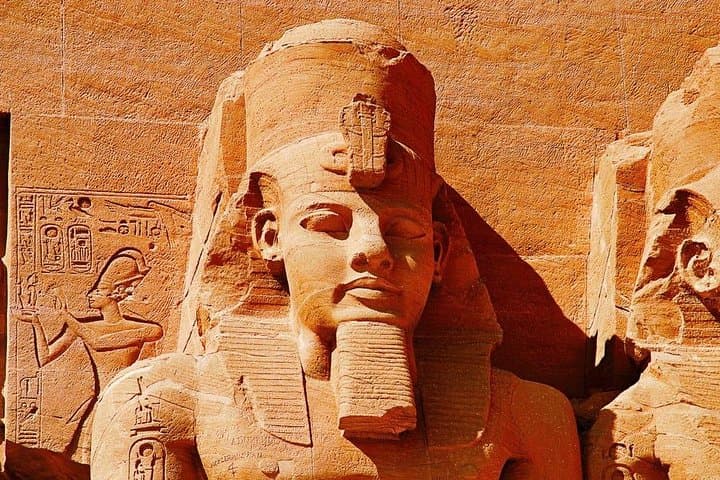

You lift off from Aswan just after dawn and the Nile falls away beneath the plane like a black ribbon. In under an hour the desert flattens into the broad blue of Lake Nasser, and then the colossal façade of Ramses II appears, four seated kings carved from living rock, staring down the plain.
You lift off from Aswan just after dawn and the Nile falls away beneath the plane like a black ribbon. In under an hour the desert flattens into the broad blue of Lake Nasser, and then the colossal façade of Ramses II appears, four seated kings carved from living rock, staring down the plain.
The twin temples at Abu Simbel were carved in the 13th century BCE and famously moved block-by-block in the 1960s to escape the rising waters behind the Aswan High Dam. Geology here is exposed Nubian sandstone capped by compacted desert crust; the stone’s grain and patina absorb heat and light, making reliefs read differently as the sun climbs.
Culturally, Abu Simbel is both royal propaganda and a modern conservation milestone: Ramses II’s iconography asserts power, while the UNESCO relocation tells a story of international stewardship. Local guides will place the temples in the sweep of Egyptian history and the mid-20th-century engineering triumph that saved them.
Practically, the trip is a half-day loop: hotel pickup in Aswan, a short flight, guided exploration on relatively level surfaces, then return. Expect 1–2 hours on-site, strong sun, and limited shade. Bring water, a hat, and shoes suitable for short walks over stone and compacted sand. Photography is generous but be respectful of signage and restricted areas.
This private flight tour compresses distance and time—replacing a long road transfer with aerial convenience—so you get maximum temple time without an exhausting commute. Plan for early departures, and book in advance during peak season to secure preferred times.