THE ADVENTURE COLLECTIVE® · Independent discovery and booking for outdoor travel

Explore the winding alleys of Fez with a private local guide and driver. Visit madrasas, the tanneries, the Mellah and royal precincts during a 6–8 hour cultural immersion through one of Morocco’s oldest cities.
Explore the winding alleys of Fez with a private local guide and driver. Visit madrasas, the tanneries, the Mellah and royal precincts during a 6–8 hour cultural immersion through one of Morocco’s oldest cities.
You step through Bab Bou Jeloud and the city shifts around you: narrow lanes fold into shaded courtyards, the air rings with calls to prayer and the sharp scent of spices from stalls that have stood for centuries.
Verified experiences and guided adventures in the surrounding area.
Operated by Salim Khettabi Filali · Fez, Fès-Meknès
You step through Bab Bou Jeloud and the city shifts around you: narrow lanes fold into shaded courtyards, the air rings with calls to prayer and the sharp scent of spices from stalls that have stood for centuries.
This guided cultural tour threads the UNESCO-listed medina of Fez, a living archive of Moroccan history. Founded around the 9th century and expanded under the Marinids, Fez became a center of scholarship—the Al-Qarawiyyin university dates to 859 CE—while merchants and artisans carved the city into distinct quarters: the Mellah, the funduqs, and the scent-filled souks. The Oued Fes runs like a quiet spine through the old city, its water once vital to tanners and dyers who still work in stone vats near Chouara tannery.
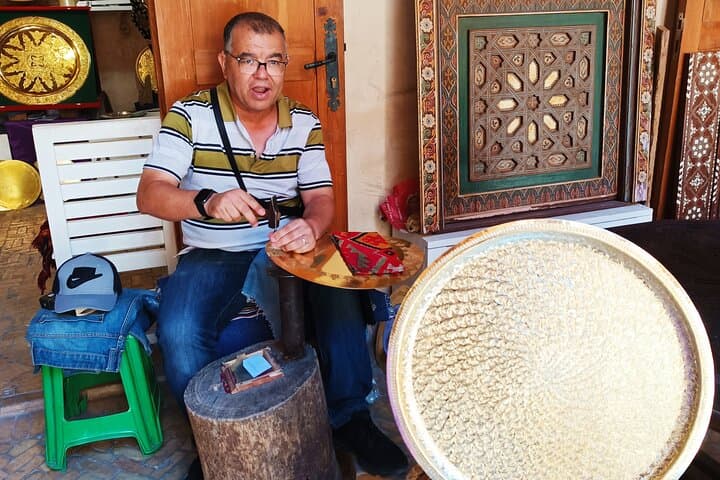
Architectural highlights include the intricately carved Marinid madrasas, wooden mashrabiya balconies, the ornate gates of Fes el Bali and the royal precinct of Fes el Jdid. Local culture is tactile: craftsmen hammer brass, leatherworkers dye hides, and rooftop viewpoints offer pragmatic panoramas of chimneys and dye-pools.
Practical guidance: expect a 6–8 hour private day tour with an air-conditioned driver between sites, but much time is spent on foot in uneven alleys. Carry small change for modest entrance fees to a few madrasas, wear closed-toe walking shoes, and bring a refillable water bottle and a scarf for respectful, comfortable visits to religious sites. Start early to avoid midday heat and plan for moderate walking pace—this is a cultural immersion where curiosity and stamina are rewarded.
easy.
6–8 hours.
Suitable for most fitness levels; expect several hours of walking on uneven, cobbled streets.
Most guided tours include transport and guide services but not small entrance fees to some madrasas or museums; expect modest fees (around €2) at selected sites.
No—many streets are narrow, stepped, and uneven; the tour is best for those able to walk short distances on challenging surfaces.
Guides on this tour are typically multilingual; confirm your preferred language at booking to ensure availability.
Tipping is customary in Morocco—plan to tip your guide and driver if the service was good; small local currency notes are appreciated.
Fez developed into Morocco’s spiritual and scholarly heart from the 9th century onward; Al-Qarawiyyin is one of the oldest continuously operating educational institutions in the world.
Respect the medina by staying on public paths, avoiding litter, and supporting local artisans; minimize single-use plastics and use refillable bottles to reduce waste.
Salim Khettabi Filali operates guided outdoor trips and adventures with an emphasis on safety, stewardship, and memorable experiences.
You step through Bab Bou Jeloud and the city shifts around you: narrow lanes fold into shaded courtyards, the air rings with calls to prayer and the sharp scent of spices from stalls that have stood for centuries.
You step through Bab Bou Jeloud and the city shifts around you: narrow lanes fold into shaded courtyards, the air rings with calls to prayer and the sharp scent of spices from stalls that have stood for centuries.
This guided cultural tour threads the UNESCO-listed medina of Fez, a living archive of Moroccan history. Founded around the 9th century and expanded under the Marinids, Fez became a center of scholarship—the Al-Qarawiyyin university dates to 859 CE—while merchants and artisans carved the city into distinct quarters: the Mellah, the funduqs, and the scent-filled souks. The Oued Fes runs like a quiet spine through the old city, its water once vital to tanners and dyers who still work in stone vats near Chouara tannery.
Architectural highlights include the intricately carved Marinid madrasas, wooden mashrabiya balconies, the ornate gates of Fes el Bali and the royal precinct of Fes el Jdid. Local culture is tactile: craftsmen hammer brass, leatherworkers dye hides, and rooftop viewpoints offer pragmatic panoramas of chimneys and dye-pools.
Practical guidance: expect a 6–8 hour private day tour with an air-conditioned driver between sites, but much time is spent on foot in uneven alleys. Carry small change for modest entrance fees to a few madrasas, wear closed-toe walking shoes, and bring a refillable water bottle and a scarf for respectful, comfortable visits to religious sites. Start early to avoid midday heat and plan for moderate walking pace—this is a cultural immersion where curiosity and stamina are rewarded.