THE ADVENTURE COLLECTIVE® · Independent discovery and booking for outdoor travel

A compact two-day journey from Fes to Merzouga that pairs Middle Atlas passes and cedar forests with an overnight at the towering Erg Chebbi dunes. Expect long drives, a camel sunrise, fossil workshops in Erfoud, and a practical desert camp experience.
A compact two-day journey from Fes to Merzouga that pairs Middle Atlas passes and cedar forests with an overnight at the towering Erg Chebbi dunes. Expect long drives, a camel sunrise, fossil workshops in Erfoud, and a practical desert camp experience.
Morning light finds the minibus threading out of Fes, windows framing the Middle Atlas as it climbs toward cedar forests and towns that feel almost European in their geometry. The road unfolds—Ifrane’s tidy avenues, the chatter of a market in Azrou, cedar groves where Barbary macaques watch from high branches—before the landscape thins to scrub and plateaus and the first orange ribs of Erg Chebbi appear on the horizon.
Verified experiences and guided adventures in the surrounding area.
Operated by Nice Morocco Trips · Merzouga, Drâa-Tafilalet
Morning light finds the minibus threading out of Fes, windows framing the Middle Atlas as it climbs toward cedar forests and towns that feel almost European in their geometry. The road unfolds—Ifrane’s tidy avenues, the chatter of a market in Azrou, cedar groves where Barbary macaques watch from high branches—before the landscape thins to scrub and plateaus and the first orange ribs of Erg Chebbi appear on the horizon.
Geology here is straightforward and raw: folded Atlas ranges push up to 1,500–2,200 m before spilling into ancient alluvial plains and the Saharan erg where wind sorts sand into towering dunes. Erfoud, with its fossil workshops, points to a very different past when seas covered this region. Culturally, the route traces old caravan corridors and settlement patterns shaped by water and trade; small towns still keep Berber hospitality and music alive.
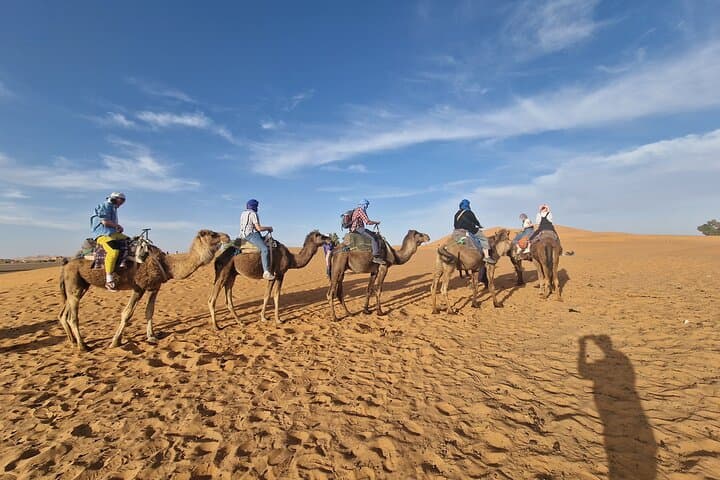
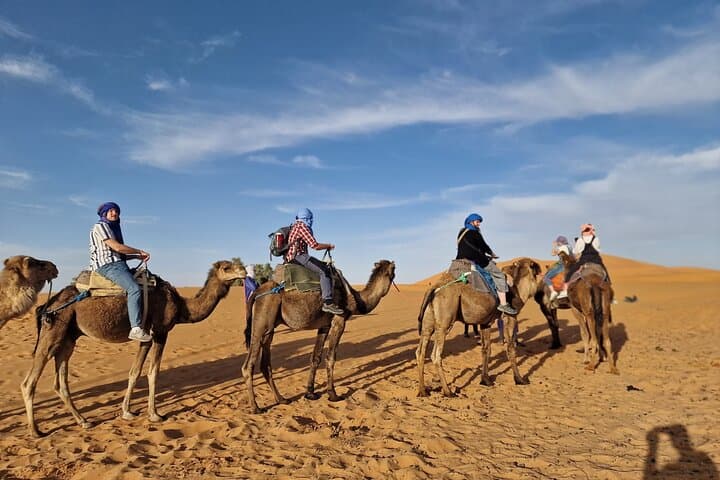
Practical notes arrive with the dusk. The camp is a practical Berber setup—tents, a shared dining space and a low-fire evening where musicians may play. An early wake-up rewards you with a sunrise camel ride: the dunes glow, shadows run down the lee slopes, and the desert seems to push you forward.
Expect a lot of driving (Fes to Merzouga ~470 km one-way, several stops), basic camping comforts, and wide temperature swings. Pack layers, sunscreen, good footwear, and a small daypack. Hydrate before and during the desert portion, and reserve energy for dune climbs if you want a higher viewpoint. The tour is an efficient two-day snapshot of Morocco’s diverse landscapes—mountain, plateau, and sand—best enjoyed with patience and straightforward gear.
moderate.
2 days (48 hours).
Suitable for travelers in average fitness: long hours in vehicle and short dune climbs; not strenuous but requires mobility for camel mounting and hill climbs.
Expect about 7–9 hours of driving one-way with scheduled stops (Ifrane, Azrou, Midelt, Erfoud) depending on traffic and group pace.
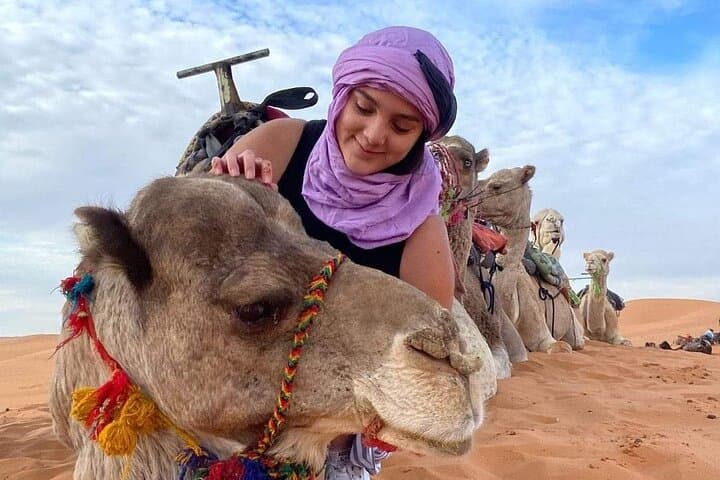
Camel rides to the camp and back are typically included; dune rides last 30–90 minutes depending on the itinerary and sunset/sunrise timing.
Camps are simple Berber-style with mattresses, blankets, communal dining and shared wash facilities; some provide private tents for an additional fee.
The tour is family-friendly and noted as suitable for all fitness levels, but camel mounting and uneven sand can be difficult for limited mobility—inform the operator ahead for accommodations.
The route follows historic trans-Saharan corridors; towns like Erfoud grew around trade and, more recently, a fossil craft industry. Parts of the region were shaped under the Alawite dynasty.
Dune systems are sensitive to vehicle tracks and foot traffic—stick to marked paths, minimize camp waste, and use refillable water containers to reduce plastic.
Nice Morocco Trips operates guided outdoor trips and adventures with an emphasis on safety, stewardship, and memorable experiences.
Morning light finds the minibus threading out of Fes, windows framing the Middle Atlas as it climbs toward cedar forests and towns that feel almost European in their geometry. The road unfolds—Ifrane’s tidy avenues, the chatter of a market in Azrou, cedar groves where Barbary macaques watch from high branches—before the landscape thins to scrub and plateaus and the first orange ribs of Erg Chebbi appear on the horizon.
Morning light finds the minibus threading out of Fes, windows framing the Middle Atlas as it climbs toward cedar forests and towns that feel almost European in their geometry. The road unfolds—Ifrane’s tidy avenues, the chatter of a market in Azrou, cedar groves where Barbary macaques watch from high branches—before the landscape thins to scrub and plateaus and the first orange ribs of Erg Chebbi appear on the horizon.
Geology here is straightforward and raw: folded Atlas ranges push up to 1,500–2,200 m before spilling into ancient alluvial plains and the Saharan erg where wind sorts sand into towering dunes. Erfoud, with its fossil workshops, points to a very different past when seas covered this region. Culturally, the route traces old caravan corridors and settlement patterns shaped by water and trade; small towns still keep Berber hospitality and music alive.
Practical notes arrive with the dusk. The camp is a practical Berber setup—tents, a shared dining space and a low-fire evening where musicians may play. An early wake-up rewards you with a sunrise camel ride: the dunes glow, shadows run down the lee slopes, and the desert seems to push you forward.
Expect a lot of driving (Fes to Merzouga ~470 km one-way, several stops), basic camping comforts, and wide temperature swings. Pack layers, sunscreen, good footwear, and a small daypack. Hydrate before and during the desert portion, and reserve energy for dune climbs if you want a higher viewpoint. The tour is an efficient two-day snapshot of Morocco’s diverse landscapes—mountain, plateau, and sand—best enjoyed with patience and straightforward gear.