THE ADVENTURE COLLECTIVE® · Independent discovery and booking for outdoor travel

Traverse from Fes to Marrakech in three days, crossing cedar forests, desert sands and the High Atlas. Ride camels at Erg Chebbi, hike Todgha Gorge and visit the UNESCO kasbah at Ait Ben Haddou.
Traverse from Fes to Marrakech in three days, crossing cedar forests, desert sands and the High Atlas. Ride camels at Erg Chebbi, hike Todgha Gorge and visit the UNESCO kasbah at Ait Ben Haddou.
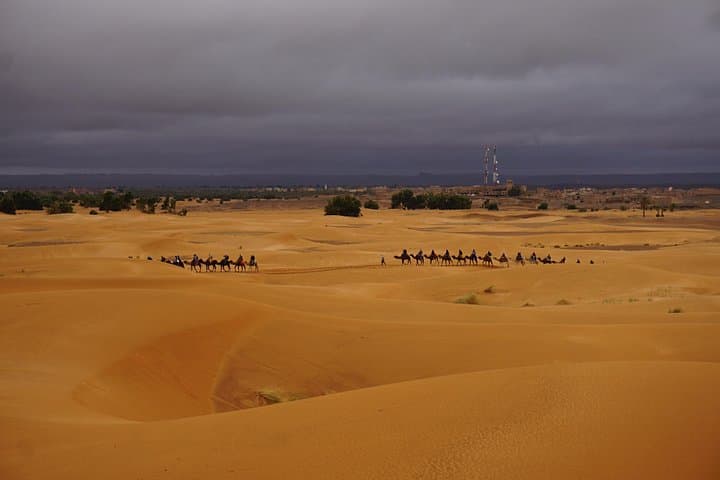
Dawn breaks over Fes and the city’s minarets shrink as the van eases onto the plains of Saïss. By noon the cedar forests of the Middle Atlas slide past the window, and by evening the Erg Chebbi dunes rise like a living wall that dares you to climb them. On this three-day overland route you move from old medina alleys to wind-sculpted sand and then descend the Atlas, watching villages made of rammed earth trade shade for sky.
Verified experiences and guided adventures in the surrounding area.
Operated by Jrana Tours Morocco · Fes, Fès-Meknès
Dawn breaks over Fes and the city’s minarets shrink as the van eases onto the plains of Saïss. By noon the cedar forests of the Middle Atlas slide past the window, and by evening the Erg Chebbi dunes rise like a living wall that dares you to climb them. On this three-day overland route you move from old medina alleys to wind-sculpted sand and then descend the Atlas, watching villages made of rammed earth trade shade for sky.
The route threads centuries of Berber history, carved trade routes and film sets: Merzouga’s camel caravans have followed the same lines as salt caravans, while Ait Ben Haddou — a compact kasbah of packed-earth towers — stands as a UNESCO reminder of trans-Saharan commerce and cinematic spectacle. Geologically, Erg Chebbi’s dunes reach roughly 100–150 meters; the Todgha Gorge slices limestone walls up to 160 meters high. Culture here is practical and open: rose-water cooperatives in Kalaa Mgouna, nomad music at desert camps, and shepherding communities on Atlas slopes.
Practical guide: this private tour covers ~1,000–1,200 km over three days with long driving legs (day 1 ≈ 8 hrs, day 2 ≈ 4 hrs, day 3 ≈ 7 hrs). Expect early starts for sunrise/sunset viewing, basic to comfortable camp accommodations, and narrow mountain passes such as Tizi n’Tichka near 2,260 m. Pack layers for hot days and cold desert nights, bring sun protection and at least 2–3 liters of water per person, and prepare for unpaved tracks around Merzouga. The route is accessible to most fit travelers but includes uneven terrain and extended vehicle time—plan rest and motion-sickness strategies before you go.
moderate.
3 days.
Suitable for travelers with basic fitness who can handle long drives, short dune hikes and uneven terrain; not strenuous but requires stamina for transfers.
No. Camel rides are guided, usually short (sunrise/sunset), with handlers to assist mounting; wear long pants and avoid loose straps.
Options range from comfortable to luxury desert camps; expect private or shared tents with basic sanitary facilities—luxury options offer private bathrooms.
Adult breakfasts and dinners are typically included on the tour; specific dietary needs should be communicated at booking for accommodation.
Cell coverage is intermittent in remote desert and mountain sections; larger towns (Erfoud, Ouarzazate) have reliable service—plan accordingly.
The route follows historic trans-Saharan corridors; Ait Ben Haddou grew wealthy as a fortified caravan stop and later became a film set for international productions.
Travelers should avoid disturbing nomadic camps and pack out waste; these fragile ecosystems recover slowly—use established tracks and support local cooperatives.
Jrana Tours Morocco operates guided outdoor trips and adventures with an emphasis on safety, stewardship, and memorable experiences.
Dawn breaks over Fes and the city’s minarets shrink as the van eases onto the plains of Saïss. By noon the cedar forests of the Middle Atlas slide past the window, and by evening the Erg Chebbi dunes rise like a living wall that dares you to climb them. On this three-day overland route you move from old medina alleys to wind-sculpted sand and then descend the Atlas, watching villages made of rammed earth trade shade for sky.
Dawn breaks over Fes and the city’s minarets shrink as the van eases onto the plains of Saïss. By noon the cedar forests of the Middle Atlas slide past the window, and by evening the Erg Chebbi dunes rise like a living wall that dares you to climb them. On this three-day overland route you move from old medina alleys to wind-sculpted sand and then descend the Atlas, watching villages made of rammed earth trade shade for sky.
The route threads centuries of Berber history, carved trade routes and film sets: Merzouga’s camel caravans have followed the same lines as salt caravans, while Ait Ben Haddou — a compact kasbah of packed-earth towers — stands as a UNESCO reminder of trans-Saharan commerce and cinematic spectacle. Geologically, Erg Chebbi’s dunes reach roughly 100–150 meters; the Todgha Gorge slices limestone walls up to 160 meters high. Culture here is practical and open: rose-water cooperatives in Kalaa Mgouna, nomad music at desert camps, and shepherding communities on Atlas slopes.
Practical guide: this private tour covers ~1,000–1,200 km over three days with long driving legs (day 1 ≈ 8 hrs, day 2 ≈ 4 hrs, day 3 ≈ 7 hrs). Expect early starts for sunrise/sunset viewing, basic to comfortable camp accommodations, and narrow mountain passes such as Tizi n’Tichka near 2,260 m. Pack layers for hot days and cold desert nights, bring sun protection and at least 2–3 liters of water per person, and prepare for unpaved tracks around Merzouga. The route is accessible to most fit travelers but includes uneven terrain and extended vehicle time—plan rest and motion-sickness strategies before you go.