THE ADVENTURE COLLECTIVE® · Independent discovery and booking for outdoor travel

Walk three hours through Fes’s living medina with a local guide who leads you to Al‑Qarawiyyin, historic madrasas, and the famous leather tanneries. This shared tour blends compact history with practical navigation of the city’s narrow lanes.
Walk three hours through Fes’s living medina with a local guide who leads you to Al‑Qarawiyyin, historic madrasas, and the famous leather tanneries. This shared tour blends compact history with practical navigation of the city’s narrow lanes.
A narrow shaft of light cuts through the medina at mid-morning, revealing mosaics and the worn stones underfoot as a small group threads between copper lanterns and spice stalls. On a shared guided tour of Fes Medina, the city itself becomes a guidebook—alleys press forward like pages, each turn offering a new chapter of craftsmen, courtyards, and calligraphy.
Verified experiences and guided adventures in the surrounding area.
Operated by Salim Khettabi Filali · Fes, Fès-Meknès
A narrow shaft of light cuts through the medina at mid-morning, revealing mosaics and the worn stones underfoot as a small group threads between copper lanterns and spice stalls. On a shared guided tour of Fes Medina, the city itself becomes a guidebook—alleys press forward like pages, each turn offering a new chapter of craftsmen, courtyards, and calligraphy.
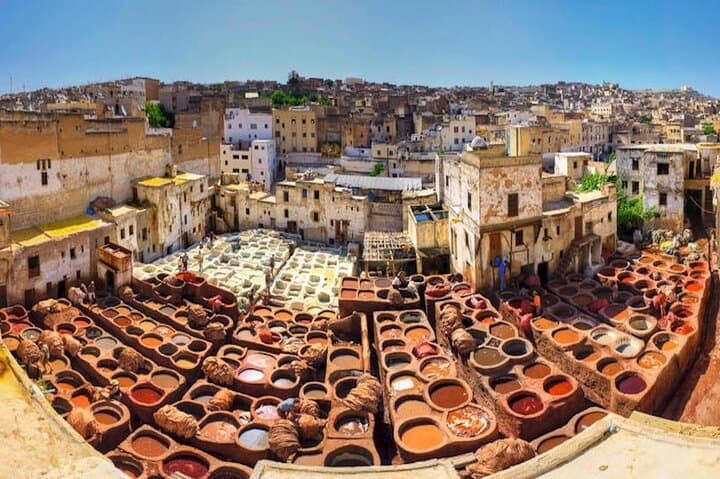
Fes is one of Morocco’s oldest living cities; Al‑Qarawiyyin University dates to 859 CE and remains an anchor of learning. The medina’s urban geology—compact lanes built on centuries of trade—creates microclimates where shaded alleys stay cool while rooftops catch the sun. Culturally, Fes is a working city: tanners still pit and dye leather using centuries‑old techniques, and zaouias (shrines) hold community and history in carved wood and polychrome tile.
Practical guidance: the shared tour runs roughly three hours and covers uneven stone steps and tightly packed streets—comfortable, sturdy shoes are essential. Expect short stops at Madrasas, the tanneries, and the tomb of Moulay Idriss II; entrances to some sites may require modest fees. Dress respectfully—shoulders and knees covered in religious sites—and carry small bills for tips and purchases. Photographs of artisans are common but ask before shooting close‑up.
Timing matters: go early to avoid midday crowds and to see tannery vats in clearer light. A local guide will navigate permissions, interpret inscriptions, and point out rooftop views often missed by independent walkers. The result is practical, sensory, and rooted in history: a concentrated immersion into Fes’s living medina.
easy.
2–3 hours.
Suitable for travelers in regular walking shape; involves standing, climbing short flights of stairs, and navigating narrow streets.
The tour lasts about three hours and involves continuous walking through narrow alleys with short stair sections; pace is moderate with frequent stops.
Some stops include admission while others are observed from outside; check the booking details or ask the guide on arrival for any small fees.
Guides typically speak English, Spanish, and Portuguese according to the listing; confirm language needs at booking.
Most of the medina has uneven stone and narrow passages that make stroller and wheelchair access difficult; travelers with mobility concerns should inquire about private options or alternative routes.
Fes became a major intellectual center after the 9th century; Al‑Qarawiyyin, founded in 859, is one of the world’s oldest continuously operating educational institutions.
Heavy foot traffic and modern tourism pressure historic fabric; visitors should stay on established paths, minimize single‑use plastics, and ask before entering private workshops to reduce impact.
Salim Khettabi Filali operates guided outdoor trips and adventures with an emphasis on safety, stewardship, and memorable experiences.
A narrow shaft of light cuts through the medina at mid-morning, revealing mosaics and the worn stones underfoot as a small group threads between copper lanterns and spice stalls. On a shared guided tour of Fes Medina, the city itself becomes a guidebook—alleys press forward like pages, each turn offering a new chapter of craftsmen, courtyards, and calligraphy.
A narrow shaft of light cuts through the medina at mid-morning, revealing mosaics and the worn stones underfoot as a small group threads between copper lanterns and spice stalls. On a shared guided tour of Fes Medina, the city itself becomes a guidebook—alleys press forward like pages, each turn offering a new chapter of craftsmen, courtyards, and calligraphy.
Fes is one of Morocco’s oldest living cities; Al‑Qarawiyyin University dates to 859 CE and remains an anchor of learning. The medina’s urban geology—compact lanes built on centuries of trade—creates microclimates where shaded alleys stay cool while rooftops catch the sun. Culturally, Fes is a working city: tanners still pit and dye leather using centuries‑old techniques, and zaouias (shrines) hold community and history in carved wood and polychrome tile.
Practical guidance: the shared tour runs roughly three hours and covers uneven stone steps and tightly packed streets—comfortable, sturdy shoes are essential. Expect short stops at Madrasas, the tanneries, and the tomb of Moulay Idriss II; entrances to some sites may require modest fees. Dress respectfully—shoulders and knees covered in religious sites—and carry small bills for tips and purchases. Photographs of artisans are common but ask before shooting close‑up.
Timing matters: go early to avoid midday crowds and to see tannery vats in clearer light. A local guide will navigate permissions, interpret inscriptions, and point out rooftop views often missed by independent walkers. The result is practical, sensory, and rooted in history: a concentrated immersion into Fes’s living medina.