THE ADVENTURE COLLECTIVE® · Independent discovery and booking for outdoor travel

Take the Muong Hoa funicular and Fansipan cable car to reach the Roof of Indochina in a single, scenic day. This full-day Sapa tour pairs cultural valley views with a fast ascent to panoramic alpine ridgelines.
Take the Muong Hoa funicular and Fansipan cable car to reach the Roof of Indochina in a single, scenic day. This full-day Sapa tour pairs cultural valley views with a fast ascent to panoramic alpine ridgelines.
Morning mist parts over rice terraces as the funicular eases out of Sapa, gliding above the Muong Hoa Valley while villagers and rooflines shrink beneath a quilt of green. The railway hums forward; the mountains pull closer, and the Hoang Lien Son range begins to assert itself—rock, cloud, and wind arranged on an unmistakable scale.
Verified experiences and guided adventures in the surrounding area.
Operated by Vietnam - Hanoi Package Tours · Sapa, Lao Cai
Morning mist parts over rice terraces as the funicular eases out of Sapa, gliding above the Muong Hoa Valley while villagers and rooflines shrink beneath a quilt of green. The railway hums forward; the mountains pull closer, and the Hoang Lien Son range begins to assert itself—rock, cloud, and wind arranged on an unmistakable scale.
Fansipan, the Roof of Indochina at just over 3,100 meters, has long been both a geographic high point and a cultural landmark for Hmong and Dao communities in Lao Cai province. The cable car system that climbs roughly 1,400–1,500 meters in about 15 minutes opened access to the summit’s temples, terraces, and panoramic ridgelines, while the Muong Hoa funicular offers a gentler approach through terraced valleys carved by millennia of water and uplifted geology.
Expect a mix of engineered ease and high-mountain weather: panoramic viewpoints, a spiritual complex near the peak, and up-close views of terraced agriculture and ethnic villages. The trip balances cultural observation—village life, traditional textiles—with geological spectacle: steep metamorphic slopes and river-sculpted valleys.
Practical notes: this is a full-day excursion (about 8 hours) with minimal technical requirement thanks to the cable car and funicular, but summit areas sit above 3,000 m so acclimate, bring layered clothing, and move slowly. Photography windows are brief—arrive early for clearer skies—and always follow local guide instructions at the summit. The route supports low-impact travel: stay on paths, carry out waste, and respect village customs to keep this highland landscape healthy for future visitors.
easy.
8 hours (full-day).
Suitable for most fitness levels; involves short walks and stair climbs at high altitude—basic mobility required.
The Fansipan cable car ride to the summit complex takes roughly 15 minutes, ascending about 1,400–1,500 meters with extensive panoramic views.
Yes—access via cable car and funicular makes the route suitable for most ages, though mobility and short stair climbs at the summit are required.
Advance booking is recommended during high season (spring and autumn) to avoid queues and ensure cable car availability for your chosen day.
Conditions can shift rapidly—sunny valley mornings may give way to cloud, wind, or drizzle at the summit; plan for temperatures several degrees colder and lower visibility at times.
Sapa grew as a French colonial hill station in the early 20th century and remains a cultural crossroads for Hmong, Dao, and other ethnic groups living on Hoang Lien Son’s slopes.
The Hoang Lien National Park region has fragile alpine ecosystems; visitors should stay on marked paths, avoid single-use plastics, and support community-based tourism to reduce impact.
Vietnam - Hanoi Package Tours operates guided outdoor trips and adventures with an emphasis on safety, stewardship, and memorable experiences.
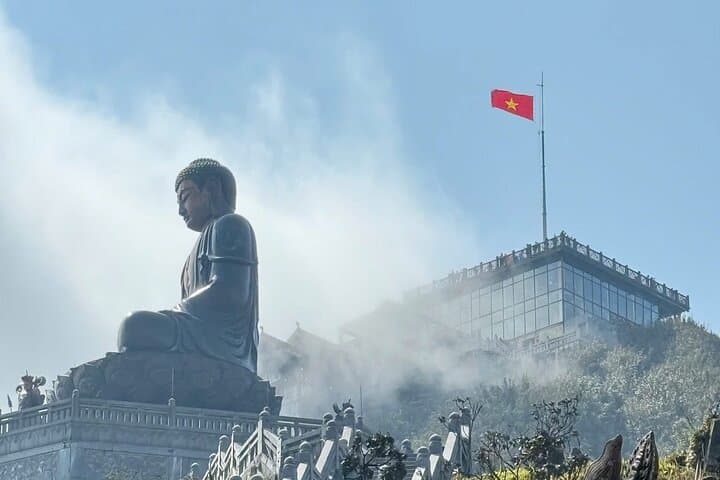


Morning mist parts over rice terraces as the funicular eases out of Sapa, gliding above the Muong Hoa Valley while villagers and rooflines shrink beneath a quilt of green. The railway hums forward; the mountains pull closer, and the Hoang Lien Son range begins to assert itself—rock, cloud, and wind arranged on an unmistakable scale.
Morning mist parts over rice terraces as the funicular eases out of Sapa, gliding above the Muong Hoa Valley while villagers and rooflines shrink beneath a quilt of green. The railway hums forward; the mountains pull closer, and the Hoang Lien Son range begins to assert itself—rock, cloud, and wind arranged on an unmistakable scale.
Fansipan, the Roof of Indochina at just over 3,100 meters, has long been both a geographic high point and a cultural landmark for Hmong and Dao communities in Lao Cai province. The cable car system that climbs roughly 1,400–1,500 meters in about 15 minutes opened access to the summit’s temples, terraces, and panoramic ridgelines, while the Muong Hoa funicular offers a gentler approach through terraced valleys carved by millennia of water and uplifted geology.
Expect a mix of engineered ease and high-mountain weather: panoramic viewpoints, a spiritual complex near the peak, and up-close views of terraced agriculture and ethnic villages. The trip balances cultural observation—village life, traditional textiles—with geological spectacle: steep metamorphic slopes and river-sculpted valleys.
Practical notes: this is a full-day excursion (about 8 hours) with minimal technical requirement thanks to the cable car and funicular, but summit areas sit above 3,000 m so acclimate, bring layered clothing, and move slowly. Photography windows are brief—arrive early for clearer skies—and always follow local guide instructions at the summit. The route supports low-impact travel: stay on paths, carry out waste, and respect village customs to keep this highland landscape healthy for future visitors.