THE ADVENTURE COLLECTIVE® · Independent discovery and booking for outdoor travel

Stand beneath the 25‑meter arms of Las Manos de la Pachamama and peer into the Ulba River Canyon—an easy stop above Baños that combines bold public art with sweeping Andean views. Plan for changeable weather and short walks from the parking area.
Stand beneath the 25‑meter arms of Las Manos de la Pachamama and peer into the Ulba River Canyon—an easy stop above Baños that combines bold public art with sweeping Andean views. Plan for changeable weather and short walks from the parking area.
You arrive at the viewpoint just as mountain light sharpens the rim of the canyon. Concrete arms reach out—each limb a broad, measured gesture—25 meters in length, palms spanning a circular 64 meters across. From the plaza the Ulba River Canyon drops away below and, on clear days, the slopes of Sangay and Llanganates National Parks stitch the horizon with cloud and volcanic rock.
Verified experiences and guided adventures in the surrounding area.
Operated by Special holiday offer. Best of Ecuador | Tour Operator - Explorjungle · Baños de Agua Santa, Tungurahua
You arrive at the viewpoint just as mountain light sharpens the rim of the canyon. Concrete arms reach out—each limb a broad, measured gesture—25 meters in length, palms spanning a circular 64 meters across. From the plaza the Ulba River Canyon drops away below and, on clear days, the slopes of Sangay and Llanganates National Parks stitch the horizon with cloud and volcanic rock.
The Hands of Pachamama is a contemporary public artwork that celebrates agrarian life and the relationship between people and the earth; it was installed to draw visitors to the high viewpoints above Baños de Agua Santa. Geologically the scene is Andean: deep river incision through young volcanic deposits, steep ridgelines, and frequent cloud movement that sculpts visibility. Culturally, Baños mixes Quechua traditions and Ecuadorian mountain-town tourism—expect local vendors, devotional shrines in town, and a pragmatic friendliness toward visitors.
Practically: the viewpoint is reached by a short drive and a modest walk from the parking area; many organized two-hour tours include air-conditioned transport and a guided stop. Bring layers—the elevation around Baños is roughly 1,800–1,900 m so temperature swings are common—and a light rain shell for quick showers. Visit at golden hour for the best light, and return at night if you want to see the palms lit by colored fixtures that change the sculpture’s presence.
Plan for uneven footing near the platform, watch wind gusts at the edges, and allow time to scan the canyons and parks visible from the site. The stop pairs well with other short hikes, waterfalls, or a drive along the scenic routes surrounding Baños.
easy.
2 hours.
Suitable for most fitness levels; requires only a short paved or compacted walk from the parking area.
Most organized stops last 30–90 minutes; private two-hour tours typically include transport and additional viewpoints.
The monument is open to the public; some tours include transport or a small local fee for site upkeep—confirm with your operator.
Access involves a short walk from parking and some uneven surfaces—mobile accessibility is limited; ask the operator about drop-off points.
Yes—some operators offer evening stops; visibility and lighting depend on scheduled electricity and local events, so book in advance.
The installation celebrates Pachamama (Mother Earth) and local agricultural heritage while creating a public viewing platform above Baños.
Visitors should stick to marked areas and avoid littering; the surrounding canyon ecosystems are sensitive to erosion and human disturbance.
Special holiday offer. Best of Ecuador | Tour Operator - Explorjungle operates guided outdoor trips and adventures with an emphasis on safety, stewardship, and memorable experiences.

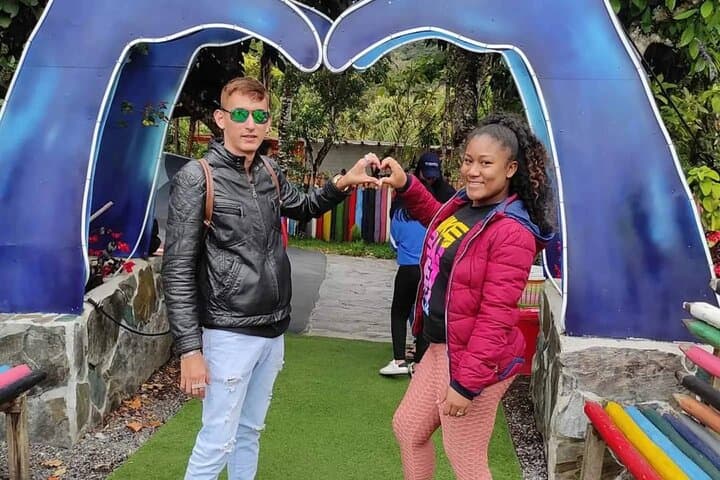


You arrive at the viewpoint just as mountain light sharpens the rim of the canyon. Concrete arms reach out—each limb a broad, measured gesture—25 meters in length, palms spanning a circular 64 meters across. From the plaza the Ulba River Canyon drops away below and, on clear days, the slopes of Sangay and Llanganates National Parks stitch the horizon with cloud and volcanic rock.
You arrive at the viewpoint just as mountain light sharpens the rim of the canyon. Concrete arms reach out—each limb a broad, measured gesture—25 meters in length, palms spanning a circular 64 meters across. From the plaza the Ulba River Canyon drops away below and, on clear days, the slopes of Sangay and Llanganates National Parks stitch the horizon with cloud and volcanic rock.
The Hands of Pachamama is a contemporary public artwork that celebrates agrarian life and the relationship between people and the earth; it was installed to draw visitors to the high viewpoints above Baños de Agua Santa. Geologically the scene is Andean: deep river incision through young volcanic deposits, steep ridgelines, and frequent cloud movement that sculpts visibility. Culturally, Baños mixes Quechua traditions and Ecuadorian mountain-town tourism—expect local vendors, devotional shrines in town, and a pragmatic friendliness toward visitors.
Practically: the viewpoint is reached by a short drive and a modest walk from the parking area; many organized two-hour tours include air-conditioned transport and a guided stop. Bring layers—the elevation around Baños is roughly 1,800–1,900 m so temperature swings are common—and a light rain shell for quick showers. Visit at golden hour for the best light, and return at night if you want to see the palms lit by colored fixtures that change the sculpture’s presence.
Plan for uneven footing near the platform, watch wind gusts at the edges, and allow time to scan the canyons and parks visible from the site. The stop pairs well with other short hikes, waterfalls, or a drive along the scenic routes surrounding Baños.