THE ADVENTURE COLLECTIVE® · Independent discovery and booking for outdoor travel

Stand on stone that carries human handwriting from the Stone Age and watch the earth cough up clay and gas. This half-day tour from Baku pairs UNESCO-listed rock art at Gobustan with the otherworldly spectacle of Azerbaijan’s mud volcanoes.
Stand on stone that carries human handwriting from the Stone Age and watch the earth cough up clay and gas. This half-day tour from Baku pairs UNESCO-listed rock art at Gobustan with the otherworldly spectacle of Azerbaijan’s mud volcanoes.
You step out of the van into wind that tastes faintly of salt and something older — gas and sediment rising from the earth. Low, rounded hills roll away under a pale sky; the first carved panels sit like an open book of human movement and weather. This is Gobustan: a place where people left their marks for tens of thousands of years, and where the land still asserts itself in smoking mud cones a short drive inland from the Caspian.
Verified experiences and guided adventures in the surrounding area.
Operated by Baku Tour Packages · Gobustan, Gobustan District
You step out of the van into wind that tastes faintly of salt and something older — gas and sediment rising from the earth. Low, rounded hills roll away under a pale sky; the first carved panels sit like an open book of human movement and weather. This is Gobustan: a place where people left their marks for tens of thousands of years, and where the land still asserts itself in smoking mud cones a short drive inland from the Caspian.
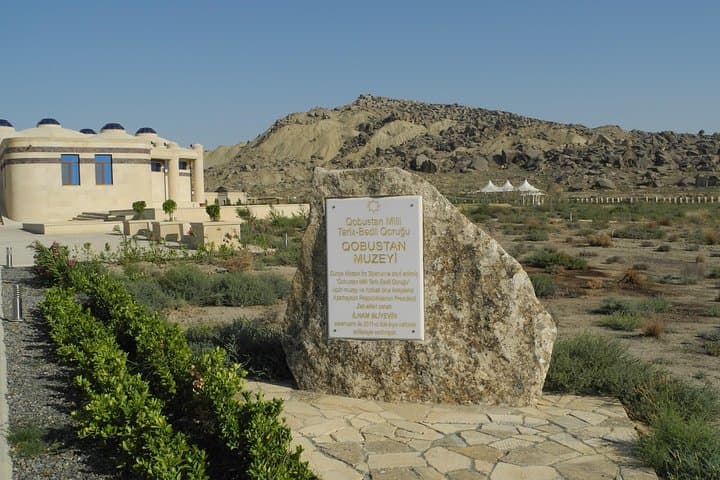
The State Historical-Artistic Reserve of Gobustan (about an hour south of Baku) holds some of the Caucasus’ most concentrated petroglyph fields. Hunters, boats and ritual scenes are etched across flat rock faces, traces of Paleolithic, Mesolithic and Neolithic lives. The on-site museum — with a collection reported in the tens of thousands — frames those panels with tools and explanations that make the images click into context: seasonal migrations, coastal economies before the Caspian shifted, and a human relationship with an energetic landscape.
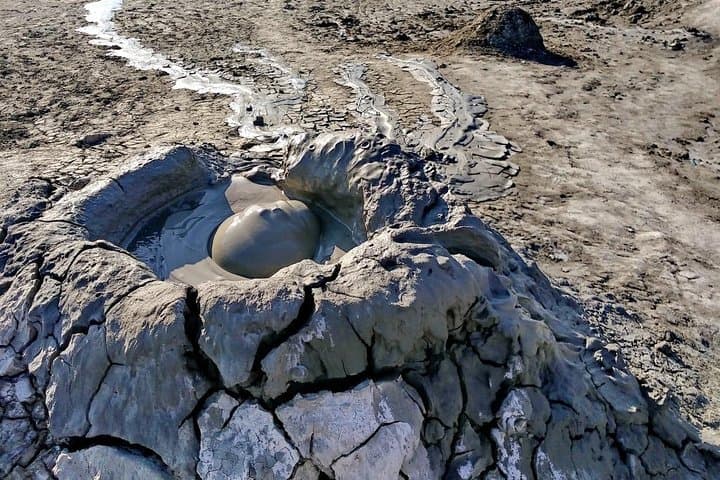
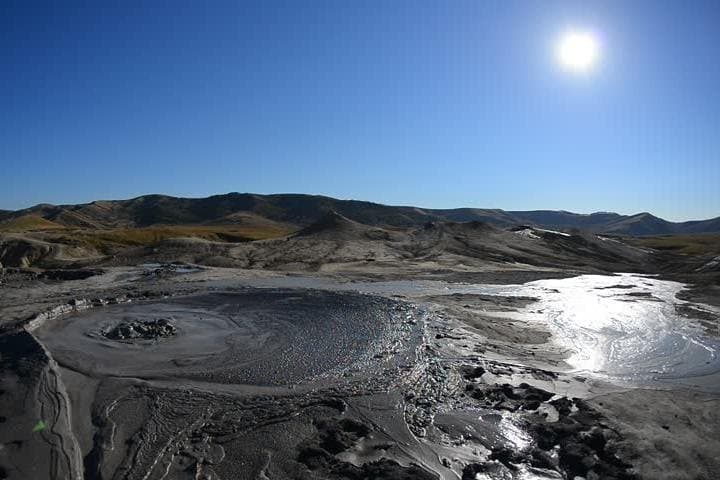
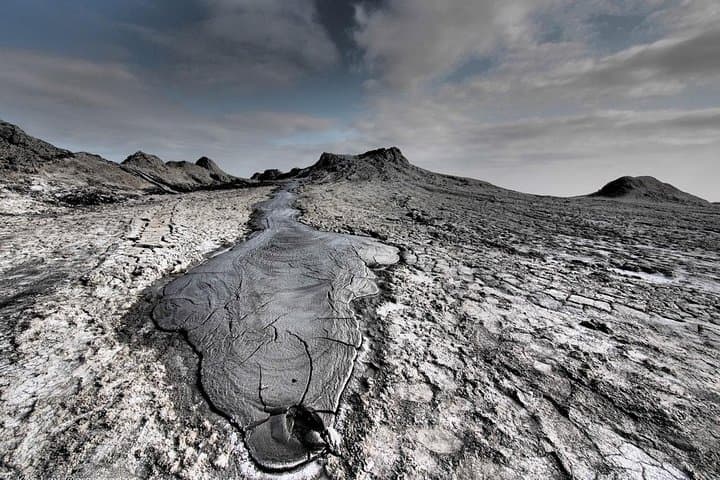
Geology writes another chapter here. Azerbaijan sits atop oil and gas-bearing layers; where pressure finds weakness, mud volcanoes form. They don’t erupt lava but a peculiar procession of bubbling clay, gas flares and, occasionally, flaming cones. Some of the local mud volcanoes are calm, slow oozes you can approach for a dramatic photograph; others can belch with force and heat. A memorable 2001 eruption near Baku produced flames and headlines, a reminder that this is living geology.
Culture threads through the day’s stops. On the return, many tours pause at Bibi-Heybat Mosque — a rebuilt 20th-century version of a medieval shrine that ties modern Baku back to its religious and maritime past.
Practicalities: expect 5–6 hours for the full loop (the standard guided itinerary allows two hours at Gobustan itself). Walking at the petroglyph site is short but over uneven rock and stony paths — plan for 1–2 kilometers on foot, little elevation gain but plenty of sun exposure. Mud-volcano fields require cautious approach and strict adherence to the guide’s boundaries; temperatures near fresh vents can be warmer and the ground unstable.
Timing matters: mornings or late afternoons give softer light for carvings and photography, with cooler temps. Bring water, sun protection, closed shoes with good grip, and a wind layer for Caspian gusts. The tour typically includes hotel pickup in central Baku, an air-conditioned vehicle, a licensed guide and drop-off — a compact way to compress deep prehistory and raw geology into a single, unforgettable day.
easy.
5–6 hours.
Suitable for general fitness; walking involves short uneven sections but no sustained climbs
The full excursion runs approximately 5–6 hours, with about two hours spent in the Gobustan reserve and time allocated for mud volcano visits and a stop at Bibi-Heybat.
Admission is not included on most standard bookings; your guide will help with ticketing or advise payment on-site.
Yes — the tour is rated easy and suitable for most ages, though rock surfaces can be uneven and require careful footing.
You can approach designated safe viewing areas, but guides will enforce distance limits for safety; never enter warm vents or unstable slopes.
Guides often speak English and Azerbaijani; confirm language needs when booking to ensure an English-speaking guide if required.
Yes — pickups from central Baku hotels are typically included; confirm exact pickup point and time after booking.
Gobustan’s petroglyphs span Paleolithic to medieval eras and were inscribed by coastal and steppe communities whose subsistence shifted with ancient sea-level changes.
Visitor numbers are managed and paths marked to protect fragile panels; avoid touching carvings and stick to designated trails to limit erosion and graffiti.
Baku Tour Packages operates guided outdoor trips and adventures with an emphasis on safety, stewardship, and memorable experiences.
You step out of the van into wind that tastes faintly of salt and something older — gas and sediment rising from the earth. Low, rounded hills roll away under a pale sky; the first carved panels sit like an open book of human movement and weather. This is Gobustan: a place where people left their marks for tens of thousands of years, and where the land still asserts itself in smoking mud cones a short drive inland from the Caspian.
You step out of the van into wind that tastes faintly of salt and something older — gas and sediment rising from the earth. Low, rounded hills roll away under a pale sky; the first carved panels sit like an open book of human movement and weather. This is Gobustan: a place where people left their marks for tens of thousands of years, and where the land still asserts itself in smoking mud cones a short drive inland from the Caspian.
The State Historical-Artistic Reserve of Gobustan (about an hour south of Baku) holds some of the Caucasus’ most concentrated petroglyph fields. Hunters, boats and ritual scenes are etched across flat rock faces, traces of Paleolithic, Mesolithic and Neolithic lives. The on-site museum — with a collection reported in the tens of thousands — frames those panels with tools and explanations that make the images click into context: seasonal migrations, coastal economies before the Caspian shifted, and a human relationship with an energetic landscape.
Geology writes another chapter here. Azerbaijan sits atop oil and gas-bearing layers; where pressure finds weakness, mud volcanoes form. They don’t erupt lava but a peculiar procession of bubbling clay, gas flares and, occasionally, flaming cones. Some of the local mud volcanoes are calm, slow oozes you can approach for a dramatic photograph; others can belch with force and heat. A memorable 2001 eruption near Baku produced flames and headlines, a reminder that this is living geology.
Culture threads through the day’s stops. On the return, many tours pause at Bibi-Heybat Mosque — a rebuilt 20th-century version of a medieval shrine that ties modern Baku back to its religious and maritime past.
Practicalities: expect 5–6 hours for the full loop (the standard guided itinerary allows two hours at Gobustan itself). Walking at the petroglyph site is short but over uneven rock and stony paths — plan for 1–2 kilometers on foot, little elevation gain but plenty of sun exposure. Mud-volcano fields require cautious approach and strict adherence to the guide’s boundaries; temperatures near fresh vents can be warmer and the ground unstable.
Timing matters: mornings or late afternoons give softer light for carvings and photography, with cooler temps. Bring water, sun protection, closed shoes with good grip, and a wind layer for Caspian gusts. The tour typically includes hotel pickup in central Baku, an air-conditioned vehicle, a licensed guide and drop-off — a compact way to compress deep prehistory and raw geology into a single, unforgettable day.