THE ADVENTURE COLLECTIVE® · Independent discovery and booking for outdoor travel

A compact 2‑day route from Hanoi that pairs short treks through Muong Hoa Valley and Cat Cat with an overnight Dzay homestay. Ideal for travelers who want immersive culture and terrace views without extensive trekking experience.
A compact 2‑day route from Hanoi that pairs short treks through Muong Hoa Valley and Cat Cat with an overnight Dzay homestay. Ideal for travelers who want immersive culture and terrace views without extensive trekking experience.
Daylight breaks over the Hoang Lien Son range as a tourist bus hums north from Hanoi, and by mid‑afternoon you step into a town sitting around 1,500 m above sea level where fog and rice terraces trade places with the sun.
Verified experiences and guided adventures in the surrounding area.
Operated by Vietnam Open Tour Limited Company · Sapa, Lao Cai
Daylight breaks over the Hoang Lien Son range as a tourist bus hums north from Hanoi, and by mid‑afternoon you step into a town sitting around 1,500 m above sea level where fog and rice terraces trade places with the sun.
This two‑day itinerary threads easy village hikes through Muong Hoa Valley and Cat Cat, offering direct encounters with Black H’mong and Dzay communities and a night at a Dzay homestay. Geologically, Sapa sits on steep metamorphic slopes carved by rivers; terraced paddies are engineered responses to the gradient and monsoon rains. Fansipan, Indochina’s highest peak (3,143 m), watches from the skyline and explains sudden weather shifts and colder nights.
Culturally, villages are working landscapes: stone irrigation channels, patchwork rice plots and hand‑stitched traditional clothing. The Muong Hoa stream route reveals ancient stone scripts and a rhythm of daily tasks rather than staged performances.
Practically, expect two core treks: a short 2.5 km descent to Cat Cat waterfall (about 2 hours, with steps) and a 9 km Lao Chai–Ta Van traverse (≈3.5 hours) through terraces and streamside paths. Trails are uneven, often muddy after rain, and altitude makes mornings brisk. Pack layers, waterproofs, solid tread footwear and cash; village services are basic. If you want to photograph terraces in low light or avoid crowds, plan pre‑ or post‑sunrise outings and communicate any dietary or mobility needs ahead of pickup in Hanoi’s Old Quarter. This trip balances accessible trekking, immersive local stay, and logistical simplicity provided by round‑trip bus transfer.
moderate.
2 days (including transfers; ~5–6 hours total trekking).
Good for travelers who can hike 2–4 hours with short steep sections and manage uneven, sometimes slippery terrain
Day 1 includes a ~2.5 km trek to Cat Cat (~2 hours); Day 2 covers roughly 9 km between Lao Chai and Ta Van (~3–3.5 hours).
Overnight is a private room at a selected Sapa hotel or a Dzay homestay depending on booking—amenities are basic in villages but hotels provide private rooms.
Sapa sits around 1,500 m—most visitors do not experience severe symptoms, but stay hydrated, move at a comfortable pace and inform guides if you feel unwell.
The tour notes special requests should be sent in advance; village and hotel food can be simple so communicate allergies or preferences before departure.
Sapa grew as a French hill station in the early 20th century and is home to multiple ethnic minorities—Black H’mong, Dzay and Dzao—whose agricultural systems shaped the terraces.
Tourism pressures and changing agriculture challenge terrace maintenance; support local guides and avoid trampling young rice plots to help preserve the landscape.
Vietnam Open Tour Limited Company operates guided outdoor trips and adventures with an emphasis on safety, stewardship, and memorable experiences.
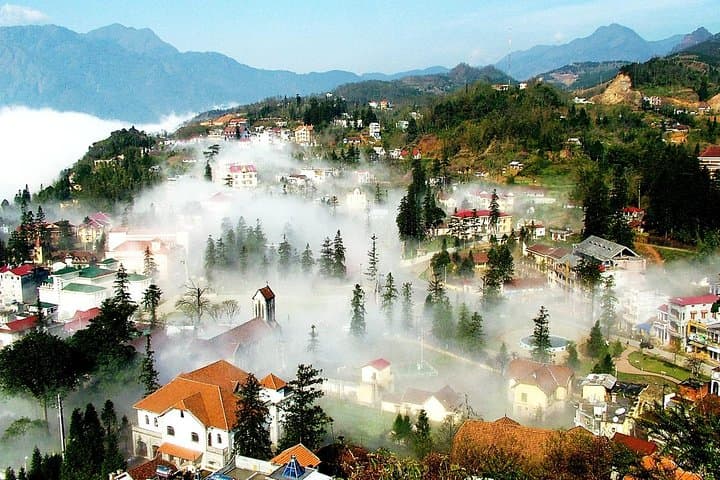
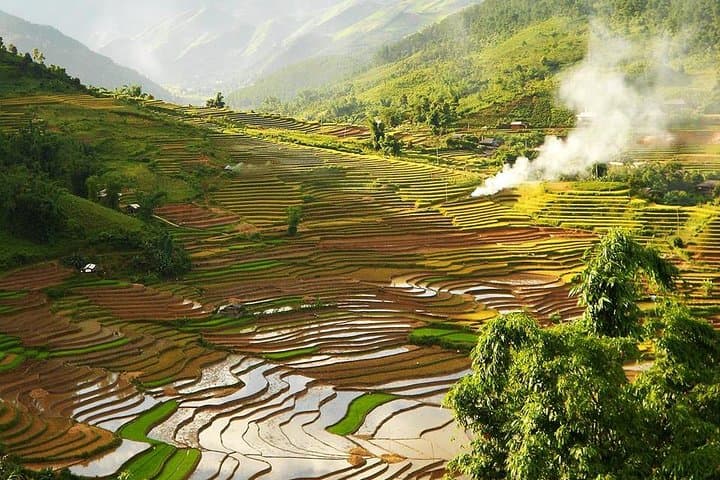
Daylight breaks over the Hoang Lien Son range as a tourist bus hums north from Hanoi, and by mid‑afternoon you step into a town sitting around 1,500 m above sea level where fog and rice terraces trade places with the sun.
Daylight breaks over the Hoang Lien Son range as a tourist bus hums north from Hanoi, and by mid‑afternoon you step into a town sitting around 1,500 m above sea level where fog and rice terraces trade places with the sun.
This two‑day itinerary threads easy village hikes through Muong Hoa Valley and Cat Cat, offering direct encounters with Black H’mong and Dzay communities and a night at a Dzay homestay. Geologically, Sapa sits on steep metamorphic slopes carved by rivers; terraced paddies are engineered responses to the gradient and monsoon rains. Fansipan, Indochina’s highest peak (3,143 m), watches from the skyline and explains sudden weather shifts and colder nights.
Culturally, villages are working landscapes: stone irrigation channels, patchwork rice plots and hand‑stitched traditional clothing. The Muong Hoa stream route reveals ancient stone scripts and a rhythm of daily tasks rather than staged performances.
Practically, expect two core treks: a short 2.5 km descent to Cat Cat waterfall (about 2 hours, with steps) and a 9 km Lao Chai–Ta Van traverse (≈3.5 hours) through terraces and streamside paths. Trails are uneven, often muddy after rain, and altitude makes mornings brisk. Pack layers, waterproofs, solid tread footwear and cash; village services are basic. If you want to photograph terraces in low light or avoid crowds, plan pre‑ or post‑sunrise outings and communicate any dietary or mobility needs ahead of pickup in Hanoi’s Old Quarter. This trip balances accessible trekking, immersive local stay, and logistical simplicity provided by round‑trip bus transfer.