THE ADVENTURE COLLECTIVE® · Independent discovery and booking for outdoor travel

Descend from the Roman Forum into the Mamertine Prison, then continue to the labyrinthine Catacombs of San Callisto on the Appian Way. This guided tour pairs political and religious history with easy walks and skip-the-line access for a compact underground Roman experience.
Descend from the Roman Forum into the Mamertine Prison, then continue to the labyrinthine Catacombs of San Callisto on the Appian Way. This guided tour pairs political and religious history with easy walks and skip-the-line access for a compact underground Roman experience.
Step beneath Rome’s sunlit streets into corridors where echoes of the ancient city still linger. The tour opens at the Mamertine Prison, an austere stone chamber carved into volcanic tuff beside the Forum where, according to tradition, early Christian figures were detained. You feel the cool, damp air change as the guide leads you down into narrow vaulted rooms — history compressed into a handful of shadowed cells.
Verified experiences and guided adventures in the surrounding area.
Operated by Journey Tours · Rome, Lazio
Step beneath Rome’s sunlit streets into corridors where echoes of the ancient city still linger. The tour opens at the Mamertine Prison, an austere stone chamber carved into volcanic tuff beside the Forum where, according to tradition, early Christian figures were detained. You feel the cool, damp air change as the guide leads you down into narrow vaulted rooms — history compressed into a handful of shadowed cells.
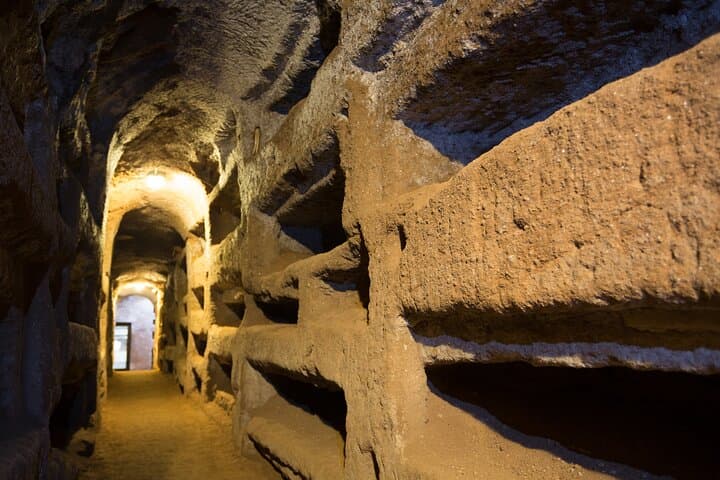
From there the route moves south to the Appian Way and the Catacombs of San Callisto, a subterranean network hewn from soft pumice and tufa. The catacombs’ low ceilings and painted niches tell a layered story: Roman funerary practice, early Christian iconography and the improvisational use of local stone types. Along the way, guides point out inscriptions, fresco fragments and the practical engineering that kept these galleries stable for two millennia.
This is an urban archaeology tour as much as a walk: it ties Roman political history to Christian cult practice and to the geology of the region, where volcanic deposits shaped building and burial choices. Cultural context—church authority, burial customs, and the Forum’s political life—frames each stop, with local anecdotes that make the sites feel immediate rather than museumlike.
Practical notes: the experience is mostly on foot with some uneven surfaces and low passages. Dress respectfully for religious sites (shoulders and knees covered), bring a bottle of water, and wear supportive shoes. The tour includes transportation between sites and skip-the-line access, but people with claustrophobia should plan accordingly. Morning departures avoid heat and crowds; afternoons can be quieter in the catacombs.
easy.
3–4 hours.
Suitable for most fitness levels; involves moderate walking and some stairs but no technical exertion.
The guided tour runs approximately 3 to 4 hours, including transportation between the Mamertine Prison and the Catacombs of San Callisto.
The Mamertine Prison and catacombs have stairs and some low passages; those with significant mobility limitations should check accessibility in advance and may find parts of the visit challenging.
Photography rules vary—flash is often discouraged in the catacombs to protect frescoes; follow the guide’s instructions at each stop.
Yes. These are religious and historical sites: shoulders and knees should be covered to gain entry.
The Mamertine Prison was used from Republican Rome through imperial times and later became associated with the imprisonment of important figures; the Catacombs of San Callisto are one of Rome’s major early-Christian burial complexes, expanded from the 2nd to 4th centuries AD.
The sites face wear from humidity, visitor traffic and light exposure; guided tours and restricted access help protect frescoes and fragile tomb surfaces while educating visitors about preservation.
Journey Tours operates guided outdoor trips and adventures with an emphasis on safety, stewardship, and memorable experiences.
Step beneath Rome’s sunlit streets into corridors where echoes of the ancient city still linger. The tour opens at the Mamertine Prison, an austere stone chamber carved into volcanic tuff beside the Forum where, according to tradition, early Christian figures were detained. You feel the cool, damp air change as the guide leads you down into narrow vaulted rooms — history compressed into a handful of shadowed cells.
Step beneath Rome’s sunlit streets into corridors where echoes of the ancient city still linger. The tour opens at the Mamertine Prison, an austere stone chamber carved into volcanic tuff beside the Forum where, according to tradition, early Christian figures were detained. You feel the cool, damp air change as the guide leads you down into narrow vaulted rooms — history compressed into a handful of shadowed cells.
From there the route moves south to the Appian Way and the Catacombs of San Callisto, a subterranean network hewn from soft pumice and tufa. The catacombs’ low ceilings and painted niches tell a layered story: Roman funerary practice, early Christian iconography and the improvisational use of local stone types. Along the way, guides point out inscriptions, fresco fragments and the practical engineering that kept these galleries stable for two millennia.
This is an urban archaeology tour as much as a walk: it ties Roman political history to Christian cult practice and to the geology of the region, where volcanic deposits shaped building and burial choices. Cultural context—church authority, burial customs, and the Forum’s political life—frames each stop, with local anecdotes that make the sites feel immediate rather than museumlike.
Practical notes: the experience is mostly on foot with some uneven surfaces and low passages. Dress respectfully for religious sites (shoulders and knees covered), bring a bottle of water, and wear supportive shoes. The tour includes transportation between sites and skip-the-line access, but people with claustrophobia should plan accordingly. Morning departures avoid heat and crowds; afternoons can be quieter in the catacombs.