THE ADVENTURE COLLECTIVE® · Independent discovery and booking for outdoor travel

Paddle into Phong Nha Cave’s dark river, hike to a secret underground lake, and trace ancient Cham markings in a single day. This one-day tour pairs technical karst geology with hands-on exploration—ideal for travelers comfortable on water and uneven rock.
Paddle into Phong Nha Cave’s dark river, hike to a secret underground lake, and trace ancient Cham markings in a single day. This one-day tour pairs technical karst geology with hands-on exploration—ideal for travelers comfortable on water and uneven rock.
A day begins at the riverbank where limestone walls throw long shadows over tannin-dark water. Guides check life jackets and flashlights while the river seems to dare each kayak forward; paddles whisper against the cave mouth and then darkness swallows sound. Inside Phong Nha Cave, a subterranean river threads through vaults carved from Paleozoic limestone, and the boat moves beneath columns and curtains of calcite that grew drop by patient drop.
Verified experiences and guided adventures in the surrounding area.
Operated by Phong Nha Trekking Tours · Phong Nha, Quang Binh
A day begins at the riverbank where limestone walls throw long shadows over tannin-dark water. Guides check life jackets and flashlights while the river seems to dare each kayak forward; paddles whisper against the cave mouth and then darkness swallows sound. Inside Phong Nha Cave, a subterranean river threads through vaults carved from Paleozoic limestone, and the boat moves beneath columns and curtains of calcite that grew drop by patient drop.
Phong Nha–Ke Bang National Park is a UNESCO World Heritage site—the karst here dates to some of the oldest limestone on Earth and holds passages mapped for kilometers. Cham-era inscriptions and traces of prehistoric people appear in dry chambers outside the main river, linking the landscape to long human stories.
Expect half the day on water and the rest on foot: an initial 3 km paddle into the cave, a 1.5 km hike to an underground lake, a swim in sheltered dark water, then a return by kayak. Terrain shifts from flat river to packed-sand shores and damp rock walking; footing can be uneven and low-light conditions require a steady headlamp.
Practically, arrive with sturdy water shoes, a charged light, and a waterproof layer for sudden spray. Timing matters—choose the dry season for lower water and clearer walking routes. Follow guides’ instructions about fragile formations and archaeological markings; these chambers recover slowly from human contact. Hydrate, protect skin from sun between river runs, and respect the cave’s slow rhythms—inside, stone keeps its own time.
moderate.
7–8 hours.
Suitable for people with reasonable mobility and basic stamina—able to paddle 3+ km and walk on uneven, damp surfaces.
No advanced skills are required—guides provide basic instruction and the river sections used are calm, but you should be comfortable sitting in a kayak and paddling for several kilometers.
A supervised swim at an underground lake is optional on most itineraries; non-swimmers can relax on shore under guide supervision.
This tour is not recommended for pregnant travelers or those with serious spinal or heart conditions; age and fitness considerations depend on the operator—confirm during booking.
The operator may cancel or reschedule if high water or storms make cave access unsafe; the cancellation policy typically allows a full refund if moved at least 24 hours in advance.
Phong Nha–Ke Bang’s karst system preserves both geological time (ancient limestone formations) and human history—Cham inscriptions and artifacts show continuous human presence around these caves for centuries.
The park is UNESCO-protected; visitors should follow leave-no-trace rules, avoid touching formations, and rely on local guides to limit impact on sensitive chambers.
Phong Nha Trekking Tours operates guided outdoor trips and adventures with an emphasis on safety, stewardship, and memorable experiences.

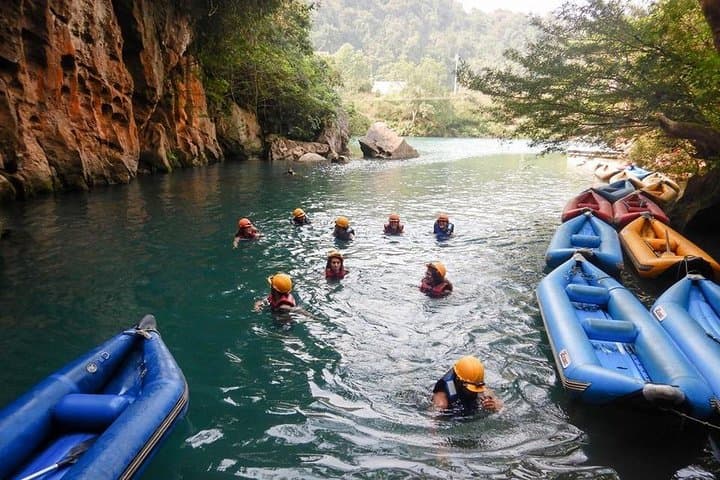


A day begins at the riverbank where limestone walls throw long shadows over tannin-dark water. Guides check life jackets and flashlights while the river seems to dare each kayak forward; paddles whisper against the cave mouth and then darkness swallows sound. Inside Phong Nha Cave, a subterranean river threads through vaults carved from Paleozoic limestone, and the boat moves beneath columns and curtains of calcite that grew drop by patient drop.
A day begins at the riverbank where limestone walls throw long shadows over tannin-dark water. Guides check life jackets and flashlights while the river seems to dare each kayak forward; paddles whisper against the cave mouth and then darkness swallows sound. Inside Phong Nha Cave, a subterranean river threads through vaults carved from Paleozoic limestone, and the boat moves beneath columns and curtains of calcite that grew drop by patient drop.
Phong Nha–Ke Bang National Park is a UNESCO World Heritage site—the karst here dates to some of the oldest limestone on Earth and holds passages mapped for kilometers. Cham-era inscriptions and traces of prehistoric people appear in dry chambers outside the main river, linking the landscape to long human stories.
Expect half the day on water and the rest on foot: an initial 3 km paddle into the cave, a 1.5 km hike to an underground lake, a swim in sheltered dark water, then a return by kayak. Terrain shifts from flat river to packed-sand shores and damp rock walking; footing can be uneven and low-light conditions require a steady headlamp.
Practically, arrive with sturdy water shoes, a charged light, and a waterproof layer for sudden spray. Timing matters—choose the dry season for lower water and clearer walking routes. Follow guides’ instructions about fragile formations and archaeological markings; these chambers recover slowly from human contact. Hydrate, protect skin from sun between river runs, and respect the cave’s slow rhythms—inside, stone keeps its own time.