THE ADVENTURE COLLECTIVE® · Independent discovery and booking for outdoor travel

Walk Gaudí’s eccentric lines and tiled benches in Park Güell, an architectural park with sweeping city views and limited-entry highlights. Book ahead, aim for morning light, and plan 1–3 hours to take it in.
Walk Gaudí’s eccentric lines and tiled benches in Park Güell, an architectural park with sweeping city views and limited-entry highlights. Book ahead, aim for morning light, and plan 1–3 hours to take it in.
You step onto a broad, undulating terrace where color and curve force the city into a new grammar. Bright ceramic shards catch sunlight; below, the grid of Eixample and the distant Mediterranean spread out like a map you can read with your eyes.
Verified experiences and guided adventures in the surrounding area.
Operated by Dream Fly Tourism LLC · Barcelona, Catalonia
You step onto a broad, undulating terrace where color and curve force the city into a new grammar. Bright ceramic shards catch sunlight; below, the grid of Eixample and the distant Mediterranean spread out like a map you can read with your eyes.
Park Güell began as an ambitious early-20th-century housing project by Antoni Gaudí and evolved into a public park that blends architecture and landscape. Built on the El Carmel hillside, its stone viaducts and serpentine bench work with the sandstone and Mediterranean pines to direct views and shade. The Monumental Zone — where the mosaic lizard, colonnaded halls, and terraced plaza live — represents Catalan Modernisme at full throttle and is part of the UNESCO-listed Gaudí works.
Culturally, a visit is as much about Barcelona’s embrace of design as it is about quiet afternoons under umbrella pines. Arrive early for cooler light and fewer people; late afternoon gathers locals walking dogs and photographers hunting backlit tile details. The park is large; the ticketed sector is compact and fragile — wear respectful behavior around mosaics and vegetation.
Practical guidance: allow 60–180 minutes, book a timed entry for the Monumental Zone, and use Metro L3 (Vallcarca or Lesseps) or buses to avoid steep climbs. Stairs and uneven paths are common; bring water, sun protection, and comfortable shoes. Peak summer gets hot and busy; mornings give the best combination of light and space for photos.
easy.
1–3 hours.
Suitable for most fitness levels; expect stairs and uneven stone paths
No—large sections of the park are free, but the Monumental Zone (mosaic terrace, main entrance, colonnades) requires a timed ticket.
Most visitors spend 1–3 hours exploring both the Monumental Zone and nearby free areas; photographers may stay longer.
Access is limited: some paths and the terrace have steps; there are accessible routes to parts of the park but check official accessibility info before visiting.
Early morning offers cooler temperatures and fewer people; late afternoon has warm light but can be crowded in high season.
Gaudí designed the park between 1900–1914 as an urban housing experiment; when the project failed, the land became a public park and an icon of Modernisme.
Visitor limits protect delicate mosaics and vegetation—stick to paths, avoid touching restored surfaces, and carry out waste to reduce impact.
Dream Fly Tourism LLC operates guided outdoor trips and adventures with an emphasis on safety, stewardship, and memorable experiences.
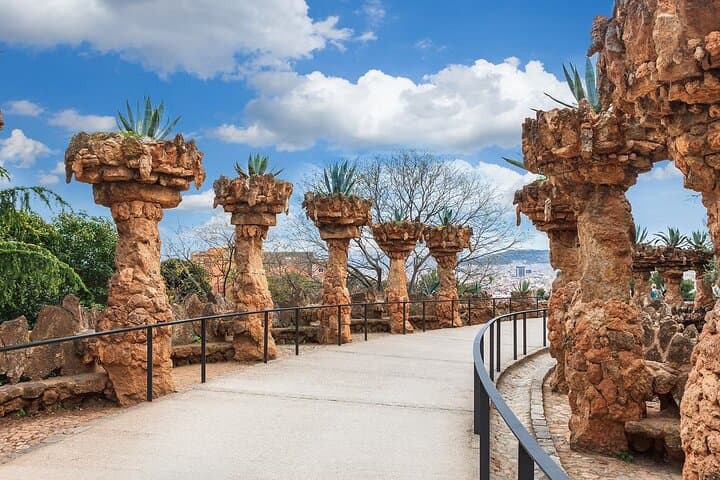


You step onto a broad, undulating terrace where color and curve force the city into a new grammar. Bright ceramic shards catch sunlight; below, the grid of Eixample and the distant Mediterranean spread out like a map you can read with your eyes.
You step onto a broad, undulating terrace where color and curve force the city into a new grammar. Bright ceramic shards catch sunlight; below, the grid of Eixample and the distant Mediterranean spread out like a map you can read with your eyes.
Park Güell began as an ambitious early-20th-century housing project by Antoni Gaudí and evolved into a public park that blends architecture and landscape. Built on the El Carmel hillside, its stone viaducts and serpentine bench work with the sandstone and Mediterranean pines to direct views and shade. The Monumental Zone — where the mosaic lizard, colonnaded halls, and terraced plaza live — represents Catalan Modernisme at full throttle and is part of the UNESCO-listed Gaudí works.
Culturally, a visit is as much about Barcelona’s embrace of design as it is about quiet afternoons under umbrella pines. Arrive early for cooler light and fewer people; late afternoon gathers locals walking dogs and photographers hunting backlit tile details. The park is large; the ticketed sector is compact and fragile — wear respectful behavior around mosaics and vegetation.
Practical guidance: allow 60–180 minutes, book a timed entry for the Monumental Zone, and use Metro L3 (Vallcarca or Lesseps) or buses to avoid steep climbs. Stairs and uneven paths are common; bring water, sun protection, and comfortable shoes. Peak summer gets hot and busy; mornings give the best combination of light and space for photos.