THE ADVENTURE COLLECTIVE® · Independent discovery and booking for outdoor travel

Walk among New Orleans’ iconic above-ground tombs on a focused two-hour guided tour. Learn burial customs, architectural styles, and local stories while exploring accessible paths and poignant memorials.
Walk among New Orleans’ iconic above-ground tombs on a focused two-hour guided tour. Learn burial customs, architectural styles, and local stories while exploring accessible paths and poignant memorials.
The air along Canal Boulevard carries a different pulse — magnolia-scented and old, punctuated by the hush of marble and iron. You meet at Morning Call, cup warm in hand, and step into rows of above-ground tombs where sunlight slices through oak branches and the city’s past leans close enough to touch.
Verified experiences and guided adventures in the surrounding area.
Operated by Haunted History Tours · New Orleans, Louisiana
The air along Canal Boulevard carries a different pulse — magnolia-scented and old, punctuated by the hush of marble and iron. You meet at Morning Call, cup warm in hand, and step into rows of above-ground tombs where sunlight slices through oak branches and the city’s past leans close enough to touch.
These cemeteries reflect New Orleans’ layered history: colonial French and Spanish influences on funerary architecture, Catholic burial rites adapted to a high water table, and the Creole and African-American traditions woven into memorial practices. Geologically, the low-lying delta forces vault burial, producing tightly packed grave yards and ornate family tombs that rise like small stone houses.
Culture here is tactile — names on bronze, personal offerings tied to ironwork, and stories told by guides who trace narratives from antebellum families to the communities reshaped after Hurricane Katrina. The tour pauses at a potter’s field that has become an informal memorial, and at crossroads where multiple cemeteries meet, each with its own personality and inscriptions that map the city’s social history.
Practical guidance: the route is roughly 1.5–2 miles across paved and gravel paths with occasional steps; expect moderate walking for two hours. Wear comfortable shoes, bring water and sun protection, and plan for mosquitoes in warm months. Photography is allowed but be respectful — these are active, sacred spaces. Tours run rain or shine; check weather and arrive 20 minutes early to collect tickets. This walk is part history lesson, part urban exploration: steady, human-scale, and quietly powerful.
moderate.
2 hours.
Suitable for those who can stand and walk for two hours on mostly flat pavement and compacted paths; light mobility limitations may be accommodated.
The guided tour lasts approximately 2 hours and covers about 1.5–2 miles on mostly flat paths.
The tour information lists wheelchair accessibility; contact the operator ahead of time to confirm accommodations and any route adjustments.
Meet in front of Morning Call Coffee Stand at 5101 Canal Boulevard; check in at least 20 minutes prior to departure.
Children are welcome and strollers are usable on most parts; photography is permitted but be respectful of graves and memorials.
New Orleans cemeteries use above-ground vaults because the city sits on marshy, high-water-table soils; tomb styles show French, Spanish, and Caribbean influences.
Visitors should stay on marked paths, avoid disturbing grave markers, and take care with litter and offerings to preserve the historic sites.
Haunted History Tours operates guided outdoor trips and adventures with an emphasis on safety, stewardship, and memorable experiences.
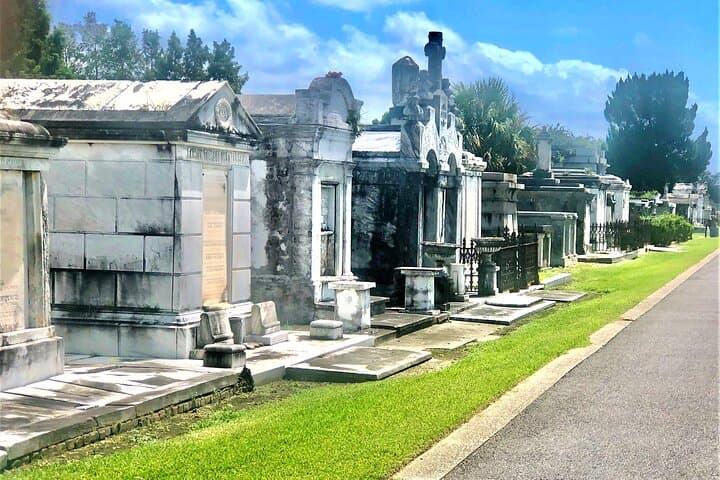


The air along Canal Boulevard carries a different pulse — magnolia-scented and old, punctuated by the hush of marble and iron. You meet at Morning Call, cup warm in hand, and step into rows of above-ground tombs where sunlight slices through oak branches and the city’s past leans close enough to touch.
The air along Canal Boulevard carries a different pulse — magnolia-scented and old, punctuated by the hush of marble and iron. You meet at Morning Call, cup warm in hand, and step into rows of above-ground tombs where sunlight slices through oak branches and the city’s past leans close enough to touch.
These cemeteries reflect New Orleans’ layered history: colonial French and Spanish influences on funerary architecture, Catholic burial rites adapted to a high water table, and the Creole and African-American traditions woven into memorial practices. Geologically, the low-lying delta forces vault burial, producing tightly packed grave yards and ornate family tombs that rise like small stone houses.
Culture here is tactile — names on bronze, personal offerings tied to ironwork, and stories told by guides who trace narratives from antebellum families to the communities reshaped after Hurricane Katrina. The tour pauses at a potter’s field that has become an informal memorial, and at crossroads where multiple cemeteries meet, each with its own personality and inscriptions that map the city’s social history.
Practical guidance: the route is roughly 1.5–2 miles across paved and gravel paths with occasional steps; expect moderate walking for two hours. Wear comfortable shoes, bring water and sun protection, and plan for mosquitoes in warm months. Photography is allowed but be respectful — these are active, sacred spaces. Tours run rain or shine; check weather and arrive 20 minutes early to collect tickets. This walk is part history lesson, part urban exploration: steady, human-scale, and quietly powerful.