THE ADVENTURE COLLECTIVE® · Independent discovery and booking for outdoor travel

Visit My Son Sanctuary’s evocative Champa temples, then learn rice paper making in a family workshop on this 6-hour day tour from Da Nang or Hoi An. Ideal for travelers who want history, hands-on culture and practical sightseeing in one day.
Visit My Son Sanctuary’s evocative Champa temples, then learn rice paper making in a family workshop on this 6-hour day tour from Da Nang or Hoi An. Ideal for travelers who want history, hands-on culture and practical sightseeing in one day.
You arrive before the heat of midday, the minivan rolling off the highway and the trees closing in. Stone towers pierce low clouds and vine-draped walls give the impression the jungle is quietly reclaiming human hands. The air tastes faintly of dust, wood smoke and river mud — a reminder that these ruins survived a long human history.
Verified experiences and guided adventures in the surrounding area.
Operated by Authentic PHU QUOC · Hoi An, Quang Nam Province
You arrive before the heat of midday, the minivan rolling off the highway and the trees closing in. Stone towers pierce low clouds and vine-draped walls give the impression the jungle is quietly reclaiming human hands. The air tastes faintly of dust, wood smoke and river mud — a reminder that these ruins survived a long human history.
My Son was the religious center of the Champa Kingdom between the 4th and 13th centuries, an inland cluster of brick temples built with laterite and fired-clay bricks. Geologically, the site sits on gentle alluvial plains at the foot of low volcanic hills; its red bricks and intricate bas-reliefs reflect a Hindu aesthetic adapted to tropical weather. Local culture remains woven into the landscape — Cham music and dance are performed near the main grouping, and the rhythm that accompanies the stories of kings and gods shapes how guides interpret the site.
After the ruins, the day shifts from archaeology to hands-on craft: a family kitchen becomes a workshop for rice paper, where you stretch batter on a round frame and learn how steam, sun and timing determine texture. Tasting freshly made rice paper is as instructive as watching — it demonstrates why simplicity is central to Vietnamese cuisine.
Practical notes: expect a 6-hour excursion with several short walks on uneven paths; wear stable shoes and sun protection. Bring small bills for incidental purchases and respect signage around fragile ruins — climbing is prohibited. Morning departures avoid midday heat and offer softer light for photos. The tour blends history, geology and local craft into a single day that’s both readable and tactile.
easy.
6 hours.
Suitable for most fitness levels; involves short walks on uneven surfaces and minimal stair-climbing.
Yes — the tour includes entrance fees and electric car transfer within the site as listed in the inclusions.
Yes — the workshop is family-friendly, but small children should be supervised near hot steam and kitchen areas.
Yes — two-way hotel pick-up and drop-off from Da Nang or Hoi An city centers are included in the tour price.
The tour involves uneven ground and steps; it’s not recommended for guests with serious spinal or mobility problems, and some areas are reached by short walks.
My Son served as the religious and political center of the Cham civilization; temples there were built from the 4th to 13th centuries and reflect strong Indian/Hindu influences adapted to local materials.
My Son is a UNESCO World Heritage Site with active conservation efforts; visitors are asked to follow paths, avoid touching bas-reliefs, and respect local restrictions to limit wear on fragile brickwork.
Authentic PHU QUOC operates guided outdoor trips and adventures with an emphasis on safety, stewardship, and memorable experiences.
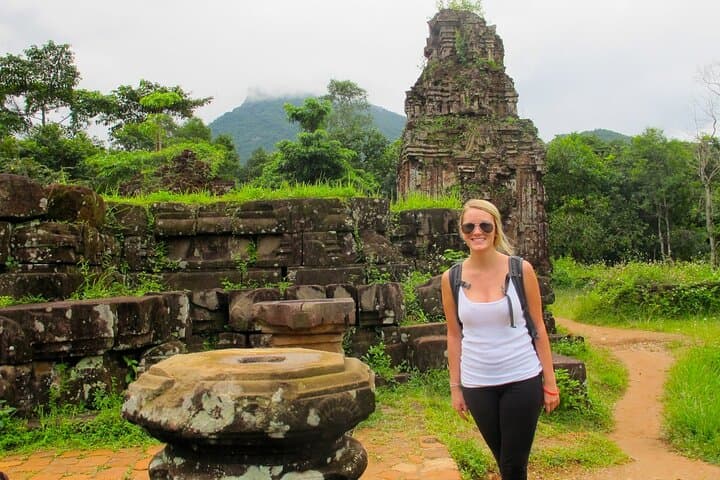


You arrive before the heat of midday, the minivan rolling off the highway and the trees closing in. Stone towers pierce low clouds and vine-draped walls give the impression the jungle is quietly reclaiming human hands. The air tastes faintly of dust, wood smoke and river mud — a reminder that these ruins survived a long human history.
You arrive before the heat of midday, the minivan rolling off the highway and the trees closing in. Stone towers pierce low clouds and vine-draped walls give the impression the jungle is quietly reclaiming human hands. The air tastes faintly of dust, wood smoke and river mud — a reminder that these ruins survived a long human history.
My Son was the religious center of the Champa Kingdom between the 4th and 13th centuries, an inland cluster of brick temples built with laterite and fired-clay bricks. Geologically, the site sits on gentle alluvial plains at the foot of low volcanic hills; its red bricks and intricate bas-reliefs reflect a Hindu aesthetic adapted to tropical weather. Local culture remains woven into the landscape — Cham music and dance are performed near the main grouping, and the rhythm that accompanies the stories of kings and gods shapes how guides interpret the site.
After the ruins, the day shifts from archaeology to hands-on craft: a family kitchen becomes a workshop for rice paper, where you stretch batter on a round frame and learn how steam, sun and timing determine texture. Tasting freshly made rice paper is as instructive as watching — it demonstrates why simplicity is central to Vietnamese cuisine.
Practical notes: expect a 6-hour excursion with several short walks on uneven paths; wear stable shoes and sun protection. Bring small bills for incidental purchases and respect signage around fragile ruins — climbing is prohibited. Morning departures avoid midday heat and offer softer light for photos. The tour blends history, geology and local craft into a single day that’s both readable and tactile.