THE ADVENTURE COLLECTIVE® · Independent discovery and booking for outdoor travel

Ride London’s famous red buses with a self-guided audio companion that routes you past major landmarks and overlooked corners alike. Flexible, multilingual, and offline-capable — this is a pay-as-you-go way to see the city from the top deck.
Ride London’s famous red buses with a self-guided audio companion that routes you past major landmarks and overlooked corners alike. Flexible, multilingual, and offline-capable — this is a pay-as-you-go way to see the city from the top deck.
A gray morning in central London softens to color as a double-decker climbs St Martin’s Lane. From the top deck the city opens in panels — the River Thames daring you to watch its ferries, a stone-faced cathedral catching light, an office block reflecting clouds — all narrated in sync with the street beneath. This self-guided audio experience uses public routes (including historic corridors covered by routes 9, 11, 15 and 24) to stitch together landmarks and lesser-known corners at your own pace.
Verified experiences and guided adventures in the surrounding area.
Operated by Vox City International Ltd · London, Greater London
A gray morning in central London softens to color as a double-decker climbs St Martin’s Lane. From the top deck the city opens in panels — the River Thames daring you to watch its ferries, a stone-faced cathedral catching light, an office block reflecting clouds — all narrated in sync with the street beneath. This self-guided audio experience uses public routes (including historic corridors covered by routes 9, 11, 15 and 24) to stitch together landmarks and lesser-known corners at your own pace.
The network itself is part of London’s transport history: red buses evolved alongside the Underground, and the Routemaster icon still shapes how visitors picture the city. Geologically the route follows a low, Thames-carved basin; architecture moves from Roman-founded walls to Victorian brick and contemporary glass. Culturally, the buses pass markets, courtyards and churchyards where local life plays out amid tourist flurries.
Practically, this tour is flexible — use contactless or Oyster to pay fares, load the multilingual audio guide for offline playback, and pick itineraries that suit a 60-minute spin or an all-day loop. Expect frequent stops, top-deck panoramas, and urban walking between disembark points. Peak commuting hours compress space; mid-morning or early evening offer softer light and steadier seats. Accessibility features mean most routes accept wheelchairs and prams, and children under 12 travel free on buses. Pack a layer, charge your phone, and plan a loop that mixes big-ticket sights with a detour to a market or quiet ruin garden — the city rewards curiosity and a well-timed bus pull-in.
easy.
1–24 hours.
Light mobility and ability to manage short walks between stops; suitable for most fitness levels.
The audio tour does not include bus fares; riders must use contactless payment, Oyster, or pay exact fare on boarding where accepted.
These are regular London bus routes — you can disembark and reboard but fares are charged per journey unless using a daily cap via Oyster/contactless.
Yes — the guide supports offline functionality and multilingual commentary in English, Spanish, French, German, Chinese and Italian.
Many London buses are wheelchair and stroller accessible; check the specific route accessibility and allow extra time for boarding with mobility aids.
London’s red bus network developed through the 20th century with the Routemaster becoming a cultural icon; routes mirror historic trade and civic corridors.
Using public buses reduces per-capita emissions compared with private cars; London’s low-emission zones and congestion charge help limit inner-city pollution.
Vox City International Ltd operates guided outdoor trips and adventures with an emphasis on safety, stewardship, and memorable experiences.

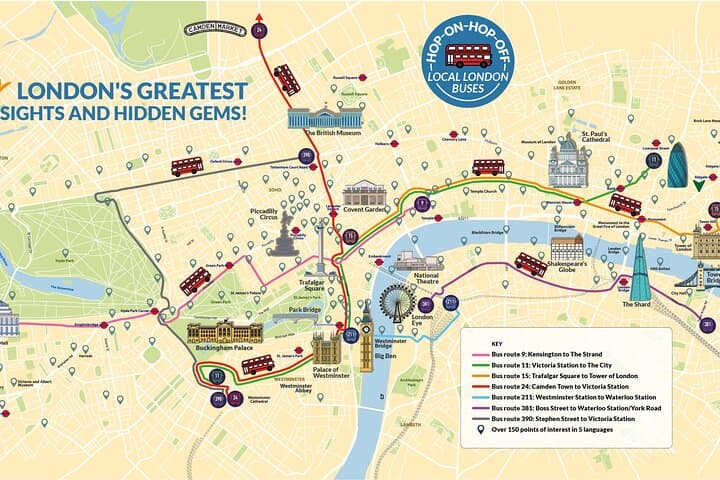

A gray morning in central London softens to color as a double-decker climbs St Martin’s Lane. From the top deck the city opens in panels — the River Thames daring you to watch its ferries, a stone-faced cathedral catching light, an office block reflecting clouds — all narrated in sync with the street beneath. This self-guided audio experience uses public routes (including historic corridors covered by routes 9, 11, 15 and 24) to stitch together landmarks and lesser-known corners at your own pace.
A gray morning in central London softens to color as a double-decker climbs St Martin’s Lane. From the top deck the city opens in panels — the River Thames daring you to watch its ferries, a stone-faced cathedral catching light, an office block reflecting clouds — all narrated in sync with the street beneath. This self-guided audio experience uses public routes (including historic corridors covered by routes 9, 11, 15 and 24) to stitch together landmarks and lesser-known corners at your own pace.
The network itself is part of London’s transport history: red buses evolved alongside the Underground, and the Routemaster icon still shapes how visitors picture the city. Geologically the route follows a low, Thames-carved basin; architecture moves from Roman-founded walls to Victorian brick and contemporary glass. Culturally, the buses pass markets, courtyards and churchyards where local life plays out amid tourist flurries.
Practically, this tour is flexible — use contactless or Oyster to pay fares, load the multilingual audio guide for offline playback, and pick itineraries that suit a 60-minute spin or an all-day loop. Expect frequent stops, top-deck panoramas, and urban walking between disembark points. Peak commuting hours compress space; mid-morning or early evening offer softer light and steadier seats. Accessibility features mean most routes accept wheelchairs and prams, and children under 12 travel free on buses. Pack a layer, charge your phone, and plan a loop that mixes big-ticket sights with a detour to a market or quiet ruin garden — the city rewards curiosity and a well-timed bus pull-in.