THE ADVENTURE COLLECTIVE® · Independent discovery and booking for outdoor travel

Walk Kotor’s UNESCO-listed Old Town with a local guide and cover the medieval squares, St. Tryphon’s cathedral and coastal history in one hour. This compact tour is ideal for visitors who want context and highlights without a long hike.
Walk Kotor’s UNESCO-listed Old Town with a local guide and cover the medieval squares, St. Tryphon’s cathedral and coastal history in one hour. This compact tour is ideal for visitors who want context and highlights without a long hike.
The gate clangs behind you and the Adriatic air pushes through the narrow lane—Kotor’s Old Town unfolds like a fortified stage, each square a scene. In an hour, a local guide threads stories through limestone alleys, pointing out worn coats of arms, baroque facades and a clock tower that keeps time to the rhythm of ships in the bay.
Verified experiences and guided adventures in the surrounding area.
Operated by Kotour · Kotor, Kotor Municipality
The gate clangs behind you and the Adriatic air pushes through the narrow lane—Kotor’s Old Town unfolds like a fortified stage, each square a scene. In an hour, a local guide threads stories through limestone alleys, pointing out worn coats of arms, baroque facades and a clock tower that keeps time to the rhythm of ships in the bay.
Kotor sits at the head of a fjord-like inlet carved by tectonics and sea-level change; its stacked houses cling to the steep slopes of Lovćen, the mountain that rises above the town. Founded in antiquity and shaped by Venetian, Ottoman and Austro-Hungarian rule, the Old Town’s grid of medieval streets reflects centuries of maritime trade and religious life—St. Tryphon’s cathedral and the compact armory are good examples of that layered history.
Culture here is practical and public: markets, fountains and church squares are where daily life has always played out. Expect to hear tales of seafaring families, local patron saints and wartime adaptations—your guide will point to plaques and palazzos and explain how the town survived earthquakes and empire shifts.
Practical guidance: the tour is short but paced on uneven stone; wear sturdy shoes and bring water. Photogenic viewpoints are frequent—if you want reduced crowds, book early morning or late afternoon. There’s no heavy climbing on this route, but the narrow streets can fill quickly during cruise-ship season, so keep valuables secure and leave large backpacks at your hotel. End the walk with a coffee in Armory Square and let the bay’s breeze decide your next move.
easy.
1 hour.
Suitable for most fitness levels; requires steady balance on stone streets.
Yes—entrance to the Old Town is included; specific attractions like museums may have separate fees.
The route is largely flat and the operator notes wheelchair access, but some narrow lanes can be tight—notify the guide in advance.
This small-group tour caps at around 10 travelers, offering a more personal experience than large coach groups.
Infants are welcome and must sit on an adult’s lap; infant seats are available if needed.
Kotor’s fortified Old Town reflects Venetian maritime influence and has been a UNESCO World Heritage site since 1979 due to its preserved medieval urban fabric.
Visitor pressure during cruise season stresses infrastructure; favor small-group tours, avoid littering and respect signs at historic sites to help preserve the stonework.
Kotour operates guided outdoor trips and adventures with an emphasis on safety, stewardship, and memorable experiences.



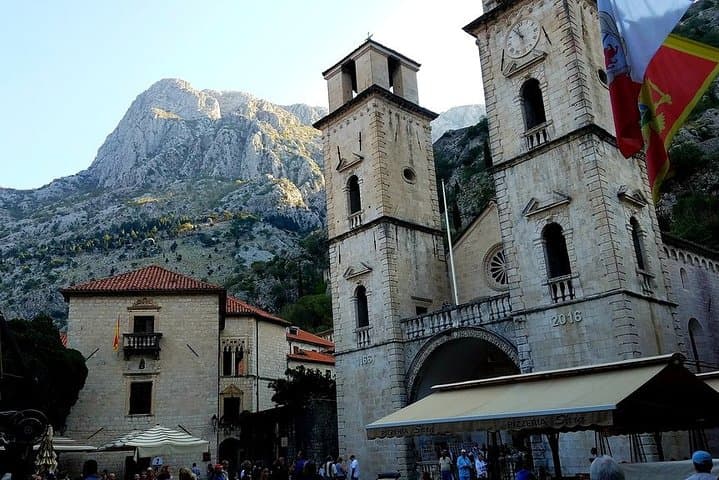
The gate clangs behind you and the Adriatic air pushes through the narrow lane—Kotor’s Old Town unfolds like a fortified stage, each square a scene. In an hour, a local guide threads stories through limestone alleys, pointing out worn coats of arms, baroque facades and a clock tower that keeps time to the rhythm of ships in the bay.
The gate clangs behind you and the Adriatic air pushes through the narrow lane—Kotor’s Old Town unfolds like a fortified stage, each square a scene. In an hour, a local guide threads stories through limestone alleys, pointing out worn coats of arms, baroque facades and a clock tower that keeps time to the rhythm of ships in the bay.
Kotor sits at the head of a fjord-like inlet carved by tectonics and sea-level change; its stacked houses cling to the steep slopes of Lovćen, the mountain that rises above the town. Founded in antiquity and shaped by Venetian, Ottoman and Austro-Hungarian rule, the Old Town’s grid of medieval streets reflects centuries of maritime trade and religious life—St. Tryphon’s cathedral and the compact armory are good examples of that layered history.
Culture here is practical and public: markets, fountains and church squares are where daily life has always played out. Expect to hear tales of seafaring families, local patron saints and wartime adaptations—your guide will point to plaques and palazzos and explain how the town survived earthquakes and empire shifts.
Practical guidance: the tour is short but paced on uneven stone; wear sturdy shoes and bring water. Photogenic viewpoints are frequent—if you want reduced crowds, book early morning or late afternoon. There’s no heavy climbing on this route, but the narrow streets can fill quickly during cruise-ship season, so keep valuables secure and leave large backpacks at your hotel. End the walk with a coffee in Armory Square and let the bay’s breeze decide your next move.