THE ADVENTURE COLLECTIVE® · Independent discovery and booking for outdoor travel

Walk Dunedin’s gold-era streets at your own pace. This self-guided tour starts at the ornate Railway Station and passes grand Victorian buildings, the Octagon and a revitalized Warehouse Precinct—perfect for history-minded travelers who prefer independent exploration.
Walk Dunedin’s gold-era streets at your own pace. This self-guided tour starts at the ornate Railway Station and passes grand Victorian buildings, the Octagon and a revitalized Warehouse Precinct—perfect for history-minded travelers who prefer independent exploration.
Morning light hits the polychrome stone of Dunedin Railway Station and the city unfolds like a chapter of the 1860s—stone, ironwork and the echo of wheels on a platform that once moved fortunes. A self-guided walk from that iconic station threads through the Octagon, past former bank buildings and repurposed warehouses, placing you where gold rush ambition reshaped a Scottish settlement into a colonial commercial hub.
Verified experiences and guided adventures in the surrounding area.
Operated by VoiceMap Audio Tours · Dunedin, Otago
Morning light hits the polychrome stone of Dunedin Railway Station and the city unfolds like a chapter of the 1860s—stone, ironwork and the echo of wheels on a platform that once moved fortunes. A self-guided walk from that iconic station threads through the Octagon, past former bank buildings and repurposed warehouses, placing you where gold rush ambition reshaped a Scottish settlement into a colonial commercial hub.
The route makes the city’s history legible: Victorian and Edwardian façades reflecting Otago’s brief, intense prosperity; the Warehouse Precinct’s brick and timber hinting at past mercantile bustle and present-day creative reuse. Geologically, Dunedin sits on eroded volcanic remnants—rolling hills fall toward a working harbour—so expect short elevation changes and views that point to a landscape shaped by fire and sea rather than alpine drama.
Culturally, the walk reveals Scottish town planning, Anglican and Presbyterian institutions, and pockets of Māori and immigrant histories layered into street names and public art. Practicalities are straightforward: the tour is 1.5–2 hours of mostly paved streets and pedestrian lanes, suitable for most fitness levels and easily accessed by public transport.
Download the tour app for offline maps, plan for changeable coastal weather with a lightweight rain layer, and leave time to pop into First Church, a brewery courtyard or a café in the Warehouse Precinct. The self-guided pace means you control stops—allow extra time if you want museum entry or a rail trip from the station.
easy.
1.5–2 hours.
Light walking fitness; suitable for most ages and for those comfortable on paved city streets
The route typically takes 1.5–2 hours at a steady pace; allow extra time for cafes, museums or photo stops.
Most streets and the main sites are stroller- and wheelchair-accessible, though some historic sidewalks are uneven—plan a slightly longer time for navigation.
The self-guided tour does not include entry fees; attractions like museum exhibits, the Chinese Garden, and railway trips require separate tickets.
Yes—lifetime access to the tour means you can start anytime; mornings and late afternoons are quieter and offer better light for photography.
Dunedin’s rapid growth during the Otago Gold Rush of the 1860s funded ambitious Victorian and Edwardian construction, establishing it as a commercial center in New Zealand’s south.
City-led heritage protections preserve façades and discourage demolition; visitors are encouraged to stay on paved routes and respect private property to reduce wear on historic precincts.
VoiceMap Audio Tours operates guided outdoor trips and adventures with an emphasis on safety, stewardship, and memorable experiences.
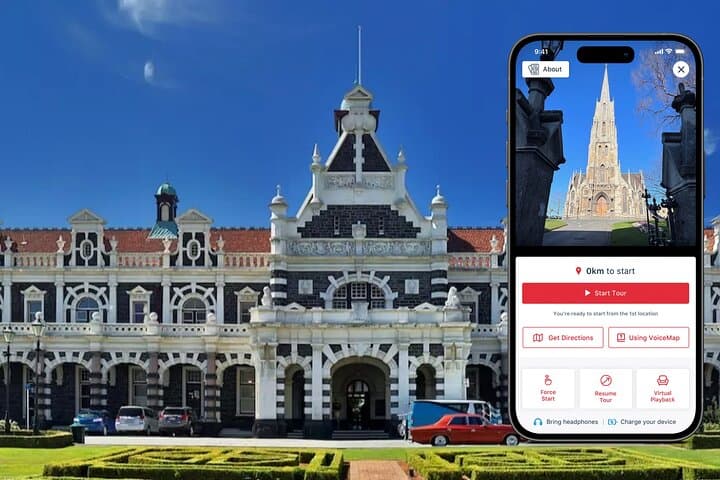



Morning light hits the polychrome stone of Dunedin Railway Station and the city unfolds like a chapter of the 1860s—stone, ironwork and the echo of wheels on a platform that once moved fortunes. A self-guided walk from that iconic station threads through the Octagon, past former bank buildings and repurposed warehouses, placing you where gold rush ambition reshaped a Scottish settlement into a colonial commercial hub.
Morning light hits the polychrome stone of Dunedin Railway Station and the city unfolds like a chapter of the 1860s—stone, ironwork and the echo of wheels on a platform that once moved fortunes. A self-guided walk from that iconic station threads through the Octagon, past former bank buildings and repurposed warehouses, placing you where gold rush ambition reshaped a Scottish settlement into a colonial commercial hub.
The route makes the city’s history legible: Victorian and Edwardian façades reflecting Otago’s brief, intense prosperity; the Warehouse Precinct’s brick and timber hinting at past mercantile bustle and present-day creative reuse. Geologically, Dunedin sits on eroded volcanic remnants—rolling hills fall toward a working harbour—so expect short elevation changes and views that point to a landscape shaped by fire and sea rather than alpine drama.
Culturally, the walk reveals Scottish town planning, Anglican and Presbyterian institutions, and pockets of Māori and immigrant histories layered into street names and public art. Practicalities are straightforward: the tour is 1.5–2 hours of mostly paved streets and pedestrian lanes, suitable for most fitness levels and easily accessed by public transport.
Download the tour app for offline maps, plan for changeable coastal weather with a lightweight rain layer, and leave time to pop into First Church, a brewery courtyard or a café in the Warehouse Precinct. The self-guided pace means you control stops—allow extra time if you want museum entry or a rail trip from the station.