THE ADVENTURE COLLECTIVE® · Independent discovery and booking for outdoor travel

Walk between Dubai’s modern icons and historic creek-side markets on a six-hour guided loop that includes the Blue Mosque, an abra crossing and photo stops at Palm Jumeirah and Burj Al Arab. Perfect for first-time visitors who want a focused, walkable city orientation.
Walk between Dubai’s modern icons and historic creek-side markets on a six-hour guided loop that includes the Blue Mosque, an abra crossing and photo stops at Palm Jumeirah and Burj Al Arab. Perfect for first-time visitors who want a focused, walkable city orientation.
A dawn-lit Dubai Creek frames the morning: wooden abras slice through glassy water, calling travelers across a city that moves between glittering skyscrapers and timeworn souks. The tour opens in front of Al Farooq Omar bin Al Khattab Mosque, where the mosque’s pale stone and geometric callouts draw attention to Islam’s visible role in urban life.
Verified experiences and guided adventures in the surrounding area.
Operated by Mahmoud Elsayed Tourism L.L.C Walking , Safari and City Tour · Dubai, Dubai
A dawn-lit Dubai Creek frames the morning: wooden abras slice through glassy water, calling travelers across a city that moves between glittering skyscrapers and timeworn souks. The tour opens in front of Al Farooq Omar bin Al Khattab Mosque, where the mosque’s pale stone and geometric callouts draw attention to Islam’s visible role in urban life.
From there the route threads modern feats — Burj Al Arab’s curved silhouette, the engineered arc of Palm Jumeirah, and the Marina’s ordered facades — back to Al Fahidi’s wind-tower lanes. The Abra ride is a short, elemental crossing where the creek’s current seems to urge progress: a simple boat connecting eras.
Dubai’s story is recent acceleration built on pearling and trade routes; the spice and gold markets recall centuries of commerce that predate oil. Geologically the city sits on a coastal plain of reclaimed sand and shell, with human-made islands rewriting the shoreline. Cultural notes are straightforward: modest dress is expected at mosques, bargaining is part of the market rhythm, and Arabic coffee is a ritual of hospitality.
Practical guidance: expect six hours of walking and short transfers; plan for heat and bright sun by scheduling early starts, carrying water, and wearing closed-toe shoes for market alleys. Bring a modest scarf for mosque entry, small local currency for vendors, and a fully charged phone for photo stops at The Frame and Dubai Mall. The pace blends structured sightseeing with time for sensory, street-level exploration — a compact orientation to Dubai’s past and present.
easy.
6 hours.
Suitable for most fitness levels; requires standing and walking on paved and uneven surfaces for several hours.
The tour includes a visit to Al Farooq Mosque; non-Muslims are generally welcome outside prayer times but must follow the mosque’s dress and behavior rules.
Pickup and drop-off from Dubai hotels is listed as included—confirm the exact meeting point and time when booking.
The abra crossing across Dubai Creek is brief—typically 5–15 minutes—but offers authentic views of the creek and marketfronts.
Souk alleys can be narrow and uneven; travelers with mobility limitations should notify the operator in advance to assess accessibility and alternate routing.
Dubai grew from a 19th-century fishing and pearling community into a global port and city-state; its old souks are direct descendants of centuries of maritime trade.
Rapid development has transformed coastal habitats, so visitors are encouraged to respect protected areas and reduce single-use plastic consumption while touring.
Mahmoud Elsayed Tourism L.L.C Walking , Safari and City Tour operates guided outdoor trips and adventures with an emphasis on safety, stewardship, and memorable experiences.
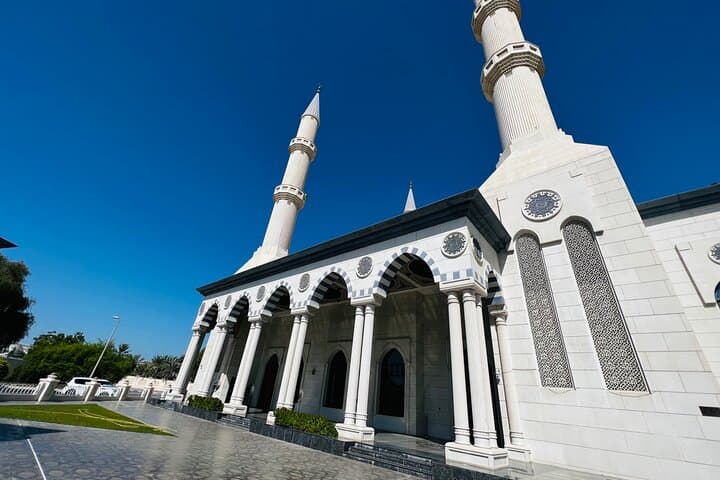
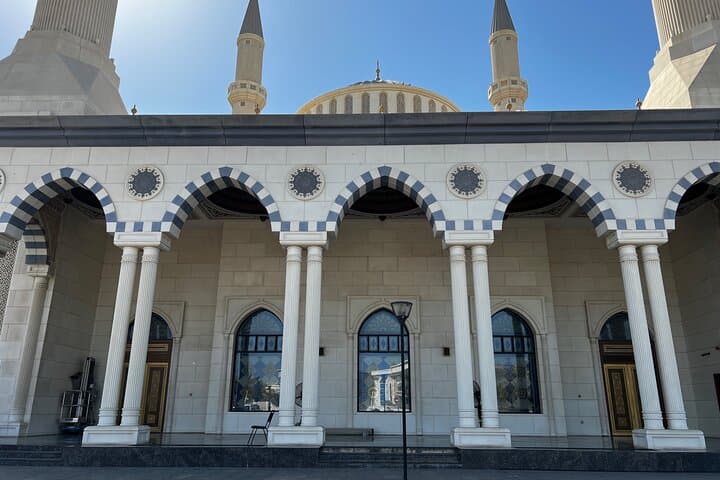
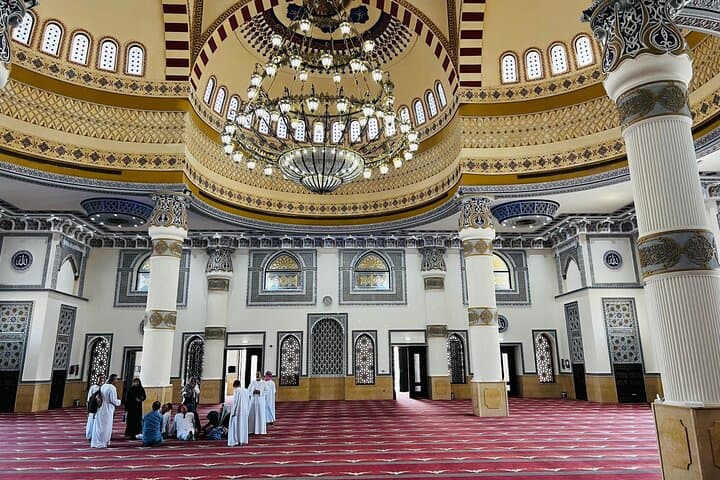
A dawn-lit Dubai Creek frames the morning: wooden abras slice through glassy water, calling travelers across a city that moves between glittering skyscrapers and timeworn souks. The tour opens in front of Al Farooq Omar bin Al Khattab Mosque, where the mosque’s pale stone and geometric callouts draw attention to Islam’s visible role in urban life.
A dawn-lit Dubai Creek frames the morning: wooden abras slice through glassy water, calling travelers across a city that moves between glittering skyscrapers and timeworn souks. The tour opens in front of Al Farooq Omar bin Al Khattab Mosque, where the mosque’s pale stone and geometric callouts draw attention to Islam’s visible role in urban life.
From there the route threads modern feats — Burj Al Arab’s curved silhouette, the engineered arc of Palm Jumeirah, and the Marina’s ordered facades — back to Al Fahidi’s wind-tower lanes. The Abra ride is a short, elemental crossing where the creek’s current seems to urge progress: a simple boat connecting eras.
Dubai’s story is recent acceleration built on pearling and trade routes; the spice and gold markets recall centuries of commerce that predate oil. Geologically the city sits on a coastal plain of reclaimed sand and shell, with human-made islands rewriting the shoreline. Cultural notes are straightforward: modest dress is expected at mosques, bargaining is part of the market rhythm, and Arabic coffee is a ritual of hospitality.
Practical guidance: expect six hours of walking and short transfers; plan for heat and bright sun by scheduling early starts, carrying water, and wearing closed-toe shoes for market alleys. Bring a modest scarf for mosque entry, small local currency for vendors, and a fully charged phone for photo stops at The Frame and Dubai Mall. The pace blends structured sightseeing with time for sensory, street-level exploration — a compact orientation to Dubai’s past and present.