THE ADVENTURE COLLECTIVE® · Independent discovery and booking for outdoor travel

Spend a full day traveling from Lisbon into Alentejo to explore Évora’s Roman and medieval core and two of Portugal’s most important megalithic sites. This private ten‑hour tour pairs guided city walks with open‑air archaeology and rolling rural scenery.
Spend a full day traveling from Lisbon into Alentejo to explore Évora’s Roman and medieval core and two of Portugal’s most important megalithic sites. This private ten‑hour tour pairs guided city walks with open‑air archaeology and rolling rural scenery.
You arrive on a flat, sun-baked plain where cork oaks and olive rows stretch to the horizon, the road slicing through a quiet, ordered landscape that has held human activity for millennia.
Verified experiences and guided adventures in the surrounding area.
Operated by Essência da Latitude Turismo Lda · Évora, Alentejo
You arrive on a flat, sun-baked plain where cork oaks and olive rows stretch to the horizon, the road slicing through a quiet, ordered landscape that has held human activity for millennia.
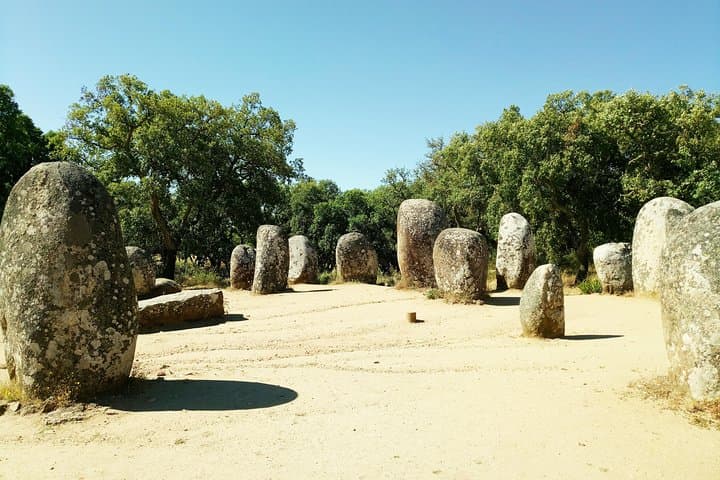
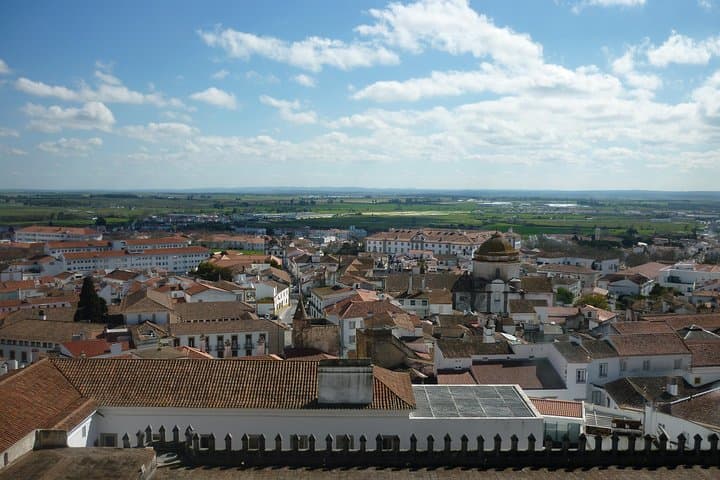
The day moves from Évora’s compact medieval streets to the open geometry of the Almendres Cromlech and the hulking chamber of the Anta Grande do Zambujeiro. In Évora, Roman ruins—most famously the Temple—and the 13th‑century cathedral press their stones into daily life: university students spill into cafés beneath lintelled doorways, and the Bones Chapel reminds visitors of continuity and mortality.
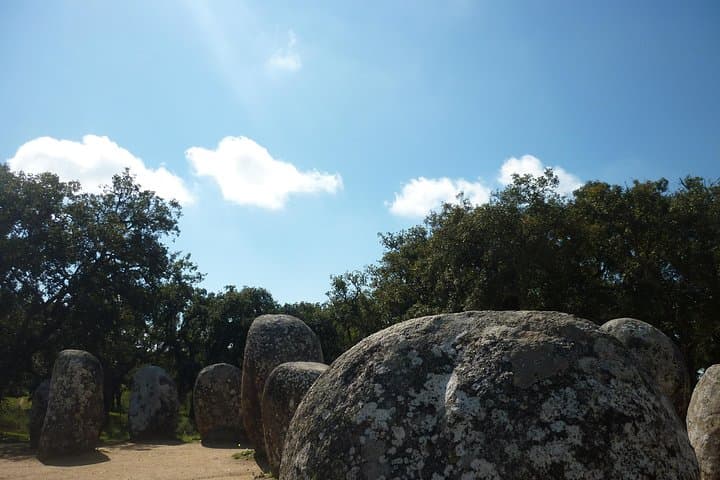
Geologically, the Alentejo plain sits on schist and granite outcrops; prehistoric communities used local stone to raise cromlechs aligned with seasonal sun events. Culturally, the region blends agrarian rhythms—vineyards, cork harvesting—and a cuisine built around slow‑cooked pork, bread, and local wines.
Practically, expect a ten‑hour private minivan itinerary with hotel pickup from Lisbon, three core stops and short guided walks at each site. There is minimal elevation gain but uneven footing at megalithic sites and cobbled streets in Évora; comfortable shoes are essential. Admission to monuments may be separate from the tour; bring water, sun protection, and a light layer for coastal winds near Lisbon. Photographs are welcome, but avoid climbing on fragile stones and follow guide instructions.
This trip pairs archaeology with rural scenery—ideal for travelers who want a single, well‑paced day that combines big ancient monuments and a compact, walkable UNESCO city.
easy.
10 hours.
Light activity; able to manage short walks on uneven ground and brief standing tours.
Most outdoor megalithic sites have no entry fee, but some museums in Évora (like the Cathedral or public monuments) may charge separately; check with the operator before you go.
Expect several short walks at each stop—typically 10–30 minutes across uneven surfaces—while most transit is by comfortable minivan.
Yes; infant seats are available on request and the tour is suitable for all fitness levels, but Portuguese law requires appropriate child restraints in vehicles.
The tour has a set start time with pickup from central Lisbon hotels or the cruise terminal; confirm your pickup point when booking and note that a 30‑minute delay may be treated as a no‑show.
Évora was a major urban center in Roman Lusitania and later a medieval religious and educational hub; the Almendres Cromlech and Anta Grande date to the Neolithic, thousands of years before Roman occupation.
The megalithic stones and surrounding cork oak landscapes are vulnerable to erosion and human impact—stay on paths, avoid touching engraved surfaces, and support local efforts that limit visitor pressure.
Essência da Latitude Turismo Lda operates guided outdoor trips and adventures with an emphasis on safety, stewardship, and memorable experiences.

You arrive on a flat, sun-baked plain where cork oaks and olive rows stretch to the horizon, the road slicing through a quiet, ordered landscape that has held human activity for millennia.
You arrive on a flat, sun-baked plain where cork oaks and olive rows stretch to the horizon, the road slicing through a quiet, ordered landscape that has held human activity for millennia.
The day moves from Évora’s compact medieval streets to the open geometry of the Almendres Cromlech and the hulking chamber of the Anta Grande do Zambujeiro. In Évora, Roman ruins—most famously the Temple—and the 13th‑century cathedral press their stones into daily life: university students spill into cafés beneath lintelled doorways, and the Bones Chapel reminds visitors of continuity and mortality.
Geologically, the Alentejo plain sits on schist and granite outcrops; prehistoric communities used local stone to raise cromlechs aligned with seasonal sun events. Culturally, the region blends agrarian rhythms—vineyards, cork harvesting—and a cuisine built around slow‑cooked pork, bread, and local wines.
Practically, expect a ten‑hour private minivan itinerary with hotel pickup from Lisbon, three core stops and short guided walks at each site. There is minimal elevation gain but uneven footing at megalithic sites and cobbled streets in Évora; comfortable shoes are essential. Admission to monuments may be separate from the tour; bring water, sun protection, and a light layer for coastal winds near Lisbon. Photographs are welcome, but avoid climbing on fragile stones and follow guide instructions.
This trip pairs archaeology with rural scenery—ideal for travelers who want a single, well‑paced day that combines big ancient monuments and a compact, walkable UNESCO city.