THE ADVENTURE COLLECTIVE® · Independent discovery and booking for outdoor travel

Cross three 5,300+m passes on a demanding 18-day circuit through the Khumbu. This trek links Everest Base Camp and Gokyo with remote high saddles, teahouse nights, and panoramic glacier views.
Cross three 5,300+m passes on a demanding 18-day circuit through the Khumbu. This trek links Everest Base Camp and Gokyo with remote high saddles, teahouse nights, and panoramic glacier views.
A thin blue line of ridgeline appears as the plane drops toward Lukla, and from that little airstrip the Khumbu opens—rock, moraine and an ordered chaos of prayer flags. The Everest Three Pass Trek threads through that raw geometry: high passes that test lungs and boots, turquoise Gokyo lakes that mirror Everest’s ice-plated face, and the stepped villages where Sherpa life continues at altitude.
Verified experiences and guided adventures in the surrounding area.
Operated by Nepal Himalayan Hiker (P) Ltd. · Lukla, Solukhumbu
A thin blue line of ridgeline appears as the plane drops toward Lukla, and from that little airstrip the Khumbu opens—rock, moraine and an ordered chaos of prayer flags. The Everest Three Pass Trek threads through that raw geometry: high passes that test lungs and boots, turquoise Gokyo lakes that mirror Everest’s ice-plated face, and the stepped villages where Sherpa life continues at altitude.
Geology here is recent and violent—Himalayan uplift drives jagged schist and granite into sharp arêtes, feeding glaciers that sculpt moraines and plunge into milky streams. Culturally the route crosses the heart of the Khumbu, through Namche Bazaar’s market bustle and monasteries that keep local calendars of festivals and yak schedules. The trek also passes within Sagarmatha National Park, a protected landscape with clearly posted permit requirements and conservation rules.
Practically: expect 15–18 days on trail depending on schedule, multiple nights in tea houses, and three major high passes—Kongma La (≈5,535m), Cho La (≈5,420m), Renjo La (≈5,360m). Weather shifts fast; snowfields can linger into spring and re-form in autumn. Acclimatization days are non-negotiable; plan for slow gains and contingency time for Lukla flights.
Gear and preparation matter: insulated layers, reliable high-ankle boots, a warm sleeping system for teahouse dorms, and experience with long days above 3,500 m. Hydrate proactively, know symptoms of acute mountain sickness, and carry park permits and a small first-aid kit. The route rewards steady pace with big views—glacial bowls, turquoise lakes, and summit faces that keep you moving forward, one careful step at a time.
difficult.
18 days.
Requires very good aerobic fitness and proven experience with multi-day mountain trekking at altitude
Yes: a Sagarmatha National Park entry permit and a TIMS card are required and checked along the route.
Pre-monsoon spring (March–May) and post-monsoon autumn (late Sept–Nov) offer the most stable weather and clearer views.
The route is non-technical in normal conditions, but basic crampon skills can be useful; guided groups may carry ropes if conditions dictate.
Ascend slowly, hydrate, avoid alcohol, use acclimatization days, and descend immediately if severe AMS symptoms appear; consider carrying acetazolamide after consulting a physician.
The Khumbu has long been home to Sherpa communities whose trading and mountaineering cultures grew with Himalayan expeditions; modern trekking routes evolved alongside early 20th-century explorations and mountaineering history.
The trail runs through Sagarmatha National Park — carry out all waste, use refillable containers, and respect local water and fuel scarcities to reduce environmental impact.
Nepal Himalayan Hiker (P) Ltd. operates guided outdoor trips and adventures with an emphasis on safety, stewardship, and memorable experiences.


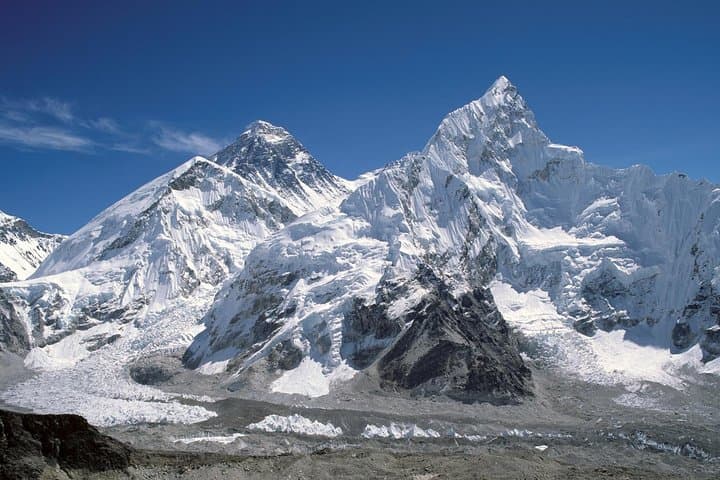
A thin blue line of ridgeline appears as the plane drops toward Lukla, and from that little airstrip the Khumbu opens—rock, moraine and an ordered chaos of prayer flags. The Everest Three Pass Trek threads through that raw geometry: high passes that test lungs and boots, turquoise Gokyo lakes that mirror Everest’s ice-plated face, and the stepped villages where Sherpa life continues at altitude.
A thin blue line of ridgeline appears as the plane drops toward Lukla, and from that little airstrip the Khumbu opens—rock, moraine and an ordered chaos of prayer flags. The Everest Three Pass Trek threads through that raw geometry: high passes that test lungs and boots, turquoise Gokyo lakes that mirror Everest’s ice-plated face, and the stepped villages where Sherpa life continues at altitude.
Geology here is recent and violent—Himalayan uplift drives jagged schist and granite into sharp arêtes, feeding glaciers that sculpt moraines and plunge into milky streams. Culturally the route crosses the heart of the Khumbu, through Namche Bazaar’s market bustle and monasteries that keep local calendars of festivals and yak schedules. The trek also passes within Sagarmatha National Park, a protected landscape with clearly posted permit requirements and conservation rules.
Practically: expect 15–18 days on trail depending on schedule, multiple nights in tea houses, and three major high passes—Kongma La (≈5,535m), Cho La (≈5,420m), Renjo La (≈5,360m). Weather shifts fast; snowfields can linger into spring and re-form in autumn. Acclimatization days are non-negotiable; plan for slow gains and contingency time for Lukla flights.
Gear and preparation matter: insulated layers, reliable high-ankle boots, a warm sleeping system for teahouse dorms, and experience with long days above 3,500 m. Hydrate proactively, know symptoms of acute mountain sickness, and carry park permits and a small first-aid kit. The route rewards steady pace with big views—glacial bowls, turquoise lakes, and summit faces that keep you moving forward, one careful step at a time.