THE ADVENTURE COLLECTIVE® · Independent discovery and booking for outdoor travel

See Mount Everest from the air and land for breakfast at Hotel Everest View on a half-day helicopter tour from Kathmandu. Early-morning departures maximize visibility and pack a high-altitude Himalayan primer into a single, unforgettable outing.
See Mount Everest from the air and land for breakfast at Hotel Everest View on a half-day helicopter tour from Kathmandu. Early-morning departures maximize visibility and pack a high-altitude Himalayan primer into a single, unforgettable outing.
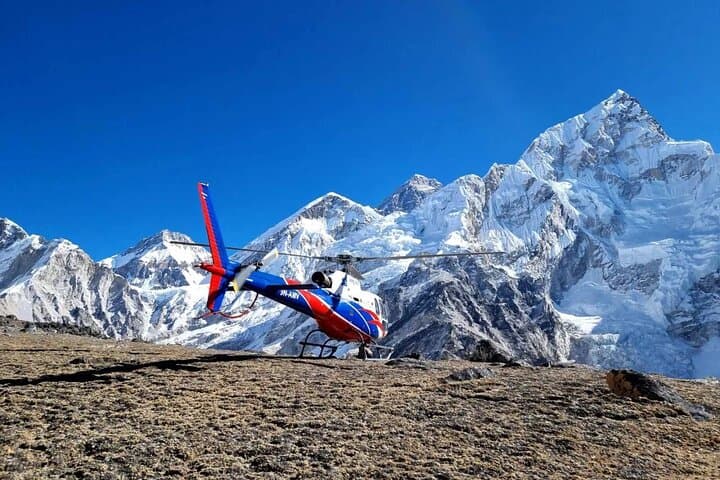
The rotors lift you above Kathmandu’s weaving rooftops before the valley drops away and the Himalaya pushes up like a broken line on the horizon. In the thin, cold air the mountains take on a startling clarity: Ama Dablam’s sharp ridge, the ragged sweep of the Khumbu Glacier, and then Everest itself, enormous and uncompromising.
Verified experiences and guided adventures in the surrounding area.
Operated by Breakfree Adventures Pvt. Ltd. · Kathmandu, Bagmati Province
The rotors lift you above Kathmandu’s weaving rooftops before the valley drops away and the Himalaya pushes up like a broken line on the horizon. In the thin, cold air the mountains take on a startling clarity: Ama Dablam’s sharp ridge, the ragged sweep of the Khumbu Glacier, and then Everest itself, enormous and uncompromising.
This one-day aerial trip follows a classic route used by climbers and trekkers: a refuel stop in Lukla, then over Namche Bazaar, Tengboche and the high trail to Dingboche, the helicopter skimming glacial bowls and moraine fields. Geologically the range is young and raw — uplifted rock and ice grinding into jagged summits — and culturally the flight traces Sherpa communities and Buddhist monasteries that have guided mountaineering since the early 20th century. You land at Syangboche near the Hotel Everest View (about 3,380 m) for breakfast with Everest framed behind the cup of tea.
Practical notes: flights depart at first light when visibility is best; weather cancels are common so build flexibility into your schedule. Dress in insulated layers, bring sunglasses and spare camera batteries (cold drains power fast). Expect brief walkouts on compacted snow at higher landings; the provider includes safety equipment and oxygen. Be mindful of altitude symptoms — even short stays above 3,000 m can affect some people — and follow crew guidance. For photographers and first-time visitors, this tour compresses the Everest approach into a single, cinematic morning: a high-speed primer on Himalayan scale, culture and geology with straightforward logistics and high safety standards.
easy.
4–7 hours.
No special fitness required; participants should be able to sit for extended periods and manage short, uneven snow or rock surfaces during landings.
Most shared flights perform flyovers of Everest Base Camp and Kala Patthar; some itineraries include a landing nearby such as Syangboche/Hotel Everest View but not at the Base Camp glacier itself.
Operators typically attempt a rebook the next available morning; full refunds are generally available if you cancel at least 24 hours ahead or if there’s no suitable alternative.
Shared helicopters commonly enforce weight limits per passenger for safety; booking requires passenger weight and age details—check with the operator in advance.
Tours state suitability for all ages but pregnant travelers should consult a physician and the operator due to altitude and emergency considerations.
The Khumbu region has been home to Sherpa communities for centuries and became internationally known during the early Everest expeditions of the 1950s; Sagarmatha National Park was designated in 1976 and is a UNESCO World Heritage site.
High-altitude tourism places pressure on fragile alpine environments and local resources—choose operators that support park fees, waste management, and community benefits to minimize impact.
Breakfree Adventures Pvt. Ltd. operates guided outdoor trips and adventures with an emphasis on safety, stewardship, and memorable experiences.


The rotors lift you above Kathmandu’s weaving rooftops before the valley drops away and the Himalaya pushes up like a broken line on the horizon. In the thin, cold air the mountains take on a startling clarity: Ama Dablam’s sharp ridge, the ragged sweep of the Khumbu Glacier, and then Everest itself, enormous and uncompromising.
The rotors lift you above Kathmandu’s weaving rooftops before the valley drops away and the Himalaya pushes up like a broken line on the horizon. In the thin, cold air the mountains take on a startling clarity: Ama Dablam’s sharp ridge, the ragged sweep of the Khumbu Glacier, and then Everest itself, enormous and uncompromising.
This one-day aerial trip follows a classic route used by climbers and trekkers: a refuel stop in Lukla, then over Namche Bazaar, Tengboche and the high trail to Dingboche, the helicopter skimming glacial bowls and moraine fields. Geologically the range is young and raw — uplifted rock and ice grinding into jagged summits — and culturally the flight traces Sherpa communities and Buddhist monasteries that have guided mountaineering since the early 20th century. You land at Syangboche near the Hotel Everest View (about 3,380 m) for breakfast with Everest framed behind the cup of tea.
Practical notes: flights depart at first light when visibility is best; weather cancels are common so build flexibility into your schedule. Dress in insulated layers, bring sunglasses and spare camera batteries (cold drains power fast). Expect brief walkouts on compacted snow at higher landings; the provider includes safety equipment and oxygen. Be mindful of altitude symptoms — even short stays above 3,000 m can affect some people — and follow crew guidance. For photographers and first-time visitors, this tour compresses the Everest approach into a single, cinematic morning: a high-speed primer on Himalayan scale, culture and geology with straightforward logistics and high safety standards.