THE ADVENTURE COLLECTIVE® · Independent discovery and booking for outdoor travel

See Mount Everest from a small sightseeing aircraft on a three-hour morning flight from Kathmandu. This aerial tour delivers close-up views of Everest, Nuptse, Pumori and the eastern Himalaya with minimal physical effort.
See Mount Everest from a small sightseeing aircraft on a three-hour morning flight from Kathmandu. This aerial tour delivers close-up views of Everest, Nuptse, Pumori and the eastern Himalaya with minimal physical effort.
You lift off from Kathmandu, the valley shrinking beneath a tidy grid of streets and stupas, and within minutes the Himalaya crowd the horizon — serrated ridgelines cutting the sky. The aircraft banks and entire mountain ranges unfold: Pumori and Nuptse at first, then the enormous, solitary silhouette of Everest rising above a sea of ice and shadow.
Verified experiences and guided adventures in the surrounding area.
Operated by Walk Mountain Pvt Ltd. · Kathmandu, Bagmati Province
You lift off from Kathmandu, the valley shrinking beneath a tidy grid of streets and stupas, and within minutes the Himalaya crowd the horizon — serrated ridgelines cutting the sky. The aircraft banks and entire mountain ranges unfold: Pumori and Nuptse at first, then the enormous, solitary silhouette of Everest rising above a sea of ice and shadow.
This flight follows the story of two colliding continents. The Himalaya are young in geological terms — the Indian Plate smashing northward into Eurasia — creating steep relief, active glaciers and frequent avalanches that shape the landscape you’re seeing from above. Culturally, these peaks carry names and meaning: Sagarmatha to Nepalis, Chomolungma to Tibetans. Nearby valleys host Sherpa communities and monasteries whose prayer flags flutter against the same winds that scour the ridgelines.
Expect an intense but brief experience: about three hours total, with 30–60 minutes of sustained mountain viewing depending on routing and conditions. Morning departures usually offer the clearest air; monsoon months bring cloud and cancellations. Flights don’t land on the range — the experience is visual and photographic — so plan for limited movement, cold cabin air and the photographic challenges of high-contrast snowfields.
Practical tips: book an early window seat, bring layers and sunscreen, store electronics safely, and carry your passport for airport processing. Flights have a carbon footprint and weather can cancel last-minute; treat this as a rare visual encounter with the world’s highest peaks rather than a summit. The flight rewards anyone who wants a close, panoramic perspective of the Himalaya without the time or risk of trekking to the high valleys.
easy.
3 hours.
No special fitness required; you should be able to sit for the duration and handle airport procedures.
Total trip time from Kathmandu is about three hours, with roughly 30–60 minutes of sustained mountain viewing depending on routing and conditions.
No — this is a sightseeing flight that circles and approaches the high peaks for viewing and photography; there is no landing on the range.
Early mornings in spring and autumn typically offer the clearest skies; monsoon months (June–August) bring more clouds and cancellations.
These flights are generally suitable for all fitness levels but infants may need to sit on a lap and passengers with respiratory or cardiac conditions should consult a doctor due to brief exposure to higher altitudes.
Mount Everest was first summited in 1953 by Sir Edmund Hillary and Tenzing Norgay; the mountain has long been sacred to local Himalayan cultures and features in Nepali and Tibetan names.
Aerial tours concentrate impact in the sky but still contribute to carbon emissions; support local conservation by choosing operators that follow airspace regulations and by offsetting travel emissions.
Walk Mountain Pvt Ltd. operates guided outdoor trips and adventures with an emphasis on safety, stewardship, and memorable experiences.
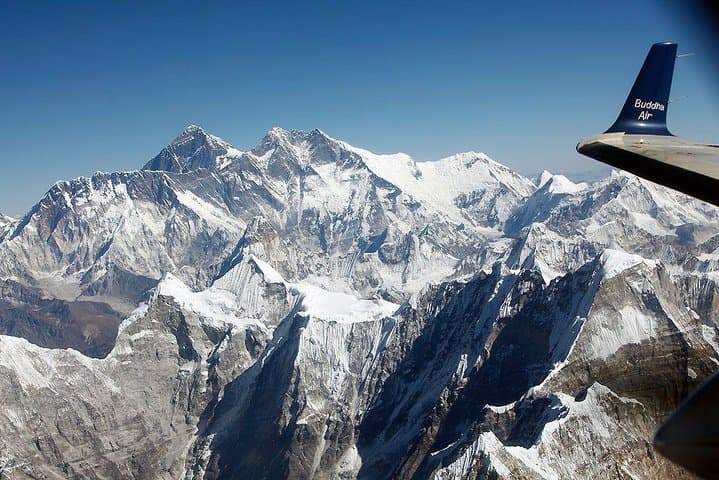
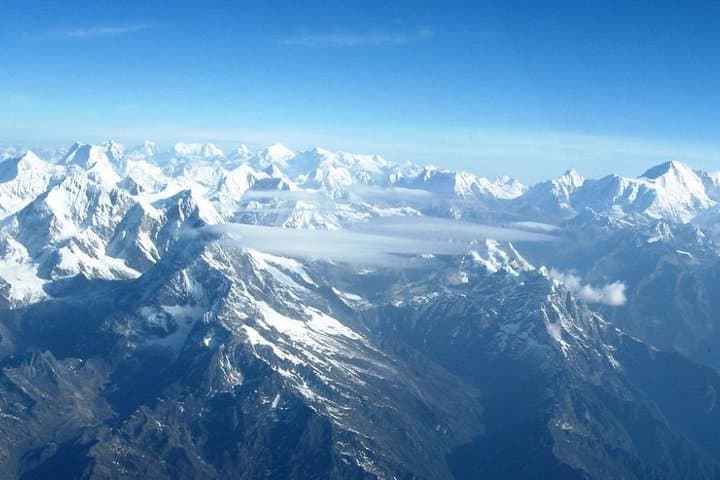
You lift off from Kathmandu, the valley shrinking beneath a tidy grid of streets and stupas, and within minutes the Himalaya crowd the horizon — serrated ridgelines cutting the sky. The aircraft banks and entire mountain ranges unfold: Pumori and Nuptse at first, then the enormous, solitary silhouette of Everest rising above a sea of ice and shadow.
You lift off from Kathmandu, the valley shrinking beneath a tidy grid of streets and stupas, and within minutes the Himalaya crowd the horizon — serrated ridgelines cutting the sky. The aircraft banks and entire mountain ranges unfold: Pumori and Nuptse at first, then the enormous, solitary silhouette of Everest rising above a sea of ice and shadow.
This flight follows the story of two colliding continents. The Himalaya are young in geological terms — the Indian Plate smashing northward into Eurasia — creating steep relief, active glaciers and frequent avalanches that shape the landscape you’re seeing from above. Culturally, these peaks carry names and meaning: Sagarmatha to Nepalis, Chomolungma to Tibetans. Nearby valleys host Sherpa communities and monasteries whose prayer flags flutter against the same winds that scour the ridgelines.
Expect an intense but brief experience: about three hours total, with 30–60 minutes of sustained mountain viewing depending on routing and conditions. Morning departures usually offer the clearest air; monsoon months bring cloud and cancellations. Flights don’t land on the range — the experience is visual and photographic — so plan for limited movement, cold cabin air and the photographic challenges of high-contrast snowfields.
Practical tips: book an early window seat, bring layers and sunscreen, store electronics safely, and carry your passport for airport processing. Flights have a carbon footprint and weather can cancel last-minute; treat this as a rare visual encounter with the world’s highest peaks rather than a summit. The flight rewards anyone who wants a close, panoramic perspective of the Himalaya without the time or risk of trekking to the high valleys.