THE ADVENTURE COLLECTIVE® · Independent discovery and booking for outdoor travel

Climb Etna’s north flank in a 4x4 from Piano Provenzana to Pizzi Deneri (≈2,810 m) and walk up to the summit craters and the 2002 eruption rim. Expect volcanic scree, wide coastal views and expert volcanology commentary.
Climb Etna’s north flank in a 4x4 from Piano Provenzana to Pizzi Deneri (≈2,810 m) and walk up to the summit craters and the 2002 eruption rim. Expect volcanic scree, wide coastal views and expert volcanology commentary.
Mist and wind thread through the lava fields as the 4x4 hums up the north flank of Etna. You leave the village of Piano Provenzana behind and climb an unpaved road that angles through black pumice and ancient lobate flows, the sea narrowing into a pale ribbon on the horizon.
Verified experiences and guided adventures in the surrounding area.
Operated by Alternativetna · Piano Provenzana, Sicily
Mist and wind thread through the lava fields as the 4x4 hums up the north flank of Etna. You leave the village of Piano Provenzana behind and climb an unpaved road that angles through black pumice and ancient lobate flows, the sea narrowing into a pale ribbon on the horizon.
This route takes you toward Pizzi Deneri at about 2,810 m; from there a short walk puts the summit craters and the broad chasm of the Valle del Bove in full view. Etna’s geology is immediate here — fresh scoria, layered tephra and welded lava create a landscape shaped by repeated eruptions from the central and flank vents. The massif has been active for millennia, its eruptions recorded in local lore and shaping nearby towns such as Linguaglossa.
Culturally, the slopes host mountain pastures, old shepherd tracks and tiny hamlets that reflect Sicily’s volcanic agriculture: vineyards and almond groves below, sparse alpine scrub higher up.
Practical guidance: tours typically top out near 2,805–2,865 m depending on activity, and include short guided walks (one ascent to 2,865 m and a 20-minute trek to the 2002 crater rim from ~2,200 m). Expect wind, rapid temperature changes, and uneven volcanic scree underfoot. Hydrate before the climb, wear sturdy footwear and layers, and allow time to acclimate if you’re sensitive to altitude. The guided format and 4x4 access make this accessible for most fit travelers, but those with cardiovascular issues or pregnancy should avoid it.
moderate.
2–3 hours.
Light-to-moderate fitness; able to walk 20–40 minutes on uneven, steep volcanic terrain at high altitude.
The 4x4 reaches around 2,810–2,850 m at Pizzi Deneri, with a short guided walk to view the summit craters depending on volcanic activity.
The vehicle access and short walks make it broadly accessible, but younger children and older adults should be comfortable with uneven terrain and altitude; infants must sit on laps as required.
Proximity to fresh lava depends on current volcanic activity and safety restrictions; guides keep groups at safe viewing distances and follow park regulations.
No technical hiking experience is required, but basic mobility on loose volcanic ground and the ability to handle short steep sections is necessary.
Mount Etna has been intermittently active for thousands of years; eruptions have periodically reshaped slopes and influenced settlement patterns on the island.
Etna is a protected regional park—stay on marked routes, pack out waste and avoid disturbing fragile volcanic soils and endemic plants.
Alternativetna operates guided outdoor trips and adventures with an emphasis on safety, stewardship, and memorable experiences.
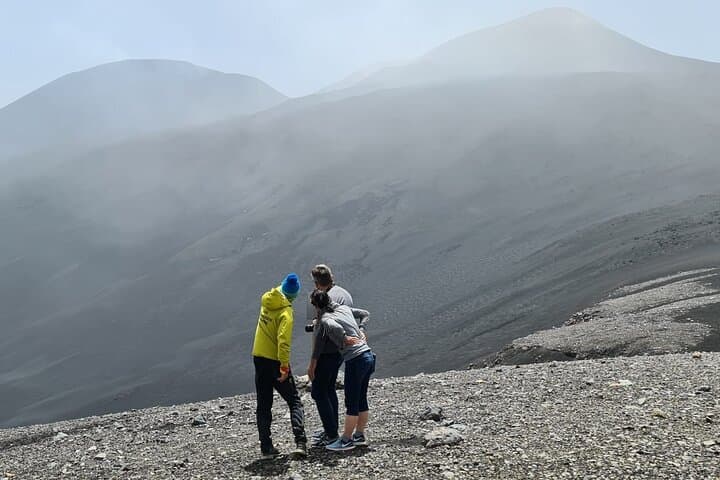
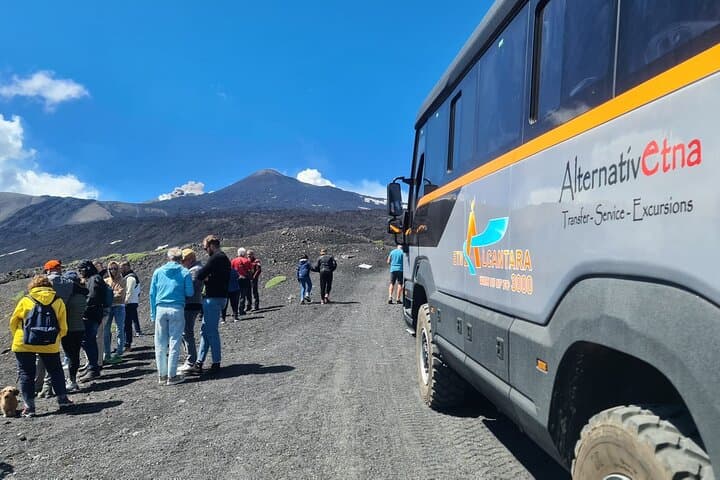
Mist and wind thread through the lava fields as the 4x4 hums up the north flank of Etna. You leave the village of Piano Provenzana behind and climb an unpaved road that angles through black pumice and ancient lobate flows, the sea narrowing into a pale ribbon on the horizon.
Mist and wind thread through the lava fields as the 4x4 hums up the north flank of Etna. You leave the village of Piano Provenzana behind and climb an unpaved road that angles through black pumice and ancient lobate flows, the sea narrowing into a pale ribbon on the horizon.
This route takes you toward Pizzi Deneri at about 2,810 m; from there a short walk puts the summit craters and the broad chasm of the Valle del Bove in full view. Etna’s geology is immediate here — fresh scoria, layered tephra and welded lava create a landscape shaped by repeated eruptions from the central and flank vents. The massif has been active for millennia, its eruptions recorded in local lore and shaping nearby towns such as Linguaglossa.
Culturally, the slopes host mountain pastures, old shepherd tracks and tiny hamlets that reflect Sicily’s volcanic agriculture: vineyards and almond groves below, sparse alpine scrub higher up.
Practical guidance: tours typically top out near 2,805–2,865 m depending on activity, and include short guided walks (one ascent to 2,865 m and a 20-minute trek to the 2002 crater rim from ~2,200 m). Expect wind, rapid temperature changes, and uneven volcanic scree underfoot. Hydrate before the climb, wear sturdy footwear and layers, and allow time to acclimate if you’re sensitive to altitude. The guided format and 4x4 access make this accessible for most fit travelers, but those with cardiovascular issues or pregnancy should avoid it.