THE ADVENTURE COLLECTIVE® · Independent discovery and booking for outdoor travel

Climb Mount Etna on a guided, small-group trek to the base of the summit craters, explore a lava tube and learn the story of the 2002–2003 eruption. This half-day high-altitude hike combines up-close volcanic activity with panoramic views of the Valle del Bove.
Climb Mount Etna on a guided, small-group trek to the base of the summit craters, explore a lava tube and learn the story of the 2002–2003 eruption. This half-day high-altitude hike combines up-close volcanic activity with panoramic views of the Valle del Bove.
You step out of the cable-car wind and the world changes — the pines fall away and a raw, ash-swept landscape opens under a high, thin sky. Scree crunches underfoot as the guide points to steam rising from a rim of jagged rock: these are Etna’s summit craters, alive and breathing.
Verified experiences and guided adventures in the surrounding area.
Operated by Trip on Top / Official Etna Guides · Nicolosi, Sicily
You step out of the cable-car wind and the world changes — the pines fall away and a raw, ash-swept landscape opens under a high, thin sky. Scree crunches underfoot as the guide points to steam rising from a rim of jagged rock: these are Etna’s summit craters, alive and breathing.
The route follows the volcano’s recent history: a quick ascent by cable car to about 2,500 m, then a steady climb on volcanic ash to the base of the summit at roughly 3,000 m. Along the way you’ll pass the theater of the 2002–2003 eruption, examine fresh lava flows and enter a cooled lava tunnel where textures and cooling features read like pages of geological time. From the higher ridgelines the Valle del Bove unfolds — a vast collapsed flank that records repeated flank failures and long-term growth of Etna.
Culturally, Etna has shaped local agriculture, myths and Catania’s skyline for millennia; your volcanological guide will weave eruption science with local stories and safety briefings. Expect mixed terrain: compacted ash, loose scoria, occasional rocky steps and short slopes exposed to wind.
Practical: plan for rapid temperature change and strong sun at altitude, bring layered clothing, sturdy boots and at least 1.5–2 liters of water. The trek is high-altitude non-technical hiking but demanding on cardio and knees; helmets are supplied and guides monitor volcanic conditions. Tours run in small groups and usually return by cable car — timing depends on weather and volcanic advisories.
challenging.
5–6 hours.
Moderate to good cardiovascular fitness; comfortable hiking on loose scree and uneven ground.
The excursion reaches the base of Etna’s summit craters at approximately 3,000 meters, with a cable-car lift to about 2,500 meters followed by on-foot ascent.
This is non-technical high-altitude hiking; helmets are provided and no ropes or technical climbing equipment are required.
Participants should be at least 10 years old and have moderate fitness; the tour is not recommended for pregnant travelers or those with serious heart or back problems.
Guides constantly assess volcanic conditions; the operator may modify or cancel the tour for safety and typically offers refunds if cancelled at short notice.
Etna is one of the world’s most active volcanoes with recorded eruptions since antiquity; the tour highlights the dramatic 2002–2003 eruptive phase and its lava fields.
Stick to marked routes, avoid collecting rocks or disturbing vegetation, and follow guide instructions to limit erosion and preserve fragile volcanic features.
Trip on Top / Official Etna Guides operates guided outdoor trips and adventures with an emphasis on safety, stewardship, and memorable experiences.

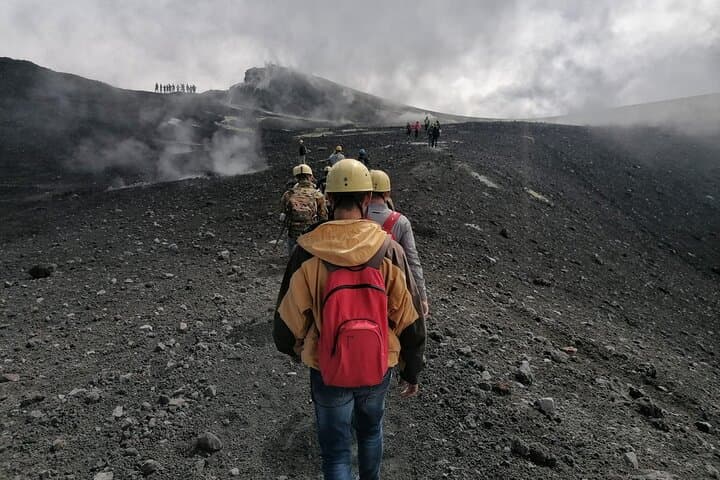


You step out of the cable-car wind and the world changes — the pines fall away and a raw, ash-swept landscape opens under a high, thin sky. Scree crunches underfoot as the guide points to steam rising from a rim of jagged rock: these are Etna’s summit craters, alive and breathing.
You step out of the cable-car wind and the world changes — the pines fall away and a raw, ash-swept landscape opens under a high, thin sky. Scree crunches underfoot as the guide points to steam rising from a rim of jagged rock: these are Etna’s summit craters, alive and breathing.
The route follows the volcano’s recent history: a quick ascent by cable car to about 2,500 m, then a steady climb on volcanic ash to the base of the summit at roughly 3,000 m. Along the way you’ll pass the theater of the 2002–2003 eruption, examine fresh lava flows and enter a cooled lava tunnel where textures and cooling features read like pages of geological time. From the higher ridgelines the Valle del Bove unfolds — a vast collapsed flank that records repeated flank failures and long-term growth of Etna.
Culturally, Etna has shaped local agriculture, myths and Catania’s skyline for millennia; your volcanological guide will weave eruption science with local stories and safety briefings. Expect mixed terrain: compacted ash, loose scoria, occasional rocky steps and short slopes exposed to wind.
Practical: plan for rapid temperature change and strong sun at altitude, bring layered clothing, sturdy boots and at least 1.5–2 liters of water. The trek is high-altitude non-technical hiking but demanding on cardio and knees; helmets are supplied and guides monitor volcanic conditions. Tours run in small groups and usually return by cable car — timing depends on weather and volcanic advisories.