THE ADVENTURE COLLECTIVE® · Independent discovery and booking for outdoor travel

Ride a dromedary along Essaouira’s Atlantic shore for two hours of steady steps, coastal views, and historical markers like the Portuguese borj. This easy, private experience mixes gentle terrain with cultural insights—ideal for travelers seeking a relaxed, photogenic outing.
Ride a dromedary along Essaouira’s Atlantic shore for two hours of steady steps, coastal views, and historical markers like the Portuguese borj. This easy, private experience mixes gentle terrain with cultural insights—ideal for travelers seeking a relaxed, photogenic outing.
The Atlantic wind tugs at your scarf as a patient dromedary rises from the hard-packed sand; the beach opens ahead in a long, pale ribbon and the town’s low fort appears like an old map marker. On this two-hour camel ride outside Essaouira, the pace is unhurried—steady steps, shifting light, the surf daring you to look away.
Verified experiences and guided adventures in the surrounding area.
Operated by Lima Dromadaires · Essaouira, Marrakech-Safi
The Atlantic wind tugs at your scarf as a patient dromedary rises from the hard-packed sand; the beach opens ahead in a long, pale ribbon and the town’s low fort appears like an old map marker. On this two-hour camel ride outside Essaouira, the pace is unhurried—steady steps, shifting light, the surf daring you to look away.
Essaouira (formerly Mogador) bears layers of history: a 16th-century Portuguese borj along the shoreline, centuries of maritime trade, and a culture shaped by fishing, argan harvests, and Saharan routes that once relied on camels. Geologically the coast is defined by long sandy spits, wind-swept dunes, and a thin coastal forest that interrupts the beach with low, salt-tolerant shrubs.
Local guides weave cultural notes into the ride, pointing out Dar Soltane’s ruins and small oyster beds while offering a traditional darâa shawl for shade. The route alternates between firm wet sand at low tide and compacted tracks into the coastal scrub—no serious climbs, just gentle undulations and changing vistas.
Practical details: plan for roughly 6–10 km of ground covered at a slow walking pace, zero technical skill required, and minimal elevation gain. Bring sun protection, a refillable water bottle, and a small camera; closed-toe shoes are helpful for mounting and dismounting. The operator provides a shawl, accepts service animals, and requires infants to sit on laps. Travelers with cardiovascular concerns should avoid riding. Bookings are private with instant confirmation and a 24-hour cancellation window.
This is an easy, sensory coastal ride: low exertion, high vista payoff, and a direct way to feel Essaouira’s wind-carved coastline from an age-old saddle.
easy.
2 hours.
Suitable for all fitness levels; requires ability to mount/dismount a camel and sit comfortably for two hours.
The operator meets guests at a designated reception point in Essaouira—your booking will list the exact pickup or meeting location and public transport options are nearby.
Infants are allowed but must sit on an adult’s lap; operators often set age or weight limits, so check during booking.
Guides are experienced with camels and lead the group for safety; standard local liability policies typically apply—confirm details with the provider before booking.
Yes—guides schedule brief stops for photos at key viewpoints such as the Portuguese borj and coastal ruins, but follow their timing to keep the itinerary on schedule.
Essaouira, once called Mogador, developed as a fortified port with Portuguese and Moroccan influences; camels were historically important to regional trade routes.
Stick to designated tracks, avoid disturbing shorelife, and support local argan cooperatives to ensure tourism benefits the coastal environment and communities.
Lima Dromadaires operates guided outdoor trips and adventures with an emphasis on safety, stewardship, and memorable experiences.


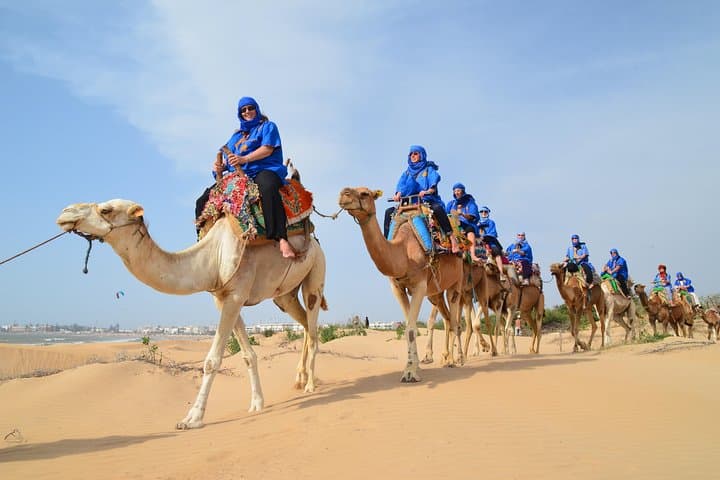

The Atlantic wind tugs at your scarf as a patient dromedary rises from the hard-packed sand; the beach opens ahead in a long, pale ribbon and the town’s low fort appears like an old map marker. On this two-hour camel ride outside Essaouira, the pace is unhurried—steady steps, shifting light, the surf daring you to look away.
The Atlantic wind tugs at your scarf as a patient dromedary rises from the hard-packed sand; the beach opens ahead in a long, pale ribbon and the town’s low fort appears like an old map marker. On this two-hour camel ride outside Essaouira, the pace is unhurried—steady steps, shifting light, the surf daring you to look away.
Essaouira (formerly Mogador) bears layers of history: a 16th-century Portuguese borj along the shoreline, centuries of maritime trade, and a culture shaped by fishing, argan harvests, and Saharan routes that once relied on camels. Geologically the coast is defined by long sandy spits, wind-swept dunes, and a thin coastal forest that interrupts the beach with low, salt-tolerant shrubs.
Local guides weave cultural notes into the ride, pointing out Dar Soltane’s ruins and small oyster beds while offering a traditional darâa shawl for shade. The route alternates between firm wet sand at low tide and compacted tracks into the coastal scrub—no serious climbs, just gentle undulations and changing vistas.
Practical details: plan for roughly 6–10 km of ground covered at a slow walking pace, zero technical skill required, and minimal elevation gain. Bring sun protection, a refillable water bottle, and a small camera; closed-toe shoes are helpful for mounting and dismounting. The operator provides a shawl, accepts service animals, and requires infants to sit on laps. Travelers with cardiovascular concerns should avoid riding. Bookings are private with instant confirmation and a 24-hour cancellation window.
This is an easy, sensory coastal ride: low exertion, high vista payoff, and a direct way to feel Essaouira’s wind-carved coastline from an age-old saddle.