THE ADVENTURE COLLECTIVE® · Independent discovery and booking for outdoor travel

Play castaway for a day on a private 48-acre island in the Waccamaw River. Teams compete in SURVIVOR-style challenges led by a guide, combining light navigation, teamwork, and Lowcountry scenery.
Play castaway for a day on a private 48-acre island in the Waccamaw River. Teams compete in SURVIVOR-style challenges led by a guide, combining light navigation, teamwork, and Lowcountry scenery.
You step off the skiff onto a narrow sand spit and the river exhales behind you — dark, slow-moving water edging stands of bald cypress and wax myrtle. The island opens into fields and shaded hollows across roughly 48 acres, and for the next four hours you become part strategist, part athlete, part island explorer.
Verified experiences and guided adventures in the surrounding area.
You step off the skiff onto a narrow sand spit and the river exhales behind you — dark, slow-moving water edging stands of bald cypress and wax myrtle. The island opens into fields and shaded hollows across roughly 48 acres, and for the next four hours you become part strategist, part athlete, part island explorer.
The Waccamaw River is a classic Lowcountry blackwater system carved through the Atlantic coastal plain. The island sits in a landscape shaped by slow sedimentation and tidal influence, where cypress knees punctuate marshy margins and the cultural imprint of the Waccamaw and Gullah-Geechee communities lingers in place names and coastal skills. Locally, these islands were used for hunting, fishing, and seasonal campgrounds for generations before being parcelled for private use.
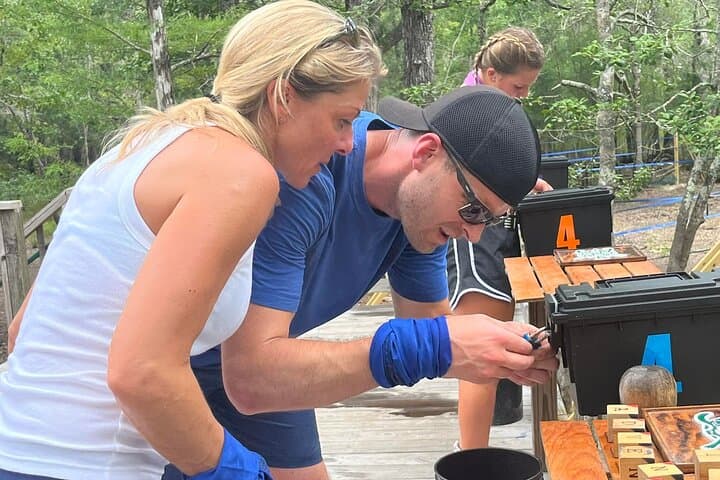
On this experience teams of 2–3 compete in SURVIVOR-style challenges — problem-solving, simple physical puzzles, and clue hunts — with a guide on the island the whole time. Expect uneven terrain: sandy spits, compacted trails, low shrubs, and occasional muddy patches. Wildlife is present but non-confrontational: shorebirds, turtles, and small mammals are the more likely sightings.
Practical guidance: wear closed-toe shoes with grip, bring 1–2 liters of water, and use insect repellent during warm months. The operator provides briefing and safety oversight but participants should be prepared for sun exposure, quick changes in weather, and short boat transfers. If you want a punctuated, social outdoor challenge that mixes navigation, teamwork, and Lowcountry scenery, this is a compact, well-guided way to play castaway without staying overnight.
moderate.
4 hours.
Moderate fitness for short bursts of activity, walking over uneven ground, and light physical challenges.
The experience lasts about four hours including boat transfers and on-island challenges.
No technical skills are needed; the host provides instructions and supervises all challenges.
Sturdy, closed-toe shoes, quick-dry clothing, and a hat; expect some walking on sand and uneven ground.
Facilities are limited; operators typically provide guidance—plan accordingly before departure.
The Waccamaw River corridor is historically tied to the Waccamaw people and later Lowcountry plantation economies; small islands served as hunting and fishing sites before private ownership.
This stretch of river is sensitive to runoff and boat wake; operators often limit group size to reduce impact and protect shoreline vegetation.
You step off the skiff onto a narrow sand spit and the river exhales behind you — dark, slow-moving water edging stands of bald cypress and wax myrtle. The island opens into fields and shaded hollows across roughly 48 acres, and for the next four hours you become part strategist, part athlete, part island explorer.
You step off the skiff onto a narrow sand spit and the river exhales behind you — dark, slow-moving water edging stands of bald cypress and wax myrtle. The island opens into fields and shaded hollows across roughly 48 acres, and for the next four hours you become part strategist, part athlete, part island explorer.
The Waccamaw River is a classic Lowcountry blackwater system carved through the Atlantic coastal plain. The island sits in a landscape shaped by slow sedimentation and tidal influence, where cypress knees punctuate marshy margins and the cultural imprint of the Waccamaw and Gullah-Geechee communities lingers in place names and coastal skills. Locally, these islands were used for hunting, fishing, and seasonal campgrounds for generations before being parcelled for private use.
On this experience teams of 2–3 compete in SURVIVOR-style challenges — problem-solving, simple physical puzzles, and clue hunts — with a guide on the island the whole time. Expect uneven terrain: sandy spits, compacted trails, low shrubs, and occasional muddy patches. Wildlife is present but non-confrontational: shorebirds, turtles, and small mammals are the more likely sightings.
Practical guidance: wear closed-toe shoes with grip, bring 1–2 liters of water, and use insect repellent during warm months. The operator provides briefing and safety oversight but participants should be prepared for sun exposure, quick changes in weather, and short boat transfers. If you want a punctuated, social outdoor challenge that mixes navigation, teamwork, and Lowcountry scenery, this is a compact, well-guided way to play castaway without staying overnight.