THE ADVENTURE COLLECTIVE® · Independent discovery and booking for outdoor travel

This private day tour from Palermo combines Segesta’s Doric temple, medieval Erice and the evocative Trapani salt pans into a 5–6 hour cultural route. Ideal for photographers and history fans, the itinerary pairs short walks with dramatic coastal views.
This private day tour from Palermo combines Segesta’s Doric temple, medieval Erice and the evocative Trapani salt pans into a 5–6 hour cultural route. Ideal for photographers and history fans, the itinerary pairs short walks with dramatic coastal views.
A salt wind lifts off the sea as the minivan threads west from Palermo, the coast shrinking into terraces of olive and carob. Within an hour the Doric silhouette of Segesta appears atop a lone hill: its temple stands like a classical marker of the island’s Greek past, sun-bleached and stubborn against time. Later, stone alleys in Erice narrow to a hush; the castle’s battlements lay the coastline at your feet, and the Egadi Islands hover on the horizon.
Verified experiences and guided adventures in the surrounding area.
Operated by Taxi cab Palermo · Erice, Sicily
A salt wind lifts off the sea as the minivan threads west from Palermo, the coast shrinking into terraces of olive and carob. Within an hour the Doric silhouette of Segesta appears atop a lone hill: its temple stands like a classical marker of the island’s Greek past, sun-bleached and stubborn against time. Later, stone alleys in Erice narrow to a hush; the castle’s battlements lay the coastline at your feet, and the Egadi Islands hover on the horizon.
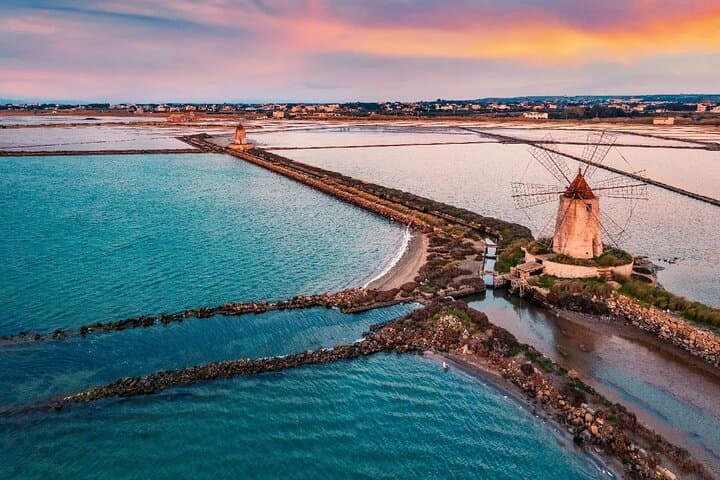
Segesta’s temple and theatre date to Magna Graecia—architecture placed deliberately on high ground to dominate the valley below. Erice sits on volcanic Monte San Giuliano; its cobbles and churches reflect Norman, Arab and Spanish layers of rule. The Trapani salt pans are geological and cultural: shallow evaporation basins shaped by Mediterranean wind and generations of salt harvesters, complete with working windmills that slice the late light.
Expect short walks and photo stops rather than strenuous hiking—stairs and cobbles in Erice and flat, open salt flats at Trapani. History and geology are on equal display: limestone temples, volcanic ridgelines, and coastal lagoons that attract flocks of birds.
Practical edge: bring sturdy shoes for cobbles, sun protection for exposed salt flats, and a light wind layer for the ridge-top breeze. Plan to arrive at the salt pans at golden hour for the most dramatic reflections. The private transfer from Palermo makes the route accessible in a long half-day (5–6 hours) and suits travelers wanting a compact, culture-rich snapshot of western Sicily.
easy.
5–6 hours.
Suitable for most travelers who can manage short walking stretches and stairs; no sustained exertion required
The private tour lasts approximately 5–6 hours, depending on traffic and how long you spend at each stop.
The tour typically includes stops and viewing time; archaeological site entrance fees are not always included—confirm with the operator.
This is a low-intensity tour, but Erice has steep, cobbled streets and stairs; those with mobility issues should plan accordingly and may require assistance.
As a private tour, the driver can often adjust timing and stops within the scheduled window—ask about any specific interests when booking.
Segesta was a major Elymian city with Greek-built monuments; Erice’s layered architecture reflects Phoenician, Greek, Roman, Arab and Norman influences.
The Trapani salt pans are managed as a nature reserve balancing traditional salt production with habitat protection for migratory birds; visitors should avoid walking on salt crystallization beds.
Taxi cab Palermo operates guided outdoor trips and adventures with an emphasis on safety, stewardship, and memorable experiences.


A salt wind lifts off the sea as the minivan threads west from Palermo, the coast shrinking into terraces of olive and carob. Within an hour the Doric silhouette of Segesta appears atop a lone hill: its temple stands like a classical marker of the island’s Greek past, sun-bleached and stubborn against time. Later, stone alleys in Erice narrow to a hush; the castle’s battlements lay the coastline at your feet, and the Egadi Islands hover on the horizon.
A salt wind lifts off the sea as the minivan threads west from Palermo, the coast shrinking into terraces of olive and carob. Within an hour the Doric silhouette of Segesta appears atop a lone hill: its temple stands like a classical marker of the island’s Greek past, sun-bleached and stubborn against time. Later, stone alleys in Erice narrow to a hush; the castle’s battlements lay the coastline at your feet, and the Egadi Islands hover on the horizon.
Segesta’s temple and theatre date to Magna Graecia—architecture placed deliberately on high ground to dominate the valley below. Erice sits on volcanic Monte San Giuliano; its cobbles and churches reflect Norman, Arab and Spanish layers of rule. The Trapani salt pans are geological and cultural: shallow evaporation basins shaped by Mediterranean wind and generations of salt harvesters, complete with working windmills that slice the late light.
Expect short walks and photo stops rather than strenuous hiking—stairs and cobbles in Erice and flat, open salt flats at Trapani. History and geology are on equal display: limestone temples, volcanic ridgelines, and coastal lagoons that attract flocks of birds.
Practical edge: bring sturdy shoes for cobbles, sun protection for exposed salt flats, and a light wind layer for the ridge-top breeze. Plan to arrive at the salt pans at golden hour for the most dramatic reflections. The private transfer from Palermo makes the route accessible in a long half-day (5–6 hours) and suits travelers wanting a compact, culture-rich snapshot of western Sicily.