THE ADVENTURE COLLECTIVE® · Independent discovery and booking for outdoor travel

Walk the marble streets of Ephesus with a private guide—see Celsus Library, the Grand Theatre and the Terrace Houses, then visit the serene House of the Virgin Mary. This shore excursion combines history with practical logistics for cruise travelers.
Walk the marble streets of Ephesus with a private guide—see Celsus Library, the Grand Theatre and the Terrace Houses, then visit the serene House of the Virgin Mary. This shore excursion combines history with practical logistics for cruise travelers.
You step off the tender and the Aegean air pushes at your sleeves; within 30 minutes you’re winding through olive groves and scrub toward stone streets walked by Romans two millennia ago. The approach to Ephesus moves from low coastal plain to the broad sweep of ruins where marble steps slope toward the sea that has long since retreated.
Verified experiences and guided adventures in the surrounding area.
Operated by Catch Up Turkey · Selçuk, İzmir Province
You step off the tender and the Aegean air pushes at your sleeves; within 30 minutes you’re winding through olive groves and scrub toward stone streets walked by Romans two millennia ago. The approach to Ephesus moves from low coastal plain to the broad sweep of ruins where marble steps slope toward the sea that has long since retreated.
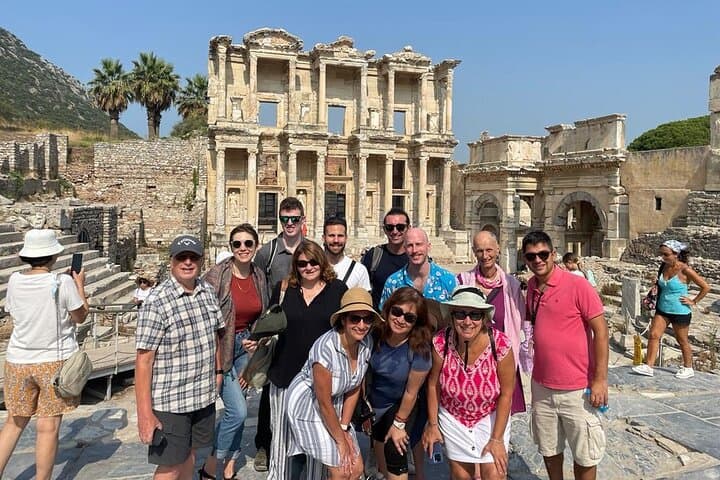
Ephesus was a major port and commercial center in Roman Asia Minor. Its marble-paved Curetes Street leads to the Biblioteca of Celsus (2nd century CE) and the Grand Theatre, which could hold roughly 25,000 spectators. Nearby, the Terrace Houses reveal frescoes and mosaics that map elite domestic life, while the House of the Virgin Mary sits higher on Mt. Koressos—a short drive and a brief climb above Selçuk.
Culturally the area mixes Ottoman-era Selçuk and modern Turkish coastal life; Temple of Artemis lies a short distance away, remembered more for its legendary status than surviving stones. Geology here is sediment-filled plain; the former harbor silted over, preserving architecture but leaving the coastline further away.
Practical guidance: the route through the site is roughly 2–3 km of mostly uneven marble and packed-earth walking with several stair sections — allow 2–3 hours on site. Bring a refillable water bottle, sun protection, and sturdy shoes; admission to national archaeological sites is typically paid on arrival unless included. Private tours from Kusadasi usually include pickup and return within cruise timelines, but confirm pickup time with your guide. Peak hours are late morning; aim for early shore arrivals to avoid heat and crowds.
moderate.
3–6 hours (including transfers).
Suitable for travelers who can walk 2–3 km on uneven ground and climb stairs; not strenuous but requires steady balance.
The transfer typically takes 20–40 minutes depending on traffic and exact pickup point; private transfers are timed to match cruise schedules.
This tour notes admission is not included; plan to pay site entrance on arrival unless your booking specifies otherwise.
It involves a short uphill walk and steps; most visitors complete it in 30–45 minutes with occasional rests — accessible by vehicle to the shrine area.
Parts of the site are uneven and have steps; strollers are possible in some areas but wheelchair access is limited—check with your operator for assistance options.
Ephesus was a major Roman metropolis and previously an Ionian city; its harbor silted over across centuries, shifting its urban layout away from the sea.
Ephesus is managed by Turkish authorities with active conservation projects; stay on marked paths to protect delicate mosaics and remains.
Catch Up Turkey operates guided outdoor trips and adventures with an emphasis on safety, stewardship, and memorable experiences.

You step off the tender and the Aegean air pushes at your sleeves; within 30 minutes you’re winding through olive groves and scrub toward stone streets walked by Romans two millennia ago. The approach to Ephesus moves from low coastal plain to the broad sweep of ruins where marble steps slope toward the sea that has long since retreated.
You step off the tender and the Aegean air pushes at your sleeves; within 30 minutes you’re winding through olive groves and scrub toward stone streets walked by Romans two millennia ago. The approach to Ephesus moves from low coastal plain to the broad sweep of ruins where marble steps slope toward the sea that has long since retreated.
Ephesus was a major port and commercial center in Roman Asia Minor. Its marble-paved Curetes Street leads to the Biblioteca of Celsus (2nd century CE) and the Grand Theatre, which could hold roughly 25,000 spectators. Nearby, the Terrace Houses reveal frescoes and mosaics that map elite domestic life, while the House of the Virgin Mary sits higher on Mt. Koressos—a short drive and a brief climb above Selçuk.
Culturally the area mixes Ottoman-era Selçuk and modern Turkish coastal life; Temple of Artemis lies a short distance away, remembered more for its legendary status than surviving stones. Geology here is sediment-filled plain; the former harbor silted over, preserving architecture but leaving the coastline further away.
Practical guidance: the route through the site is roughly 2–3 km of mostly uneven marble and packed-earth walking with several stair sections — allow 2–3 hours on site. Bring a refillable water bottle, sun protection, and sturdy shoes; admission to national archaeological sites is typically paid on arrival unless included. Private tours from Kusadasi usually include pickup and return within cruise timelines, but confirm pickup time with your guide. Peak hours are late morning; aim for early shore arrivals to avoid heat and crowds.