THE ADVENTURE COLLECTIVE® · Independent discovery and booking for outdoor travel

Ride camels across the Elsen Tasarkhai “Mini Gobi,” explore Kharkhorin’s Erdene Zuu Monastery and a living nomadic culture on a compact 2-day loop. Expect sandy ridgelines, unpaved drives, and an overnight ger camp.
Ride camels across the Elsen Tasarkhai “Mini Gobi,” explore Kharkhorin’s Erdene Zuu Monastery and a living nomadic culture on a compact 2-day loop. Expect sandy ridgelines, unpaved drives, and an overnight ger camp.
The first light hits the ridges of Elsen Tasarkhai and the sand takes on a measured, orange hush. You stand at the lip of a low dune field — the so-called "Mini Gobi" — where wind has sculpted waves of sand that push up against grassland and the dark silhouette of the Khugnu Khan Mountains.
Verified experiences and guided adventures in the surrounding area.
Operated by Augi's Travel · Kharkhorin, Övörkhangai Province
The first light hits the ridges of Elsen Tasarkhai and the sand takes on a measured, orange hush. You stand at the lip of a low dune field — the so-called "Mini Gobi" — where wind has sculpted waves of sand that push up against grassland and the dark silhouette of the Khugnu Khan Mountains.
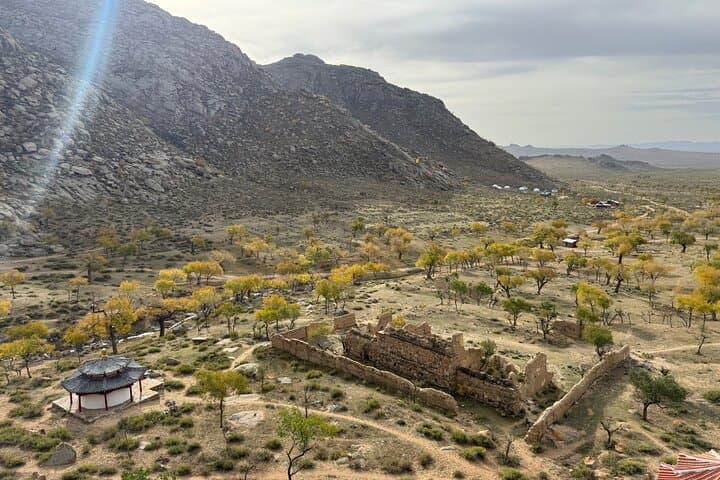
This two-day loop pairs that raw desert edge with Mongolia’s deep past. Kharkhorin (ancient Karakorum) sits nearby, once the Mongol Empire’s capital; Erdene Zuu Monastery, founded in 1586 within the ruins of Karakorum, anchors the area with white stupas and weathered temples. Geologically, the dunes are wind-blown and locally confined by alluvial plains and mountain runoff, giving sharp contrasts: soft sand, scrub grass, and volcanic outcrops.
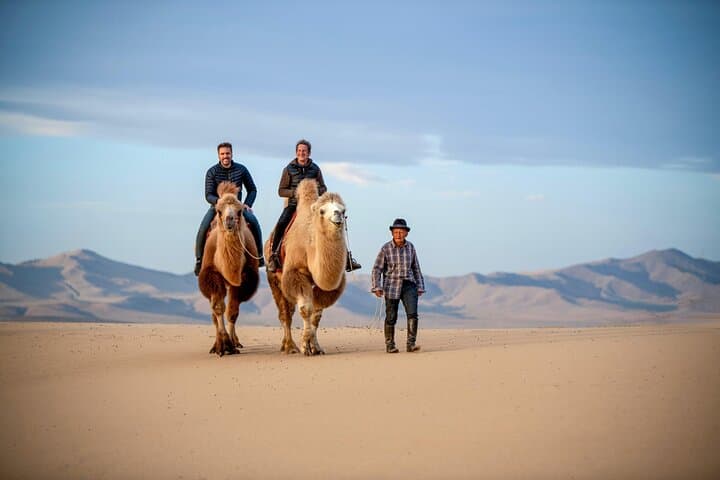
Culturally the trip cuts both ways — quiet time with nomadic families offering short camel treks across the dunes, then a walk through stone relics and museum exhibits that explain daily life and empire-era craft. Expect short drives over unpaved roads (4–6 hours from Ulaanbaatar depending on conditions), easy walking on sand and dirt tracks, and an overnight at a tourist ger camp with simple facilities.
Practical essentials: schedule walks for sunrise or late afternoon to avoid full sun, bring layered clothing for cold nights and strong daytime sun, and carry ample water — the dunes are exposed and services sparse. Modest fitness is enough; the experience is more about environment and context than strenuous hiking. Plan for dust, limited cell reception, and a respectful approach to local customs when visiting monasteries and family gers.
easy.
2 days.
Suitable for most travelers with basic mobility; includes short walks on sand and low-impact camel rides.
Driving distance is roughly 350–400 km depending on route; expect 4–6 hours each way on a mix of paved and unpaved roads.
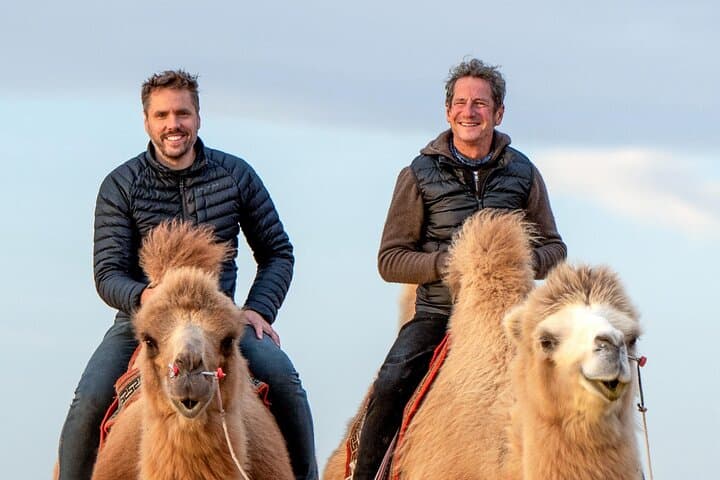
Yes — short camel treks arranged with local families are included; they are gentle and suitable for first-time riders but not recommended for people with serious back problems.
Overnight is in a tourist ger camp with basic beds, shared facilities, and Mongolian meals; expect simple comforts rather than full-service hotels.
Families can join; infant seats are available but check with the operator about camel rides and long vehicle transfers for very young children.
Kharkhorin sits on the ruins of 13th-century Karakorum; Erdene Zuu Monastery was built in 1586 using stones from the old capital and remains a center of Mongolian Buddhism.
Dune vegetation and steppe grass are fragile — stick to established paths and support local ger camps that practice low-impact waste and water use.
Augi's Travel operates guided outdoor trips and adventures with an emphasis on safety, stewardship, and memorable experiences.
The first light hits the ridges of Elsen Tasarkhai and the sand takes on a measured, orange hush. You stand at the lip of a low dune field — the so-called "Mini Gobi" — where wind has sculpted waves of sand that push up against grassland and the dark silhouette of the Khugnu Khan Mountains.
The first light hits the ridges of Elsen Tasarkhai and the sand takes on a measured, orange hush. You stand at the lip of a low dune field — the so-called "Mini Gobi" — where wind has sculpted waves of sand that push up against grassland and the dark silhouette of the Khugnu Khan Mountains.
This two-day loop pairs that raw desert edge with Mongolia’s deep past. Kharkhorin (ancient Karakorum) sits nearby, once the Mongol Empire’s capital; Erdene Zuu Monastery, founded in 1586 within the ruins of Karakorum, anchors the area with white stupas and weathered temples. Geologically, the dunes are wind-blown and locally confined by alluvial plains and mountain runoff, giving sharp contrasts: soft sand, scrub grass, and volcanic outcrops.
Culturally the trip cuts both ways — quiet time with nomadic families offering short camel treks across the dunes, then a walk through stone relics and museum exhibits that explain daily life and empire-era craft. Expect short drives over unpaved roads (4–6 hours from Ulaanbaatar depending on conditions), easy walking on sand and dirt tracks, and an overnight at a tourist ger camp with simple facilities.
Practical essentials: schedule walks for sunrise or late afternoon to avoid full sun, bring layered clothing for cold nights and strong daytime sun, and carry ample water — the dunes are exposed and services sparse. Modest fitness is enough; the experience is more about environment and context than strenuous hiking. Plan for dust, limited cell reception, and a respectful approach to local customs when visiting monasteries and family gers.