THE ADVENTURE COLLECTIVE® · Independent discovery and booking for outdoor travel

Travel from Cairo to the coastal battlefields of El Alamein on a full-day private tour that combines the War Museum, Commonwealth, German and Italian cemeteries, and guided historical context. Expect a long but focused day of sites, shoreline vistas and reflective memorials.
Travel from Cairo to the coastal battlefields of El Alamein on a full-day private tour that combines the War Museum, Commonwealth, German and Italian cemeteries, and guided historical context. Expect a long but focused day of sites, shoreline vistas and reflective memorials.
Morning light flattens the Mediterranean as the private vehicle eases out of Cairo and the city’s noise falls away. The drive to El Alamein traces a ribbon of highway across Egypt’s coastal plain—240 km northwest of Cairo, 106 km west of Alexandria—until the scrubbed desert meets the sea and the landscape takes on a different, quieter scale.
Verified experiences and guided adventures in the surrounding area.
Operated by EMO TOURS EGYPT · El Alamein, Matrouh Governorate
Morning light flattens the Mediterranean as the private vehicle eases out of Cairo and the city’s noise falls away. The drive to El Alamein traces a ribbon of highway across Egypt’s coastal plain—240 km northwest of Cairo, 106 km west of Alexandria—until the scrubbed desert meets the sea and the landscape takes on a different, quieter scale.
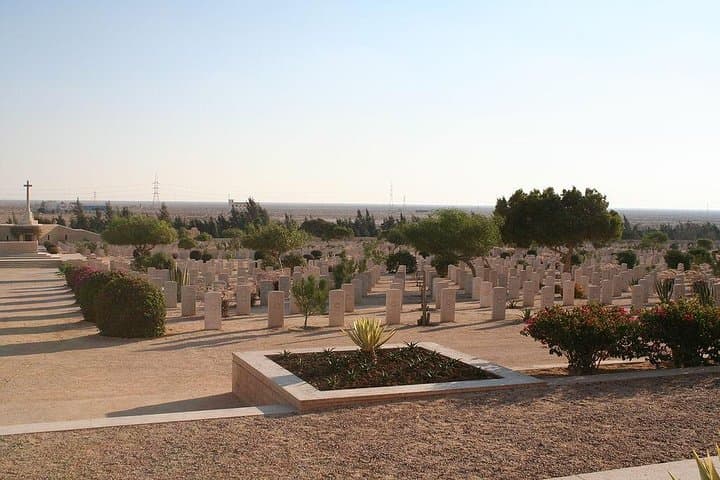
At the El Alamein War Museum, glass cases and artillery reclaim voices from 1942: maps, uniforms and records lay out the tactical chess between Montgomery and Rommel that turned the North African campaign. Outside, rows of white headstones in the Commonwealth, German and Italian cemeteries punctuate the sand, each grave a human anchor to a vast, windy battlefield. Geologically, the area is coastal sandstone and wind-sculpted dunes; culturally, small fishing communities and Alexandrian trade routes have long threaded through this coast.
The day moves at a deliberate pace—museum time, cemetery visits and quiet shoreline stretches—guided by a local expert who places events in global context and points to forgotten memorials. Expect coastal breezes that can bite in winter and sharp sun in summer; wear closed shoes for uneven paths and be prepared to walk short distances between sites.
Practicalities: the tour is a long day (10–12 hours), pickup and return to Cairo are typically included, bottled water is provided, and lunch may be optional. Photography is welcome but show restraint in cemetery areas. For history-minded travelers, the trip balances documentary detail with landscape: the sea keeps moving, the dunes reclaim bunkers, and the past remains materially present beneath the light.
easy.
10–12 hours.
Suitable for most travelers with basic mobility; requires getting in/out of a vehicle and short walks on uneven ground.
Yes; the tour typically includes hotel pickup and return in a private air-conditioned vehicle.
Admission is generally not included and may be paid on site—confirm with the operator when booking.
The tour involves minimal walking but some uneven ground; it’s generally family-friendly but not recommended for travelers with serious spinal or heart conditions.
Lunch is optional depending on the booking option—bottled water is included regardless.
El Alamein was the site of decisive 1942 battles between Allied and Axis forces; the cemeteries and museum commemorate multinational soldiers and strategic shifts in the North African campaign.
The coastal desert is ecologically sensitive—avoid driving on dunes, take all litter back to Cairo, and respect preservation signs at memorial sites.
EMO TOURS EGYPT operates guided outdoor trips and adventures with an emphasis on safety, stewardship, and memorable experiences.


Morning light flattens the Mediterranean as the private vehicle eases out of Cairo and the city’s noise falls away. The drive to El Alamein traces a ribbon of highway across Egypt’s coastal plain—240 km northwest of Cairo, 106 km west of Alexandria—until the scrubbed desert meets the sea and the landscape takes on a different, quieter scale.
Morning light flattens the Mediterranean as the private vehicle eases out of Cairo and the city’s noise falls away. The drive to El Alamein traces a ribbon of highway across Egypt’s coastal plain—240 km northwest of Cairo, 106 km west of Alexandria—until the scrubbed desert meets the sea and the landscape takes on a different, quieter scale.
At the El Alamein War Museum, glass cases and artillery reclaim voices from 1942: maps, uniforms and records lay out the tactical chess between Montgomery and Rommel that turned the North African campaign. Outside, rows of white headstones in the Commonwealth, German and Italian cemeteries punctuate the sand, each grave a human anchor to a vast, windy battlefield. Geologically, the area is coastal sandstone and wind-sculpted dunes; culturally, small fishing communities and Alexandrian trade routes have long threaded through this coast.
The day moves at a deliberate pace—museum time, cemetery visits and quiet shoreline stretches—guided by a local expert who places events in global context and points to forgotten memorials. Expect coastal breezes that can bite in winter and sharp sun in summer; wear closed shoes for uneven paths and be prepared to walk short distances between sites.
Practicalities: the tour is a long day (10–12 hours), pickup and return to Cairo are typically included, bottled water is provided, and lunch may be optional. Photography is welcome but show restraint in cemetery areas. For history-minded travelers, the trip balances documentary detail with landscape: the sea keeps moving, the dunes reclaim bunkers, and the past remains materially present beneath the light.