THE ADVENTURE COLLECTIVE® · Independent discovery and booking for outdoor travel

Walk the streets that shaped Harry Potter: a private two-hour tour through Victoria Street, graveyards, cafés and the exteriors that inspired J.K. Rowling. Expect cobbles, short hills, and a guide who connects names and places to the story.
Walk the streets that shaped Harry Potter: a private two-hour tour through Victoria Street, graveyards, cafés and the exteriors that inspired J.K. Rowling. Expect cobbles, short hills, and a guide who connects names and places to the story.
You arrive on a narrow curve of cobbles, wind pulling at your coat as bright shopfronts slope downhill like a scene waiting to be sketched.
Verified experiences and guided adventures in the surrounding area.
Operated by Opatrip.com Scotland · Edinburgh, Scotland
You arrive on a narrow curve of cobbles, wind pulling at your coat as bright shopfronts slope downhill like a scene waiting to be sketched.
This two-hour private walk threads the Royal Mile, Victoria Street and the graveyards where names and places nudged J.K. Rowling’s pen. The guide points out handprints set into stone, the back room of a café where ideas took shape, and a school whose turrets read like a rehearsal for Hogwarts. The city’s architecture—the dark volcanic plug beneath the Castle, the layered sandstone façades—gives the route a compact drama: stone that remembers siege and study, streets that keep their own echoes.
Historically, Edinburgh’s Old Town grew vertically; narrow wynds and closes were born from medieval parceling and later Georgian reordering. Geologically, the skyline sits on extinct volcanic ridges and sedimentary beds, which shaped defensible high ground and winding lanes.
Locally, listen for the cadence of street buskers and the clipped announcements at tram stops; hospitality leans toward small cafés and hushed bookshops rather than big chains. A private guide reframes names on gravestones and façades into narrative beats, but the tour keeps a practical tempo—short stops, steady walking.
Plan for uneven cobbles and short inclines: wear grippy shoes, layer for sudden gusts, and bring a compact umbrella in shoulder seasons. Public transport and taxis are plentiful at start and finish. If you want photographs without crowds, request an early-morning slot; if accessibility is a concern, confirm route adjustments with the operator in advance.
easy.
2 hours.
Suitable for most fitness levels; involves continuous walking over uneven surfaces and short inclines.
The tour runs approximately two hours and is designed as a continuous walking route with several short stop-offs.
Yes—it's family-friendly, though younger children should be prepared for cobbled surfaces and brief uphill sections.
The itinerary focuses on exteriors and public spaces; interiors like George Heriot’s School and hotel suites are viewed from outside.
The tour operator may cancel in extreme weather; otherwise come prepared with waterproof layers as portions of the route are exposed.
Edinburgh’s Old Town evolved from medieval street plots and later 18th–19th century redevelopment; many names on gravestones and buildings date to the city’s Enlightenment era and earlier.
Historic stonework is sensitive to wear and pollution—stick to paved paths, avoid touching carved surfaces where signs request, and support local businesses that fund conservation.
Opatrip.com Scotland operates guided outdoor trips and adventures with an emphasis on safety, stewardship, and memorable experiences.

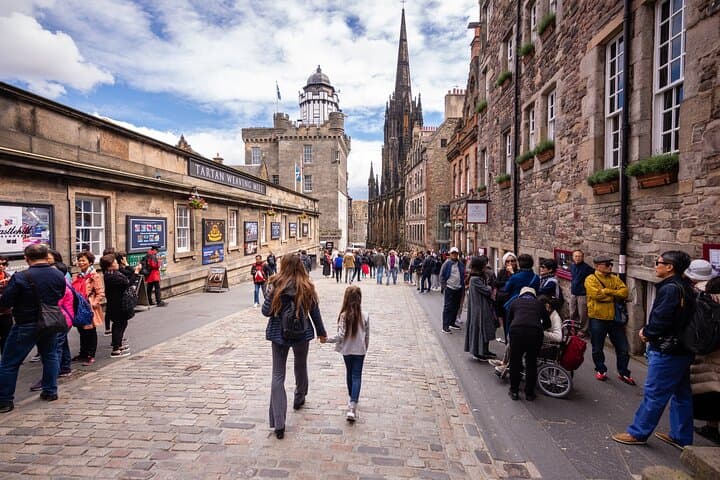

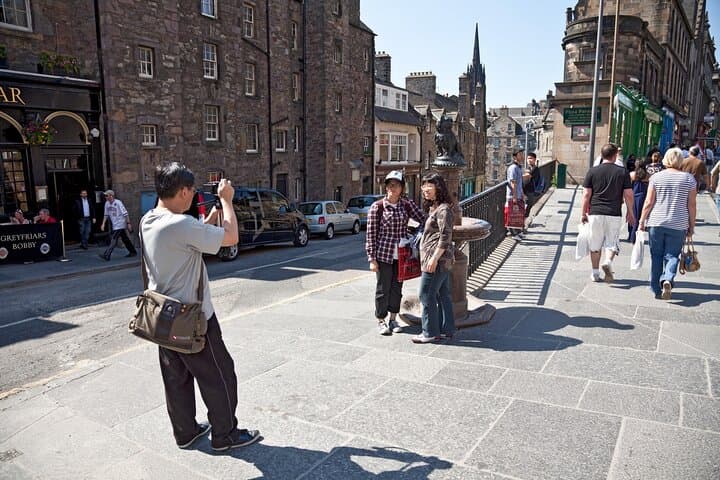
You arrive on a narrow curve of cobbles, wind pulling at your coat as bright shopfronts slope downhill like a scene waiting to be sketched.
You arrive on a narrow curve of cobbles, wind pulling at your coat as bright shopfronts slope downhill like a scene waiting to be sketched.
This two-hour private walk threads the Royal Mile, Victoria Street and the graveyards where names and places nudged J.K. Rowling’s pen. The guide points out handprints set into stone, the back room of a café where ideas took shape, and a school whose turrets read like a rehearsal for Hogwarts. The city’s architecture—the dark volcanic plug beneath the Castle, the layered sandstone façades—gives the route a compact drama: stone that remembers siege and study, streets that keep their own echoes.
Historically, Edinburgh’s Old Town grew vertically; narrow wynds and closes were born from medieval parceling and later Georgian reordering. Geologically, the skyline sits on extinct volcanic ridges and sedimentary beds, which shaped defensible high ground and winding lanes.
Locally, listen for the cadence of street buskers and the clipped announcements at tram stops; hospitality leans toward small cafés and hushed bookshops rather than big chains. A private guide reframes names on gravestones and façades into narrative beats, but the tour keeps a practical tempo—short stops, steady walking.
Plan for uneven cobbles and short inclines: wear grippy shoes, layer for sudden gusts, and bring a compact umbrella in shoulder seasons. Public transport and taxis are plentiful at start and finish. If you want photographs without crowds, request an early-morning slot; if accessibility is a concern, confirm route adjustments with the operator in advance.