THE ADVENTURE COLLECTIVE® · Independent discovery and booking for outdoor travel

A relaxed guided e-bike loop from Locorotondo to Alberobello across the Valle d’Itria. Expect trulli-lined villages, limestone country roads, panoramic viewpoints and a craft gelato finish.
A relaxed guided e-bike loop from Locorotondo to Alberobello across the Valle d’Itria. Expect trulli-lined villages, limestone country roads, panoramic viewpoints and a craft gelato finish.
You push off from Locorotondo as limestone walls and olive trunks lean toward the road, the electric motor’s quiet insistence keeping the pedals turning as the valley opens.
Verified experiences and guided adventures in the surrounding area.
Operated by Tours Puglia · Locorotondo, Apulia
You push off from Locorotondo as limestone walls and olive trunks lean toward the road, the electric motor’s quiet insistence keeping the pedals turning as the valley opens.
This guided e-bike loop visits cloud-topped trulli villages and slow agricultural land shaped by millennia of dry-stone walls. Alberobello’s cone-roofed trulli—stone huts built without mortar—reflect local tax-avoidance history and medieval building techniques; their symbolic rooftop motifs nod to folk religion and family marks. Geologically, the Itria Valley sits on Puglia’s calcareous plateau: thin soils over porous limestone create scrub, vineyards and gnarled olives rather than deep forest.
Culturally the ride alternates tactile rural work—stone pruning terraces, rows of vines—with towns where whitewashed walls meet narrow alleys. Locorotondo’s “cummerse” houses show why limewash persisted: it reflects heat, resists moisture and kept interiors cooler for centuries.
Practical guidance: expect roughly 3–3.5 hours on mostly paved country roads with short climbs and rolling terrain; the e-bike assists on ascents but plan for pedaling. Bring sunscreen and a refillable bottle—the sun in Puglia is direct. Wear closed shoes with good pedal contact and a light wind layer for early mornings.
Timing matters: mid-morning light makes the cone roofs glow for photos, while a late-afternoon gelato in Locorotondo closes the loop. Respect irrigation channels and private vineyards—stick to public lanes. The result is a compact, accessible day ride that blends easy fitness, rural geology and living Mediterranean history.
easy.
3–3.5 hours.
Suitable for most fitness levels; expect continuous pedaling on rolling terrain for a few hours, with e-bike assist reducing effort.
The tour lasts about 3–3.5 hours (approximately 210 minutes) and covers a loop of country roads between Locorotondo and Alberobello with stops—expect 20–35 km depending on exact routing.
Yes—e-bike assistance and mostly paved roads make it accessible to riders with basic fitness; guides tailor pace for group ability.
No interior admissions are included; the tour visits and explains trulli from public viewpoints and in village streets.
Tours may be canceled for heavy rain; check confirmation policies for full-refund deadlines (typically 24 hours prior).
The trulli form emerged from medieval building practices and local tax rules that encouraged dry-stone construction; the area’s white limewash has practical roots in cooling and sanitation.
Stone terracing and low-intensity farming have preserved much of the dry-stone landscape; stick to lanes to avoid trampling fragile soil and cultivated fields.
Tours Puglia operates guided outdoor trips and adventures with an emphasis on safety, stewardship, and memorable experiences.
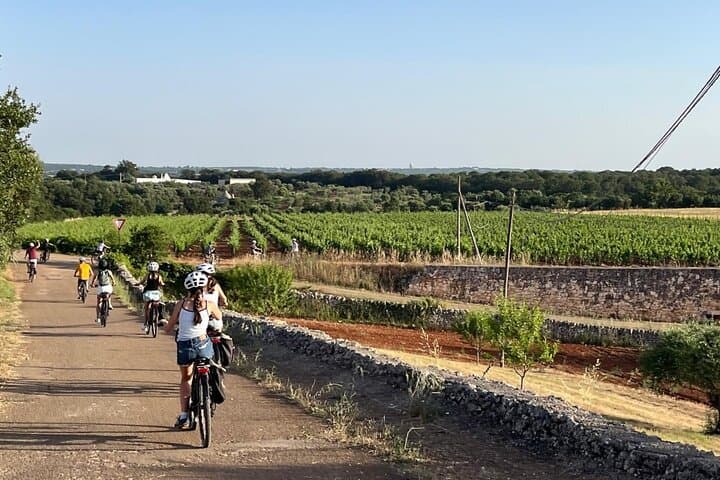

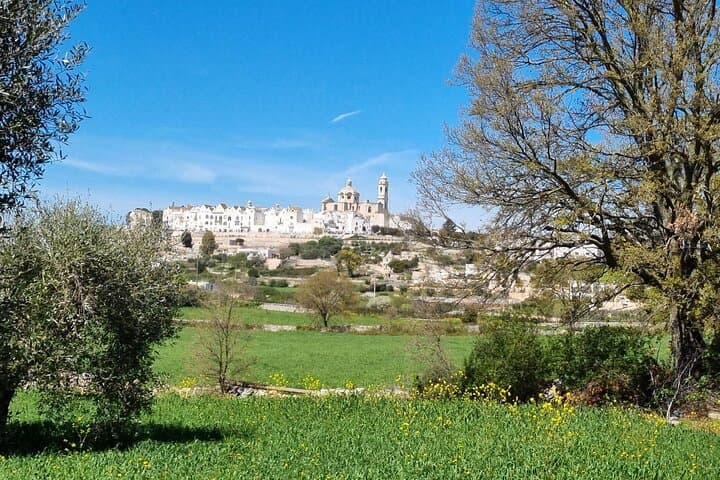
You push off from Locorotondo as limestone walls and olive trunks lean toward the road, the electric motor’s quiet insistence keeping the pedals turning as the valley opens.
You push off from Locorotondo as limestone walls and olive trunks lean toward the road, the electric motor’s quiet insistence keeping the pedals turning as the valley opens.
This guided e-bike loop visits cloud-topped trulli villages and slow agricultural land shaped by millennia of dry-stone walls. Alberobello’s cone-roofed trulli—stone huts built without mortar—reflect local tax-avoidance history and medieval building techniques; their symbolic rooftop motifs nod to folk religion and family marks. Geologically, the Itria Valley sits on Puglia’s calcareous plateau: thin soils over porous limestone create scrub, vineyards and gnarled olives rather than deep forest.
Culturally the ride alternates tactile rural work—stone pruning terraces, rows of vines—with towns where whitewashed walls meet narrow alleys. Locorotondo’s “cummerse” houses show why limewash persisted: it reflects heat, resists moisture and kept interiors cooler for centuries.
Practical guidance: expect roughly 3–3.5 hours on mostly paved country roads with short climbs and rolling terrain; the e-bike assists on ascents but plan for pedaling. Bring sunscreen and a refillable bottle—the sun in Puglia is direct. Wear closed shoes with good pedal contact and a light wind layer for early mornings.
Timing matters: mid-morning light makes the cone roofs glow for photos, while a late-afternoon gelato in Locorotondo closes the loop. Respect irrigation channels and private vineyards—stick to public lanes. The result is a compact, accessible day ride that blends easy fitness, rural geology and living Mediterranean history.