THE ADVENTURE COLLECTIVE® · Independent discovery and booking for outdoor travel

Ride an assisted e‑bike through the hill roads of Valle d'Itria to Alberobello’s trulli, then finish with a guided cellar tour and tasting in an 18th‑century farm. This easy 35 km loop pairs light exercise with regional wine and countryside views.
Ride an assisted e‑bike through the hill roads of Valle d'Itria to Alberobello’s trulli, then finish with a guided cellar tour and tasting in an 18th‑century farm. This easy 35 km loop pairs light exercise with regional wine and countryside views.
Pedaling an assisted e‑bike down a sun-warmed country lane, the low dry-stone walls slip past like punctuation marks in a slow Italian sentence. The cone-shaped trulli of Alberobello rise ahead—whitewashed, compact, and oddly alive—while vines stitch the slopes of the Valle d'Itria into neat rows that suggest order in this otherwise lazy landscape.
Verified experiences and guided adventures in the surrounding area.
Operated by ebike Puglia · Martina Franca, Puglia
Pedaling an assisted e‑bike down a sun-warmed country lane, the low dry-stone walls slip past like punctuation marks in a slow Italian sentence. The cone-shaped trulli of Alberobello rise ahead—whitewashed, compact, and oddly alive—while vines stitch the slopes of the Valle d'Itria into neat rows that suggest order in this otherwise lazy landscape.
This route threads Martina Franca and Alberobello, towns shaped by centuries of small-scale farming and an 18th-century agricultural economy. The geology here is shallow karst limestone: porous soils, ridges cut by seasonal streams, and centuries of hand-built stone walls that hold terraces and vineyards in place. Culturally, the valley is a working landscape—locals tend olive trees and grapes the same way their grandparents did, and small family cellars still vinify using techniques adapted to hot, dry summers and cool, breezy winters.
Practically, expect an easy 35 km loop over mostly paved rural roads with short rising sections and panoramic viewpoints. The e‑bike does the heavy lifting; you still need attention for narrow lanes, farm vehicles, and cobblestone in Alberobello’s centro storico. The winery visit includes a guided vineyard walk, a tour of an 18th-century farmhouse and cellars, and a tasting of local whites and reds paired with taralli and friselline.
Bring hydration, sun protection, and moderate footwear; aim for morning departures to avoid peak heat and to catch softer light on the trulli. Respect private vines, tie helmets before descents, and leave time to linger in a square—this is countryside meant to be seen slowly.
moderate.
3–4 hours.
Suitable for people in light to moderate fitness who can sit on a bike for several hours; e‑assistance reduces strain on hills.
The tour covers about 35 km over paved rural roads with short climbs and flat stretches; surfaces include asphalt and occasional cobbles in village centers.
No advanced skills are required—e‑bikes assist pedaling—but you should be comfortable riding on narrow country roads and handling basic bike controls.
Tastings typically feature local Valle d'Itria selections: crisp whites from indigenous grapes and light to medium-bodied reds, paired with regional snacks.
The tour is family-friendly for older children who can ride; it is not recommended for pregnant travelers or those with serious spinal or heart conditions—check with the operator.
The valley’s trulli buildings and dry-stone walls reflect centuries of agrarian life; many local cellars evolved from 18th-century farmsteads.
The karst landscape is fragile—stick to roads and marked paths, avoid trampling vine rows, and favor local producers to support sustainable land stewardship.
ebike Puglia operates guided outdoor trips and adventures with an emphasis on safety, stewardship, and memorable experiences.
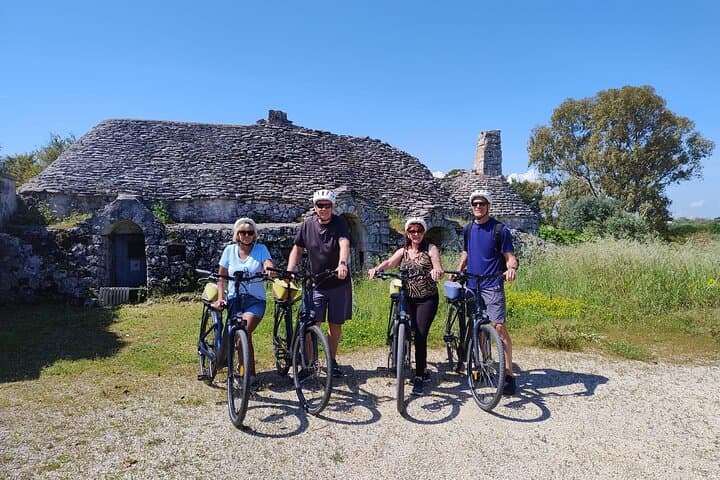


Pedaling an assisted e‑bike down a sun-warmed country lane, the low dry-stone walls slip past like punctuation marks in a slow Italian sentence. The cone-shaped trulli of Alberobello rise ahead—whitewashed, compact, and oddly alive—while vines stitch the slopes of the Valle d'Itria into neat rows that suggest order in this otherwise lazy landscape.
Pedaling an assisted e‑bike down a sun-warmed country lane, the low dry-stone walls slip past like punctuation marks in a slow Italian sentence. The cone-shaped trulli of Alberobello rise ahead—whitewashed, compact, and oddly alive—while vines stitch the slopes of the Valle d'Itria into neat rows that suggest order in this otherwise lazy landscape.
This route threads Martina Franca and Alberobello, towns shaped by centuries of small-scale farming and an 18th-century agricultural economy. The geology here is shallow karst limestone: porous soils, ridges cut by seasonal streams, and centuries of hand-built stone walls that hold terraces and vineyards in place. Culturally, the valley is a working landscape—locals tend olive trees and grapes the same way their grandparents did, and small family cellars still vinify using techniques adapted to hot, dry summers and cool, breezy winters.
Practically, expect an easy 35 km loop over mostly paved rural roads with short rising sections and panoramic viewpoints. The e‑bike does the heavy lifting; you still need attention for narrow lanes, farm vehicles, and cobblestone in Alberobello’s centro storico. The winery visit includes a guided vineyard walk, a tour of an 18th-century farmhouse and cellars, and a tasting of local whites and reds paired with taralli and friselline.
Bring hydration, sun protection, and moderate footwear; aim for morning departures to avoid peak heat and to catch softer light on the trulli. Respect private vines, tie helmets before descents, and leave time to linger in a square—this is countryside meant to be seen slowly.