THE ADVENTURE COLLECTIVE® · Independent discovery and booking for outdoor travel

Leave the city’s bustle for the slow, storied pace of the Appian Way on an e-bike. This 3-hour small-group or private tour pairs Roman history with gentle pedaling along one of the empire’s oldest roads.
Leave the city’s bustle for the slow, storied pace of the Appian Way on an e-bike. This 3-hour small-group or private tour pairs Roman history with gentle pedaling along one of the empire’s oldest roads.
Sun warms the flagstones as your e-bike hums forward and the city’s noise thins into birdsong and gravel. You begin at the Circus Maximus, eyeing the Palatine Ridge and the worn lines of imperial villas, then slip onto Via Appia Antica — a road laid in 312 BC that still sets the pace for travel south. The route threads mausoleums, aqueduct arches and the Baths of Caracalla, each structure a blunt reminder that Rome’s past sits underfoot as well as overhead.
Verified experiences and guided adventures in the surrounding area.
Operated by LivTours · Rome, Lazio
Sun warms the flagstones as your e-bike hums forward and the city’s noise thins into birdsong and gravel. You begin at the Circus Maximus, eyeing the Palatine Ridge and the worn lines of imperial villas, then slip onto Via Appia Antica — a road laid in 312 BC that still sets the pace for travel south. The route threads mausoleums, aqueduct arches and the Baths of Caracalla, each structure a blunt reminder that Rome’s past sits underfoot as well as overhead.
Geology and history meet here: volcanic tuff and basalt cobbles from ancient Roman engineering hold centuries of wear, while the surrounding fields and olive trees mark a landscape shaped by millennia of cultivation. You’ll pass Villa dei Quintilii and the Gate of San Sebastiano, hearing how the Appian Way stitched the empire together and how subterranean catacombs run like veins under the road.
Cultural notes are practical — local guides explain burial practices, pilgrim routes, and the 19th-century rediscovery that turned neglected farmland into a protected archaeological park. Expect convivial stops for photos; longer cave or catacomb tours aren’t included but are easy to add afterward.
Practical guidance: the ride is roughly 10–18 km over 3 hours on mostly flat, packed gravel and paved stretches. Use the electric assist to manage stretches of uneven cobble, bring layered clothing for sun and wind, and carry water — shade is limited between monuments. Tours run in small groups or private format; families and casual cyclists are commonly accommodated, making this an accessible, historically rich day out of central Rome.
easy.
3 hours.
Suitable for most fitness levels; able to ride intermittently for 10–18 km and stand on pedals over uneven cobbles.
Yes — the tour uses e-bikes that assist pedaling, making the route accessible to riders with varying fitness levels.
Children are welcome; infant seats or appropriate bikes can usually be arranged if you notify the operator in advance.
No — guided visits inside the catacombs aren’t included, though your guide can point where to continue independently afterward.
Tours are offered in English, French, Spanish, Portuguese and Italian; request your preferred language when booking.
The Appian Way was begun in 312 BC as a strategic military and commercial highway that connected Rome to southern Italy, and many surviving mausoleums and villas date to the Republican and Imperial periods.
The Appia Antica Regional Park protects archaeological resources and olive groves; cyclists must stick to designated paths and avoid trampling ruins or vegetation.
LivTours operates guided outdoor trips and adventures with an emphasis on safety, stewardship, and memorable experiences.
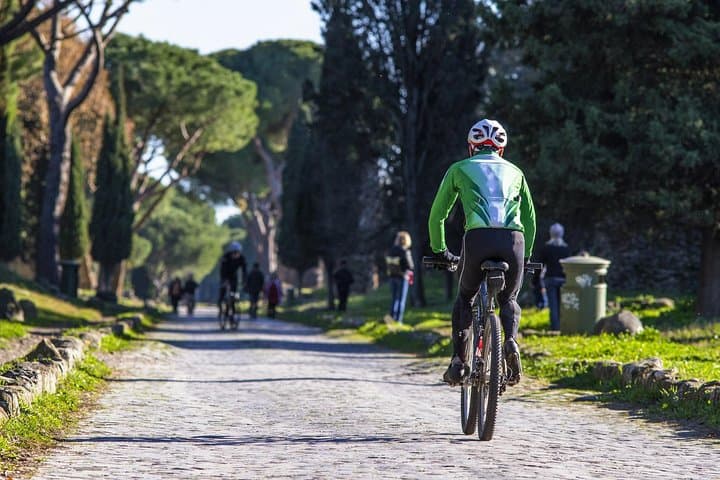
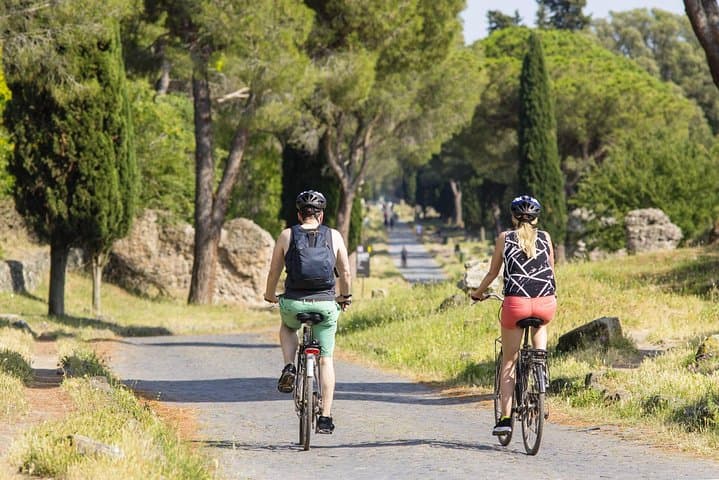


Sun warms the flagstones as your e-bike hums forward and the city’s noise thins into birdsong and gravel. You begin at the Circus Maximus, eyeing the Palatine Ridge and the worn lines of imperial villas, then slip onto Via Appia Antica — a road laid in 312 BC that still sets the pace for travel south. The route threads mausoleums, aqueduct arches and the Baths of Caracalla, each structure a blunt reminder that Rome’s past sits underfoot as well as overhead.
Sun warms the flagstones as your e-bike hums forward and the city’s noise thins into birdsong and gravel. You begin at the Circus Maximus, eyeing the Palatine Ridge and the worn lines of imperial villas, then slip onto Via Appia Antica — a road laid in 312 BC that still sets the pace for travel south. The route threads mausoleums, aqueduct arches and the Baths of Caracalla, each structure a blunt reminder that Rome’s past sits underfoot as well as overhead.
Geology and history meet here: volcanic tuff and basalt cobbles from ancient Roman engineering hold centuries of wear, while the surrounding fields and olive trees mark a landscape shaped by millennia of cultivation. You’ll pass Villa dei Quintilii and the Gate of San Sebastiano, hearing how the Appian Way stitched the empire together and how subterranean catacombs run like veins under the road.
Cultural notes are practical — local guides explain burial practices, pilgrim routes, and the 19th-century rediscovery that turned neglected farmland into a protected archaeological park. Expect convivial stops for photos; longer cave or catacomb tours aren’t included but are easy to add afterward.
Practical guidance: the ride is roughly 10–18 km over 3 hours on mostly flat, packed gravel and paved stretches. Use the electric assist to manage stretches of uneven cobble, bring layered clothing for sun and wind, and carry water — shade is limited between monuments. Tours run in small groups or private format; families and casual cyclists are commonly accommodated, making this an accessible, historically rich day out of central Rome.