THE ADVENTURE COLLECTIVE® · Independent discovery and booking for outdoor travel

Explore Venice’s power corridors and overlooked corners with a guided walk that ends inside the Doge’s Palace — skip-the-line entry included. This three-hour tour pairs compact history with practical tips so you can navigate canals, crowds, and culture like a local.
Explore Venice’s power corridors and overlooked corners with a guided walk that ends inside the Doge’s Palace — skip-the-line entry included. This three-hour tour pairs compact history with practical tips so you can navigate canals, crowds, and culture like a local.
You step out of the shadow of St. Mark’s Basilica and the square rearranges itself around you — pigeons scatter, gondoliers call across the water, and the warm, limestone facades lean close as if to share a secret. A guide appears with a small flag and a headset, and for the next three hours Venice becomes a compact, living archive: alleys that remember merchants and magistrates, squares where decisions altered map lines, and a palace whose carved stone still argues for power.
Verified experiences and guided adventures in the surrounding area.
Operated by Venice Events srl · Venice, Veneto
You step out of the shadow of St. Mark’s Basilica and the square rearranges itself around you — pigeons scatter, gondoliers call across the water, and the warm, limestone facades lean close as if to share a secret. A guide appears with a small flag and a headset, and for the next three hours Venice becomes a compact, living archive: alleys that remember merchants and magistrates, squares where decisions altered map lines, and a palace whose carved stone still argues for power.
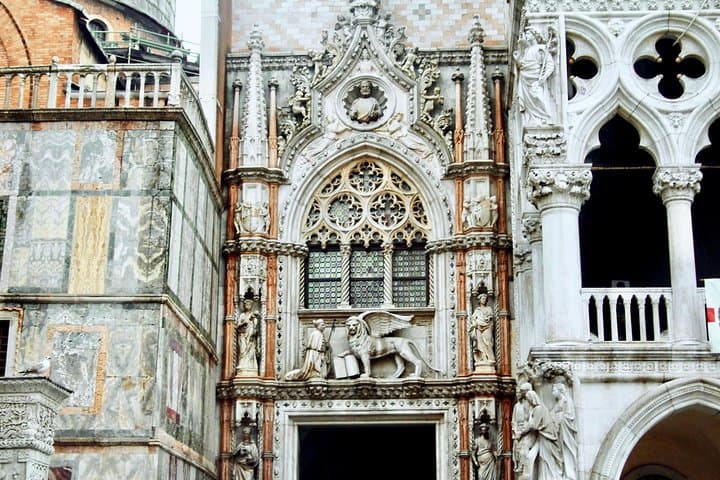
The tour begins on Calle Larga de l’Ascension, behind the Correr Museum, and winds through the Castello and San Marco neighborhoods — Marco Polo’s supposed birthplace, the Malibran Theatre, and the broad Campo S. Giovanni e Paolo with its funerary monuments. The narrative tightens as you approach the Doge’s Palace: a Gothic civic complex born from lagoon silt, salt, and centuries of trade. The palace was the heart of the Serenissima, where doges, councils, and courts negotiated maritime treaties that shaped Mediterranean commerce.
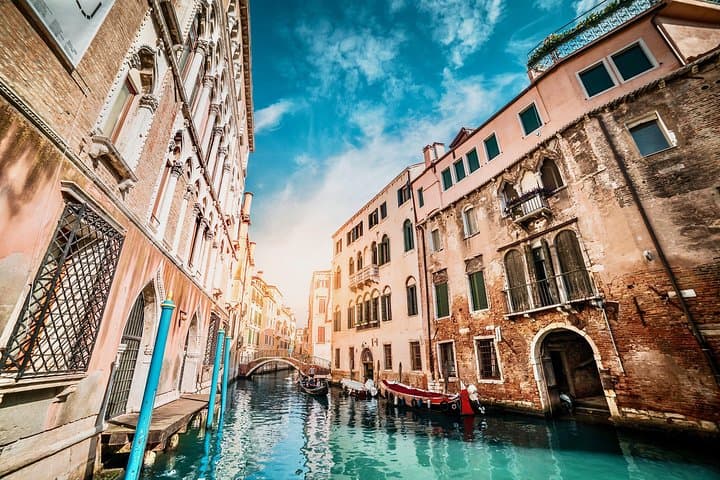
Geology and hydrology matter here. Venice rests on timber piles driven into compressible lagoon mud; the city’s ornate façades are an argument with water. Expect damp stone, salt stains on cornices, and narrow canals that direct light and movement. Culturally, the tour highlights Venice’s mercantile pluralism — Byzantine mosaics sit near Renaissance sculpture, and Latin legal codes rubbed shoulders with Venetian maritime law.
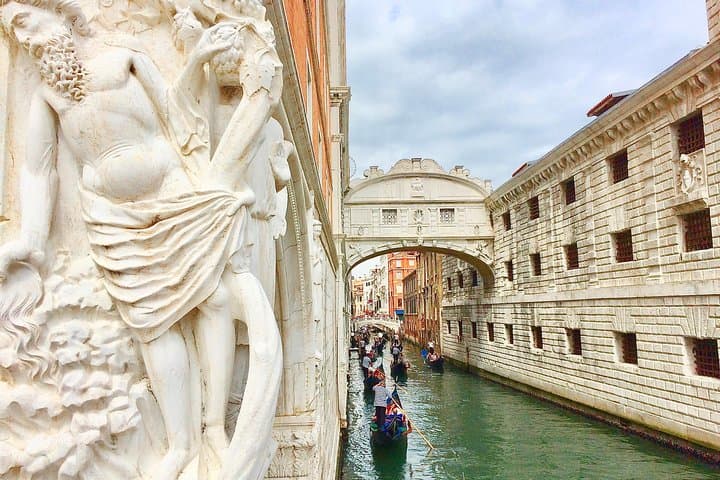
History and architecture are practical as well as pretty: your one-hour, skip-the-line entry to the Doge’s Palace takes you through gilded rooms, the Bridge of Sighs’ pale arch, and the cramped cells where prisoners awaited verdicts. Guides explain not only who built what, but why magistrates needed such elaborate spaces to wield authority.
Practical guidance: arrive 15 minutes early at the meeting point, bring ID if you have children over five, and leave large backpacks at your hotel — they’re not allowed inside the palace. The route is mostly paved and level but includes cobbled streets and steps inside the palace; comfortable walking shoes and a lightweight rain jacket are smart choices. Tours run rain or shine and accommodate multiple languages (English, French, German, Spanish). If you’re visiting from outside Venice, check whether a €5 city access fee applies on your date.
Timing changes the experience: mornings deliver softer light and fewer crowds; late afternoon gives warmer tones on the stone. Keep your Doge’s Palace ticket at the end of the tour to visit Museo Correr and the Museo Archeologico Nazionale across St. Mark’s Square. In three hours, you’ll have not just photos but a clear sense of how trade, law, and water built a city that still moves to its own tide.
moderate.
3 hours.
Suitable for most fitness levels; expect moderate walking over cobbles and steps—stand for museum explanations.
Meet 15 minutes before the tour at Calle larga de l’Ascension (behind the Correr Museum, opposite St. Mark’s Basilica); look for the TURIVE assistant near the San Marco post office.
Yes — the price includes skip-the-line admission and a one-hour guided visit inside the Doge’s Palace.
No — backpacks and large bags are prohibited; bring a small bag or leave larger items at your hotel.
No — the tour and the Doge’s Palace include steps and narrow passages and are not wheelchair accessible.
Guided tours are offered in English, French, German, and Spanish; headsets are provided to hear the guide clearly.
Children under 6 may be free, but from age 6 they require a paid ticket and must show ID to prove age.
The Doge’s Palace was the governmental center of the Republic of Venice; its rooms hosted councils, courts, and maritime administrators who directed centuries of trade.
Venice manages visitor flow with timed entries and periodic access fees; avoid feeding birds and minimize plastic use to reduce strain on the lagoon environment.
Venice Events srl operates guided outdoor trips and adventures with an emphasis on safety, stewardship, and memorable experiences.
You step out of the shadow of St. Mark’s Basilica and the square rearranges itself around you — pigeons scatter, gondoliers call across the water, and the warm, limestone facades lean close as if to share a secret. A guide appears with a small flag and a headset, and for the next three hours Venice becomes a compact, living archive: alleys that remember merchants and magistrates, squares where decisions altered map lines, and a palace whose carved stone still argues for power.
You step out of the shadow of St. Mark’s Basilica and the square rearranges itself around you — pigeons scatter, gondoliers call across the water, and the warm, limestone facades lean close as if to share a secret. A guide appears with a small flag and a headset, and for the next three hours Venice becomes a compact, living archive: alleys that remember merchants and magistrates, squares where decisions altered map lines, and a palace whose carved stone still argues for power.
The tour begins on Calle Larga de l’Ascension, behind the Correr Museum, and winds through the Castello and San Marco neighborhoods — Marco Polo’s supposed birthplace, the Malibran Theatre, and the broad Campo S. Giovanni e Paolo with its funerary monuments. The narrative tightens as you approach the Doge’s Palace: a Gothic civic complex born from lagoon silt, salt, and centuries of trade. The palace was the heart of the Serenissima, where doges, councils, and courts negotiated maritime treaties that shaped Mediterranean commerce.
Geology and hydrology matter here. Venice rests on timber piles driven into compressible lagoon mud; the city’s ornate façades are an argument with water. Expect damp stone, salt stains on cornices, and narrow canals that direct light and movement. Culturally, the tour highlights Venice’s mercantile pluralism — Byzantine mosaics sit near Renaissance sculpture, and Latin legal codes rubbed shoulders with Venetian maritime law.
History and architecture are practical as well as pretty: your one-hour, skip-the-line entry to the Doge’s Palace takes you through gilded rooms, the Bridge of Sighs’ pale arch, and the cramped cells where prisoners awaited verdicts. Guides explain not only who built what, but why magistrates needed such elaborate spaces to wield authority.
Practical guidance: arrive 15 minutes early at the meeting point, bring ID if you have children over five, and leave large backpacks at your hotel — they’re not allowed inside the palace. The route is mostly paved and level but includes cobbled streets and steps inside the palace; comfortable walking shoes and a lightweight rain jacket are smart choices. Tours run rain or shine and accommodate multiple languages (English, French, German, Spanish). If you’re visiting from outside Venice, check whether a €5 city access fee applies on your date.
Timing changes the experience: mornings deliver softer light and fewer crowds; late afternoon gives warmer tones on the stone. Keep your Doge’s Palace ticket at the end of the tour to visit Museo Correr and the Museo Archeologico Nazionale across St. Mark’s Square. In three hours, you’ll have not just photos but a clear sense of how trade, law, and water built a city that still moves to its own tide.