THE ADVENTURE COLLECTIVE® · Independent discovery and booking for outdoor travel

Stand on the Dubai Frame’s glass bridge and watch old creek-side neighborhoods and futuristic skyscrapers compete for attention. This four-hour private tour pairs the Frame’s 150-meter vantage with iconic photo stops and a mall visit—efficient, accessible, and ideal for a first-time Dubai overview.
Stand on the Dubai Frame’s glass bridge and watch old creek-side neighborhoods and futuristic skyscrapers compete for attention. This four-hour private tour pairs the Frame’s 150-meter vantage with iconic photo stops and a mall visit—efficient, accessible, and ideal for a first-time Dubai overview.
You step onto the Dubai Frame's glass bridge 150 meters above the city and the skyline rearranges itself—slick towers to the north, the older creek-side neighborhoods to the south—held in a single engineered rectangle. Light from the Persian Gulf slices between buildings; the Frame’s museum panels sketch Dubai’s shift from fishing and pearling villages to a global commerce hub.
Verified experiences and guided adventures in the surrounding area.
Operated by Princess Tourism LLC · Dubai, Dubai
You step onto the Dubai Frame's glass bridge 150 meters above the city and the skyline rearranges itself—slick towers to the north, the older creek-side neighborhoods to the south—held in a single engineered rectangle. Light from the Persian Gulf slices between buildings; the Frame’s museum panels sketch Dubai’s shift from fishing and pearling villages to a global commerce hub.
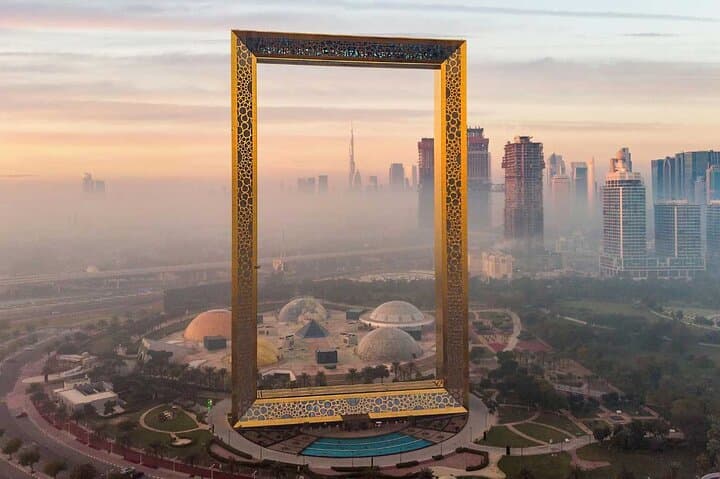
Opened in 2018 and set in Zabeel Park, the Frame was designed to literally ‘frame’ old and new Dubai: one side looks toward the historic creek and Bastakiya district, the other toward glittering skyscrapers and Sheikh Zayed Road. Nearby cultural stops often include the Jumeirah Mosque and a drive-past of Burj Al Arab and Atlantis for photo stops, while Dubai Mall offers an abrupt change of pace—malls, fountains and retail theater. The route captures geology only lightly—sandy coastal plains and reclaimed shoreline—but culture and commerce are the clearer strata here.
Practical guidance: the four-hour private tour mixes short walks on paved surfaces, elevator access and a 360-degree glass walkway; expect 2–4 km of walking depending on stops. Morning and sunset light are best for photographs and clearer glass-pane views. Dress modestly when visiting mosques, carry sunscreen and a refillable water bottle for summer heat, and use the private driver to maximize time between dispersed landmarks. Tickets for the Frame include elevator access; book ahead for sunset slots. The experience is urban, accessible, and structured—ideal for travelers who want a concentrated, efficient introduction to Dubai’s contrasts.
easy.
4 hours.
Suitable for most travelers; light walking on paved surfaces and elevators handle elevation changes.
Yes—the Dubai Frame has elevators and accessible routes to the viewing gallery and exhibitions.
Yes—sunset slots sell quickly; booking ahead secures preferred times and avoids on-site lines.
Yes—this is family-friendly but infants must sit on laps during vehicle transfers; some sites may have age or health advisories.
Visits to Jumeirah Mosque are possible via guided programs; modest dress is required and opening times vary, so confirm in advance.
Dubai rapidly transformed from pearling and fishing settlements into an international trade and tourism center in the late 20th century; the Frame is a recent icon intended to show both eras.
Water scarcity and coastal habitat sensitivity make reducing single-use plastics and staying on designated paths important; nearby reserves like Ras Al Khor are protected for migratory birds.
Princess Tourism LLC operates guided outdoor trips and adventures with an emphasis on safety, stewardship, and memorable experiences.

You step onto the Dubai Frame's glass bridge 150 meters above the city and the skyline rearranges itself—slick towers to the north, the older creek-side neighborhoods to the south—held in a single engineered rectangle. Light from the Persian Gulf slices between buildings; the Frame’s museum panels sketch Dubai’s shift from fishing and pearling villages to a global commerce hub.
You step onto the Dubai Frame's glass bridge 150 meters above the city and the skyline rearranges itself—slick towers to the north, the older creek-side neighborhoods to the south—held in a single engineered rectangle. Light from the Persian Gulf slices between buildings; the Frame’s museum panels sketch Dubai’s shift from fishing and pearling villages to a global commerce hub.
Opened in 2018 and set in Zabeel Park, the Frame was designed to literally ‘frame’ old and new Dubai: one side looks toward the historic creek and Bastakiya district, the other toward glittering skyscrapers and Sheikh Zayed Road. Nearby cultural stops often include the Jumeirah Mosque and a drive-past of Burj Al Arab and Atlantis for photo stops, while Dubai Mall offers an abrupt change of pace—malls, fountains and retail theater. The route captures geology only lightly—sandy coastal plains and reclaimed shoreline—but culture and commerce are the clearer strata here.
Practical guidance: the four-hour private tour mixes short walks on paved surfaces, elevator access and a 360-degree glass walkway; expect 2–4 km of walking depending on stops. Morning and sunset light are best for photographs and clearer glass-pane views. Dress modestly when visiting mosques, carry sunscreen and a refillable water bottle for summer heat, and use the private driver to maximize time between dispersed landmarks. Tickets for the Frame include elevator access; book ahead for sunset slots. The experience is urban, accessible, and structured—ideal for travelers who want a concentrated, efficient introduction to Dubai’s contrasts.