THE ADVENTURE COLLECTIVE® · Independent discovery and booking for outdoor travel
Step into a compact wildlife center in the heart of Dubai to see over 250 Nile crocodiles up close. This family-friendly attraction blends safe viewing platforms, museum exhibits, and scheduled demonstrations to make crocodile biology and conservation accessible.
Step into a compact wildlife center in the heart of Dubai to see over 250 Nile crocodiles up close. This family-friendly attraction blends safe viewing platforms, museum exhibits, and scheduled demonstrations to make crocodile biology and conservation accessible.
You step off the street into a pocket of heat and movement: shaded boardwalks, the low rumble of water, and the slow, indifferent presence of hundreds of scaly backs sliding through glassy pools. At Dubai Crocodile Park the landscape is organized around visibility—safe viewing platforms give close angles on powerful jaws and rippling tails while information panels put each animal in context.
Verified experiences and guided adventures in the surrounding area.
You step off the street into a pocket of heat and movement: shaded boardwalks, the low rumble of water, and the slow, indifferent presence of hundreds of scaly backs sliding through glassy pools. At Dubai Crocodile Park the landscape is organized around visibility—safe viewing platforms give close angles on powerful jaws and rippling tails while information panels put each animal in context.
The park houses more than 250 Nile crocodiles, an African species brought into an educational and research setting here in the UAE. Though crocodiles are not native to the Arabian Peninsula, the facility serves as an ex‑situ site for public education, rescue care, and exhibition—part of Dubai’s recent trend of creating specialized urban wildlife centers to broaden ecological understanding.
Geologically the setting is artificial ponds and planted berms designed to mimic river margins; culturally the attraction fits Dubai’s appetite for curated, family‑friendly experiences that mix spectacle with learning. Expect an interactive museum area and aquarium displays that explain crocodile biology, lifecycle, and conservation challenges.
Practically, plan 1–3 hours: arrive in the cooler morning or late afternoon, wear sun protection, and allow time for any scheduled feeding demonstrations and the museum. The grounds are compact—roughly 0.5–1.5 km of walking on flat paths—so it’s accessible for most visitors but observe all safety barriers and staff instructions. Photography is welcomed from platforms; do not touch or feed animals. Bring water, keep children close, and use shade breaks to avoid Dubai sun. For travelers wanting a short, wildlife‑focused stop inside the city, it’s a direct, educational encounter with one of the planet’s most formidable reptiles.
Most visitors spend 1–3 hours exploring exhibits, watching feeding demonstrations, and visiting the museum and aquarium areas.
Feeding demonstrations are typically part of the regular program—check the park’s schedule on arrival for times and any additional viewing rules.
Yes—viewing platforms and fenced enclosures are family-friendly, but children should be supervised at all times near exhibits.
No—do not feed or touch any animals; food may be restricted to designated picnic areas if allowed, and feeding wildlife is prohibited for safety and conservation reasons.
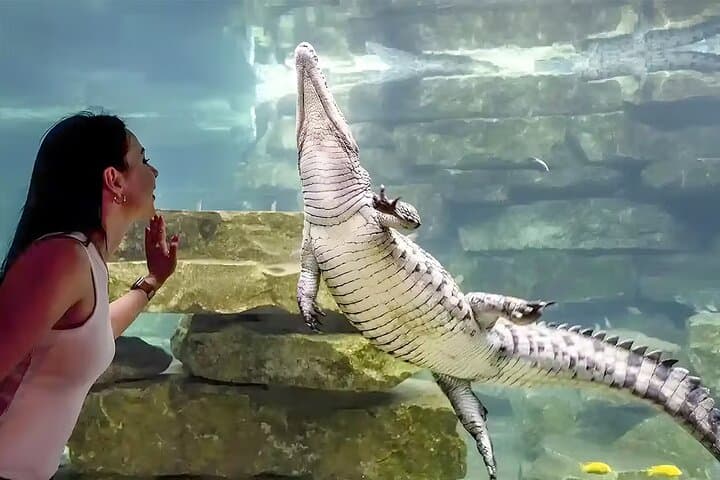
You step off the street into a pocket of heat and movement: shaded boardwalks, the low rumble of water, and the slow, indifferent presence of hundreds of scaly backs sliding through glassy pools. At Dubai Crocodile Park the landscape is organized around visibility—safe viewing platforms give close angles on powerful jaws and rippling tails while information panels put each animal in context.
You step off the street into a pocket of heat and movement: shaded boardwalks, the low rumble of water, and the slow, indifferent presence of hundreds of scaly backs sliding through glassy pools. At Dubai Crocodile Park the landscape is organized around visibility—safe viewing platforms give close angles on powerful jaws and rippling tails while information panels put each animal in context.
The park houses more than 250 Nile crocodiles, an African species brought into an educational and research setting here in the UAE. Though crocodiles are not native to the Arabian Peninsula, the facility serves as an ex‑situ site for public education, rescue care, and exhibition—part of Dubai’s recent trend of creating specialized urban wildlife centers to broaden ecological understanding.
Geologically the setting is artificial ponds and planted berms designed to mimic river margins; culturally the attraction fits Dubai’s appetite for curated, family‑friendly experiences that mix spectacle with learning. Expect an interactive museum area and aquarium displays that explain crocodile biology, lifecycle, and conservation challenges.
Practically, plan 1–3 hours: arrive in the cooler morning or late afternoon, wear sun protection, and allow time for any scheduled feeding demonstrations and the museum. The grounds are compact—roughly 0.5–1.5 km of walking on flat paths—so it’s accessible for most visitors but observe all safety barriers and staff instructions. Photography is welcomed from platforms; do not touch or feed animals. Bring water, keep children close, and use shade breaks to avoid Dubai sun. For travelers wanting a short, wildlife‑focused stop inside the city, it’s a direct, educational encounter with one of the planet’s most formidable reptiles.
