THE ADVENTURE COLLECTIVE® · Independent discovery and booking for outdoor travel

A private full-day loop around Hawai‘i Island that trades bus crowds for a tailored, comfortable drive through lava fields, rainforest, sacred sites, and rare green sand. Expect long stretches of coastal road, short hikes, and insider stories from a local guide.
A private full-day loop around Hawai‘i Island that trades bus crowds for a tailored, comfortable drive through lava fields, rainforest, sacred sites, and rare green sand. Expect long stretches of coastal road, short hikes, and insider stories from a local guide.
You step into a cool, air-conditioned Subaru Ascent as the Kona sun is still low and the ocean slides silver past the coast.
The guide lifts a hand to the map and says simply: “Today we go around.” The SUV eases onto Highway 11 and the landscape obliges — reef-edged bays, sudden columns of black lava, rainforest gutters that smell of wet fern. It’s a day of contrasts: steam vents that refuse to be ignored, green sand hidden in a remote cove, and a City of Refuge that asks for quiet.
Verified experiences and guided adventures in the surrounding area.
Operated by Olga · Kailua-Kona, Hawaii
You step into a cool, air-conditioned Subaru Ascent as the Kona sun is still low and the ocean slides silver past the coast.
The guide lifts a hand to the map and says simply: “Today we go around.” The SUV eases onto Highway 11 and the landscape obliges — reef-edged bays, sudden columns of black lava, rainforest gutters that smell of wet fern. It’s a day of contrasts: steam vents that refuse to be ignored, green sand hidden in a remote cove, and a City of Refuge that asks for quiet.
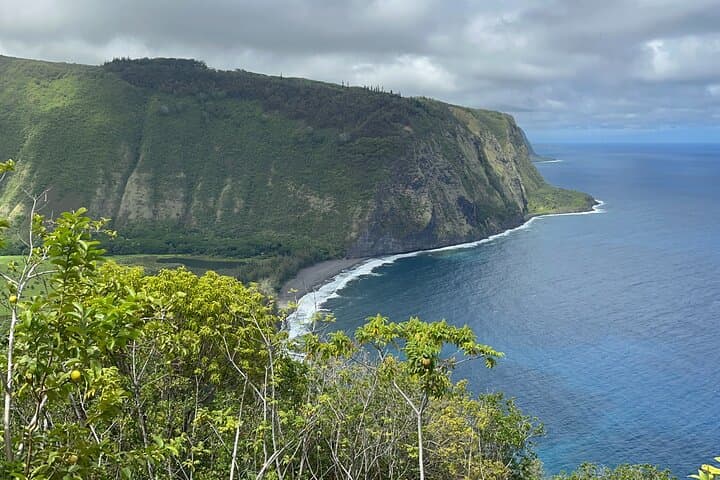
The Big Island’s loop is as much story as scenery. Puʻuhonua o Hōnaunau, the City of Refuge, preserves a legal and spiritual system that once shaped island life; warriors, chiefs, and kapu laws are carved into the place itself. Geologically, the island reads like a field guide to fire: Kīlauea and Mauna Loa’s basalt flows layer the southern coast, while olivine crystals give Papakōlea its rare green sand. The rainshadow creates abrupt climatic seams — lush Hilo rainforest one hour, sun-baked pasture the next — and with that shift comes cultural variety: surf towns, ranchland, sacred heiau, and coffee farms where kona beans cure in shaded barns.
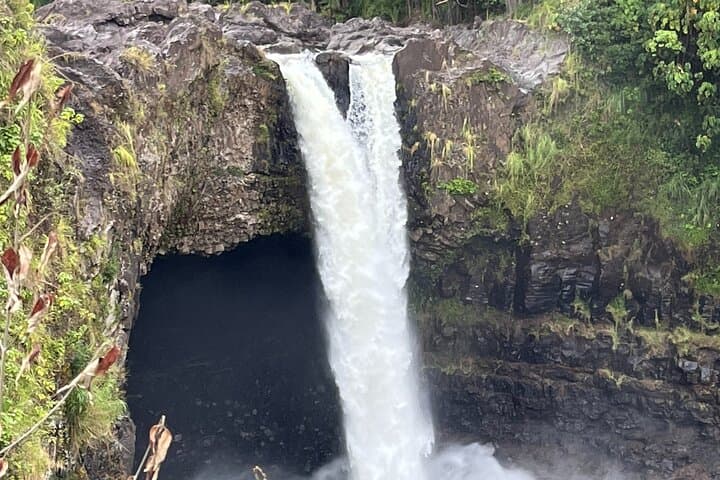
Expect a moving landscape rather than a single hike. The day covers roughly 6–10 hours and can include 200–300 miles of driving depending on your custom route, with short on-foot sections: a 10–20 minute stroll to Rainbow Falls, a steeper 45–90 minute approach near Papakōlea, and boardwalks around Thurston Lava Tube. Elevation varies sharply; some viewpoints sit near sea level, while Volcanoes National Park rises toward 4,000 ft, where the air is thinner and the wind finds you.
Practical edges: hydrate before and during the day, and carry a refillable bottle — the guide provides bottled water but refill stations are limited. Footwear should be comfortable hikers or sturdy sneakers; loose volcanic sand and lava fields can be uneven. Sun protection is non-negotiable — hat, sunscreen, and sunglasses — and layer up for higher elevations where temperatures drop and trade winds bite.
For photographers, morning light favors waterfalls and coastal bays; late afternoon brings color to lava fields and beaches. Be mindful of cultural protocol at sacred sites: speak softly, stay on marked paths, and never touch or approach resting honu (green turtles). A private tour lets you shape the day — linger at a beach, skip a stop, or add a coffee farm tasting — but it’s still a full day that rewards patience, curiosity, and respect for the land.
easy.
6–10 hours.
Suitable for travelers comfortable with a long day of sitting with several short walks and a few steeper approaches (Papakōlea).
Pickup and drop-off are door-to-door within arranged hotel zones in Kona or at the airport; confirm your preferred pickup location when booking.
Yes — the tour is private and paced to your group. It involves mostly short walks and vehicle time; notify the operator of mobility needs so the route can be adjusted.
Swimming is optional but often discouraged due to strong currents; it’s best for photos, observing honu, and beachcombing rather than casual swimming.
Reaching the green sand requires a roughly 45–90 minute hike each way from the nearest parking area or a local 4x4 transfer; check with your guide about access and fitness required.
Some stops include admission (as noted in the itinerary), but federal entrance fees for Hawai‘i Volcanoes National Park may be additional unless specified by the operator — confirm before you go.
Tipping is customary for private guides in Hawai‘i; 10–20% of the tour cost is a standard guideline if the guide provided excellent service.
Puʻuhonua o Hōnaunau preserves a former City of Refuge where ancient kapu laws allowed sanctuary to those seeking it, an important aspect of pre-contact law and social order.
Respect for cultural sites and marine life is enforced; avoid touching wildlife, use reef-safe sunscreen, and stay on trails to protect fragile ecosystems.
Olga operates guided outdoor trips and adventures with an emphasis on safety, stewardship, and memorable experiences.
You step into a cool, air-conditioned Subaru Ascent as the Kona sun is still low and the ocean slides silver past the coast.
The guide lifts a hand to the map and says simply: “Today we go around.” The SUV eases onto Highway 11 and the landscape obliges — reef-edged bays, sudden columns of black lava, rainforest gutters that smell of wet fern. It’s a day of contrasts: steam vents that refuse to be ignored, green sand hidden in a remote cove, and a City of Refuge that asks for quiet.
The Big Island’s loop is as much story as scenery. Puʻuhonua o Hōnaunau, the City of Refuge, preserves a legal and spiritual system that once shaped island life; warriors, chiefs, and kapu laws are carved into the place itself. Geologically, the island reads like a field guide to fire: Kīlauea and Mauna Loa’s basalt flows layer the southern coast, while olivine crystals give Papakōlea its rare green sand. The rainshadow creates abrupt climatic seams — lush Hilo rainforest one hour, sun-baked pasture the next — and with that shift comes cultural variety: surf towns, ranchland, sacred heiau, and coffee farms where kona beans cure in shaded barns.
Expect a moving landscape rather than a single hike. The day covers roughly 6–10 hours and can include 200–300 miles of driving depending on your custom route, with short on-foot sections: a 10–20 minute stroll to Rainbow Falls, a steeper 45–90 minute approach near Papakōlea, and boardwalks around Thurston Lava Tube. Elevation varies sharply; some viewpoints sit near sea level, while Volcanoes National Park rises toward 4,000 ft, where the air is thinner and the wind finds you.
Practical edges: hydrate before and during the day, and carry a refillable bottle — the guide provides bottled water but refill stations are limited. Footwear should be comfortable hikers or sturdy sneakers; loose volcanic sand and lava fields can be uneven. Sun protection is non-negotiable — hat, sunscreen, and sunglasses — and layer up for higher elevations where temperatures drop and trade winds bite.
For photographers, morning light favors waterfalls and coastal bays; late afternoon brings color to lava fields and beaches. Be mindful of cultural protocol at sacred sites: speak softly, stay on marked paths, and never touch or approach resting honu (green turtles). A private tour lets you shape the day — linger at a beach, skip a stop, or add a coffee farm tasting — but it’s still a full day that rewards patience, curiosity, and respect for the land.