THE ADVENTURE COLLECTIVE® · Independent discovery and booking for outdoor travel

Drive authentic 1970s buggies across Gran Canaria’s south—through dunes, canyon mouths and tiny Canarian villages. This three-hour guided ride combines hands-on driving, shoreline views, and practical stops for coffee and water.
Drive authentic 1970s buggies across Gran Canaria’s south—through dunes, canyon mouths and tiny Canarian villages. This three-hour guided ride combines hands-on driving, shoreline views, and practical stops for coffee and water.
A low sun paints the volcanic ridges golden as a pair of fiberglass buggies crunch across compacted sand and track-cut volcanic ash. Wind pushes at the occupants and the Atlantic horizon dares you to look up; the machines thrum with a retro, mechanical honesty — a 1970s driving experience retooled for modern safety and island roads.
Verified experiences and guided adventures in the surrounding area.
Operated by 70'sbuggy · Maspalomas, Las Palmas
A low sun paints the volcanic ridges golden as a pair of fiberglass buggies crunch across compacted sand and track-cut volcanic ash. Wind pushes at the occupants and the Atlantic horizon dares you to look up; the machines thrum with a retro, mechanical honesty — a 1970s driving experience retooled for modern safety and island roads.
Gran Canaria’s south is carved by ancient lava and recent erosion: steep barrancos (ravines), flat coastal dunes, and terraced farmland that remember both volcanic upheaval and the island’s pre-colonial Guanche people. The route threads coastal flats into narrow canyon mouths, crossing volcanic rock and loose sand, with stops in small Canarian villages where cafés pour strong coffee and local gossip.
Culturally, the area balances tourism near Maspalomas with agricultural hamlets like Cercado de Espino and Fataga, where stone houses and palm-fed wells hint at older rhythms. Geologically active in origin, the landscape shifts from dune to basalt bluff in minutes, a compact lesson in island building.
Practically: expect roughly three hours on tour, two people per vehicle, and a mix of paved and off-road surfaces. Drivers receive instruction and a guided route with optional detours; passengers can relax and photograph. Bring sun protection, closed-toe shoes, and a light layer for coastal winds. Rides start between 9am–5pm, so choose morning for cooler air and softer light, or late afternoon for golden views.
The experience is part mechanical thrill, part landscape primer — a short, high-energy way to feel Gran Canaria’s geological bones while sampling small-village hospitality and the practical comforts of bottled water and roadside cafés.
easy.
~3 hours.
Suitable for most fitness levels; minimal exertion required beyond basic mobility to enter/exit the vehicle.
Yes — most operators require a valid driver’s license for whoever will drive; be prepared to present it at check-in.
Yes, these tours accept two people per vehicle (driver plus one passenger) as standard.
Tours may be canceled or rescheduled if conditions are unsafe; the policy typically allows full refunds if canceled 24 hours prior.
Some operators note wheelchair accessibility for meeting areas and vehicles, but entering the buggy requires basic mobility—ask the operator about specific accommodations.
The southern routes pass through landscapes shaped by volcanic eruptions and later by Guanche settlement and Spanish agricultural terraces; villages still reflect those layered histories.
Maspalomas dunes and fragile canyon flora are sensitive—stay on designated tracks, avoid driving over protected dune vegetation, and pack out any litter.
70'sbuggy operates guided outdoor trips and adventures with an emphasis on safety, stewardship, and memorable experiences.

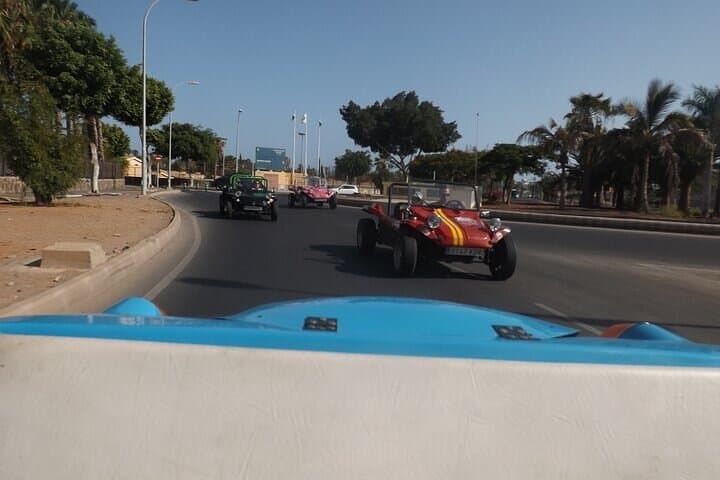


A low sun paints the volcanic ridges golden as a pair of fiberglass buggies crunch across compacted sand and track-cut volcanic ash. Wind pushes at the occupants and the Atlantic horizon dares you to look up; the machines thrum with a retro, mechanical honesty — a 1970s driving experience retooled for modern safety and island roads.
A low sun paints the volcanic ridges golden as a pair of fiberglass buggies crunch across compacted sand and track-cut volcanic ash. Wind pushes at the occupants and the Atlantic horizon dares you to look up; the machines thrum with a retro, mechanical honesty — a 1970s driving experience retooled for modern safety and island roads.
Gran Canaria’s south is carved by ancient lava and recent erosion: steep barrancos (ravines), flat coastal dunes, and terraced farmland that remember both volcanic upheaval and the island’s pre-colonial Guanche people. The route threads coastal flats into narrow canyon mouths, crossing volcanic rock and loose sand, with stops in small Canarian villages where cafés pour strong coffee and local gossip.
Culturally, the area balances tourism near Maspalomas with agricultural hamlets like Cercado de Espino and Fataga, where stone houses and palm-fed wells hint at older rhythms. Geologically active in origin, the landscape shifts from dune to basalt bluff in minutes, a compact lesson in island building.
Practically: expect roughly three hours on tour, two people per vehicle, and a mix of paved and off-road surfaces. Drivers receive instruction and a guided route with optional detours; passengers can relax and photograph. Bring sun protection, closed-toe shoes, and a light layer for coastal winds. Rides start between 9am–5pm, so choose morning for cooler air and softer light, or late afternoon for golden views.
The experience is part mechanical thrill, part landscape primer — a short, high-energy way to feel Gran Canaria’s geological bones while sampling small-village hospitality and the practical comforts of bottled water and roadside cafés.