THE ADVENTURE COLLECTIVE® · Independent discovery and booking for outdoor travel

Follow the trail of Böttger’s porcelain secrets across Dresden in a self-guided city game. Solve puzzles at landmark sites—Frauenkirche, Zwinger and Semperoper—on a flexible 2–3 hour walking route.
Follow the trail of Böttger’s porcelain secrets across Dresden in a self-guided city game. Solve puzzles at landmark sites—Frauenkirche, Zwinger and Semperoper—on a flexible 2–3 hour walking route.
Morning light catches the Elbe and you set off with only a smartphone, a map link and a story: the hunt for Böttger’s secret. The route threads from the Frauenkirche across Brühl's Terrace, past the Semperoper and the Zwinger, pausing at statuary and façades where puzzles anchor the narrative to real places. The city’s baroque stone and 20th-century reconstructions become waypoints rather than backdrops.
Verified experiences and guided adventures in the surrounding area.
Operated by Hint-Caching · Dresden, Saxony
Morning light catches the Elbe and you set off with only a smartphone, a map link and a story: the hunt for Böttger’s secret. The route threads from the Frauenkirche across Brühl's Terrace, past the Semperoper and the Zwinger, pausing at statuary and façades where puzzles anchor the narrative to real places. The city’s baroque stone and 20th-century reconstructions become waypoints rather than backdrops.
Dresden’s story is visible in its streets — the post-war rebuilding, the Saxon court’s historic wealth from porcelain and mining, and the real-life figure of alchemist Johann Friedrich Böttger whose experiments with kaolin helped spawn European porcelain. The pavements here record layers of history; even the Elbe seems to push you downriver toward new clues.
Expect 2–3 hours of easy walking, roughly 3–5 km with minimal elevation gain (under 50 m) and frequent stops to read, think and photograph. The game’s clues are integrated with sights, so progress depends more on attention than speed. Groups of 1–6 work best; larger parties split into teams.
Practical notes: a charged smartphone and a power bank are essential. Public transport can shorten or join the route, and the game can be resumed any day within a year if weather intervenes. Respect markers and monuments — puzzles require observation, not alteration. Hydrate, wear solid walking shoes, and plan pockets of time to enjoy a café or a view from Brühl’s Terrace between puzzles.
easy.
2–3 hours.
Suitable for most fitness levels; requires walking up to 5 km and standing for short puzzle periods.
The self-guided game is designed for about 2–3 hours, depending on pace and how long you stop at sights.
Yes. After booking you receive a link and can begin at any time; the game remains valid for one year if you need to reschedule due to weather.
The experience is offered in German and English through the game interface and clue text.
Many central areas and terraces are wheelchair accessible, though cobblestones and ramps may require caution; some historic interiors are step-access only.
Dresden’s porcelain boom links to Johann Friedrich Böttger’s early 18th-century experiments; the game leans on that local chapter and the city’s Saxon court heritage.
Visitors should avoid touching historic surfaces and follow signage; using public transport and staying on paved routes reduces wear on fragile sites.
Hint-Caching operates guided outdoor trips and adventures with an emphasis on safety, stewardship, and memorable experiences.



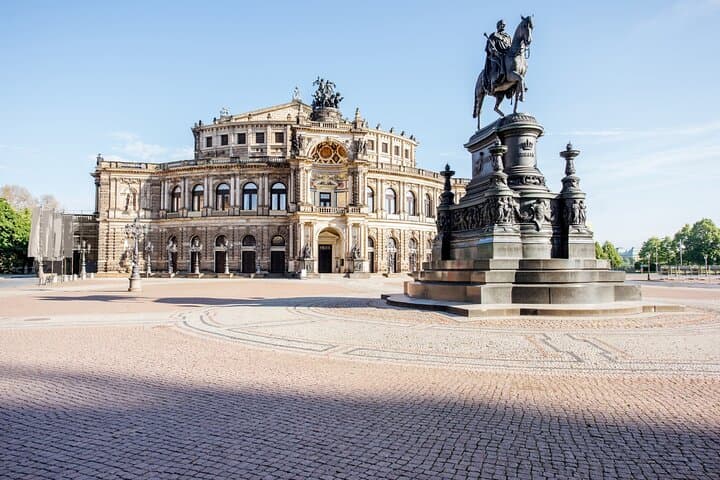
Morning light catches the Elbe and you set off with only a smartphone, a map link and a story: the hunt for Böttger’s secret. The route threads from the Frauenkirche across Brühl's Terrace, past the Semperoper and the Zwinger, pausing at statuary and façades where puzzles anchor the narrative to real places. The city’s baroque stone and 20th-century reconstructions become waypoints rather than backdrops.
Morning light catches the Elbe and you set off with only a smartphone, a map link and a story: the hunt for Böttger’s secret. The route threads from the Frauenkirche across Brühl's Terrace, past the Semperoper and the Zwinger, pausing at statuary and façades where puzzles anchor the narrative to real places. The city’s baroque stone and 20th-century reconstructions become waypoints rather than backdrops.
Dresden’s story is visible in its streets — the post-war rebuilding, the Saxon court’s historic wealth from porcelain and mining, and the real-life figure of alchemist Johann Friedrich Böttger whose experiments with kaolin helped spawn European porcelain. The pavements here record layers of history; even the Elbe seems to push you downriver toward new clues.
Expect 2–3 hours of easy walking, roughly 3–5 km with minimal elevation gain (under 50 m) and frequent stops to read, think and photograph. The game’s clues are integrated with sights, so progress depends more on attention than speed. Groups of 1–6 work best; larger parties split into teams.
Practical notes: a charged smartphone and a power bank are essential. Public transport can shorten or join the route, and the game can be resumed any day within a year if weather intervenes. Respect markers and monuments — puzzles require observation, not alteration. Hydrate, wear solid walking shoes, and plan pockets of time to enjoy a café or a view from Brühl’s Terrace between puzzles.