THE ADVENTURE COLLECTIVE® · Independent discovery and booking for outdoor travel

A short, accessible hike along the historic Monk’s Trail to Wat Pha Lat followed by a visit to the gilded Wat Phra That Doi Suthep. Expect jungle shade, carved stonework, and sweeping city views from the mountain.
A short, accessible hike along the historic Monk’s Trail to Wat Pha Lat followed by a visit to the gilded Wat Phra That Doi Suthep. Expect jungle shade, carved stonework, and sweeping city views from the mountain.
Morning light slides between dipterocarp trunks as the songthaew rumbles up the road and drops you at the trailhead — an honest, local beginning to a short mountain walk. The Monk’s Trail climbs through a green corridor of mossy stones and prayer flags, a 30–40 minute ascent that leads to Wat Pha Lat, the low-key forest temple built in 1355 where carved balustrades and shaded meditation corners feel intentionally removed from the city below.
Verified experiences and guided adventures in the surrounding area.
Operated by WanderSiam · Chiang Mai, Chiang Mai Province
Morning light slides between dipterocarp trunks as the songthaew rumbles up the road and drops you at the trailhead — an honest, local beginning to a short mountain walk. The Monk’s Trail climbs through a green corridor of mossy stones and prayer flags, a 30–40 minute ascent that leads to Wat Pha Lat, the low-key forest temple built in 1355 where carved balustrades and shaded meditation corners feel intentionally removed from the city below.
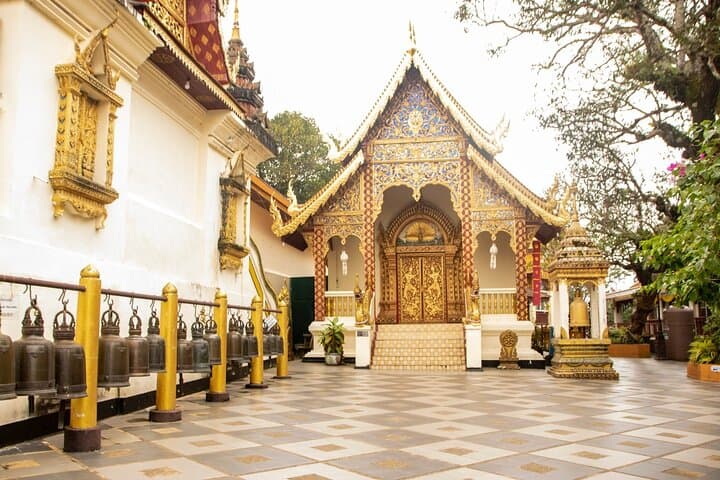
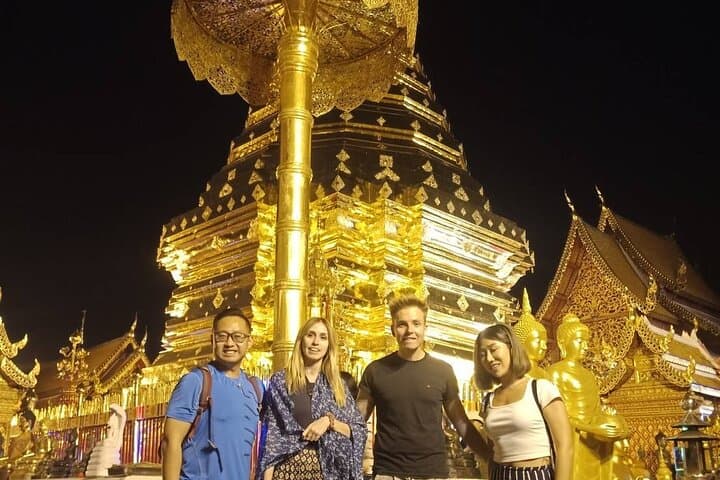
From there the route continues (or you can transfer) to Wat Phra That Doi Suthep, the gilded chedi that crowns Doi Suthep at roughly 1,053 meters above sea level. The temple’s dragon staircase, shrines, and copper-covered stupa are important both historically and spiritually for northern Thailand — pilgrims have made this climb for centuries. Geologically the ridge is part of the Chiang Mai range, with laterite and sandstone beds weathering into steep, forested slopes that funnel mist and monsoon rain into the Ping valley.
Practicalities: expect a mixed program of walking and short transfers in an open-sided songthaew; watch the stairs (over 300 steps) if you choose to climb to the chedi, or take the cable car. Bring THB 100 in cash for the Wat Pha Lat trail entrance, wear shoulders-and-knees-covered clothing for temples, and carry water and sun protection. The full outing runs around four hours including transfers; it’s accessible to most walkers but the uphill sections reward a steady, patient pace.
This trip pairs cultural immersion with a compact, readable hike — ideal for travelers who want forest shade, temple architecture, and a clean panorama of Chiang Mai without committing to a full-day trek.
easy.
4 hours.
Suitable for travelers with basic fitness; capable of a steady 30–40 minute uphill walk and climbing temple stairs if desired.
The Monk’s Trail to Wat Pha Lat takes roughly 30–40 minutes from the trailhead, on a short but occasionally steep and rocky path.
No — you can visit Wat Phra That Doi Suthep via the stairway or take the cable car; the tour also offers vehicle transfers if you prefer to avoid the climb.
Entrance to Wat Pha Lat’s Monk’s Trail is not included; expect to pay around THB 100 in cash on the day. Other temple donations or cable car fees are typically extra.
The tour uses a traditional Chiang Mai songthaew (open-sided red pickup truck with benches) for short transfers between trailhead, temples, and the city.
Wat Pha Lat dates from the mid-14th century and connects to the ancient Monk’s Trail used by pilgrims ascending to Doi Suthep, whose central chedi has been a regional religious focus for centuries.
Stay on marked trails, don’t feed wildlife, and carry out rubbish; temples and forested slopes are sensitive to erosion and visitor pressure, especially in the rainy season.
WanderSiam operates guided outdoor trips and adventures with an emphasis on safety, stewardship, and memorable experiences.


Morning light slides between dipterocarp trunks as the songthaew rumbles up the road and drops you at the trailhead — an honest, local beginning to a short mountain walk. The Monk’s Trail climbs through a green corridor of mossy stones and prayer flags, a 30–40 minute ascent that leads to Wat Pha Lat, the low-key forest temple built in 1355 where carved balustrades and shaded meditation corners feel intentionally removed from the city below.
Morning light slides between dipterocarp trunks as the songthaew rumbles up the road and drops you at the trailhead — an honest, local beginning to a short mountain walk. The Monk’s Trail climbs through a green corridor of mossy stones and prayer flags, a 30–40 minute ascent that leads to Wat Pha Lat, the low-key forest temple built in 1355 where carved balustrades and shaded meditation corners feel intentionally removed from the city below.
From there the route continues (or you can transfer) to Wat Phra That Doi Suthep, the gilded chedi that crowns Doi Suthep at roughly 1,053 meters above sea level. The temple’s dragon staircase, shrines, and copper-covered stupa are important both historically and spiritually for northern Thailand — pilgrims have made this climb for centuries. Geologically the ridge is part of the Chiang Mai range, with laterite and sandstone beds weathering into steep, forested slopes that funnel mist and monsoon rain into the Ping valley.
Practicalities: expect a mixed program of walking and short transfers in an open-sided songthaew; watch the stairs (over 300 steps) if you choose to climb to the chedi, or take the cable car. Bring THB 100 in cash for the Wat Pha Lat trail entrance, wear shoulders-and-knees-covered clothing for temples, and carry water and sun protection. The full outing runs around four hours including transfers; it’s accessible to most walkers but the uphill sections reward a steady, patient pace.
This trip pairs cultural immersion with a compact, readable hike — ideal for travelers who want forest shade, temple architecture, and a clean panorama of Chiang Mai without committing to a full-day trek.