THE ADVENTURE COLLECTIVE® · Independent discovery and booking for outdoor travel

Climb the 306 steps (or take the tram) to Wat Phra That Doi Suthep for sweeping views over Chiang Mai, then visit a Hmong village to see traditional weaving and daily life. This half-day trip blends religious history, mountain geology, and living culture into a compact morning outing.
Climb the 306 steps (or take the tram) to Wat Phra That Doi Suthep for sweeping views over Chiang Mai, then visit a Hmong village to see traditional weaving and daily life. This half-day trip blends religious history, mountain geology, and living culture into a compact morning outing.
Morning light cuts across teak and eucalyptus as the minivan climbs the switchbacks toward Doi Suthep, the city shrinking into a patchwork of roofs below.
Verified experiences and guided adventures in the surrounding area.
Operated by Oh-Hoo · Chiang Mai, Chiang Mai Province
Morning light cuts across teak and eucalyptus as the minivan climbs the switchbacks toward Doi Suthep, the city shrinking into a patchwork of roofs below.
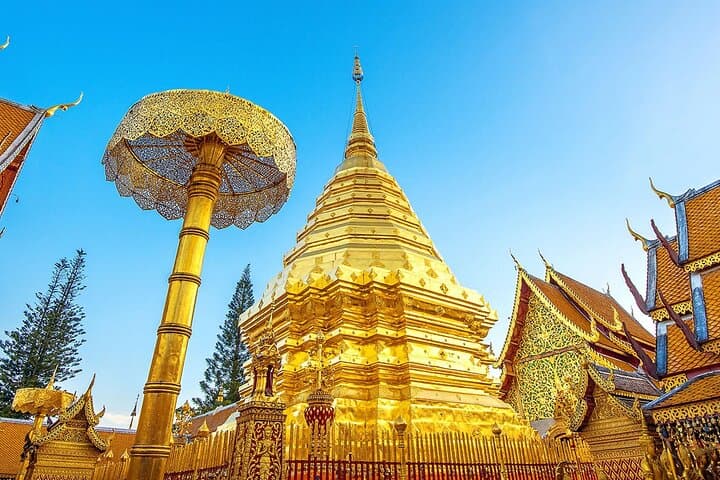
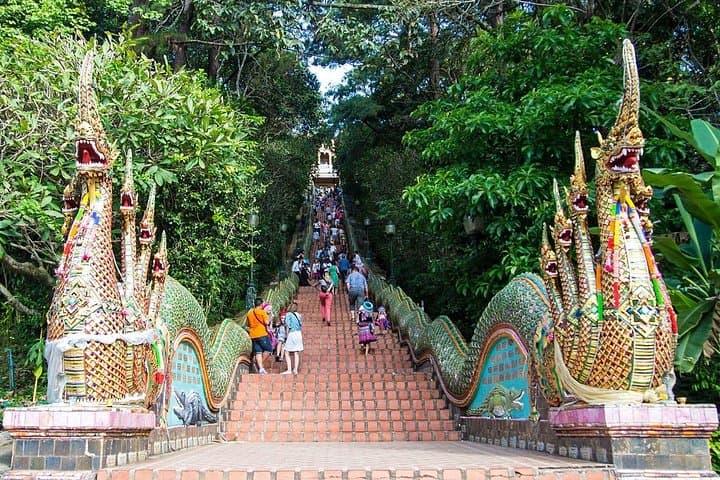
At the summit, Wat Phra That Doi Suthep occupies a ridge with gilded chedis and lacquered naga staircases; the temple’s presence is both architectural and elemental—the mountain’s ridge seems to hold the stupas in place like a hand. Founded in 1383 under King Keu Naone, the temple’s origin story—of a white elephant and a sacred relic—still shapes pilgrim rituals and the layout of the complex.
Geologically, Doi Suthep is part of the Thanon Thong Chai Range, formed by folded sedimentary rocks that create abrupt ridgelines and steep valley drops, offering broad views over the Ping River valley. Culture here is tactile: monks in saffron robes, brass bowls catching sunlight, and Hmong villagers weaving bright, geometric textiles in the foothills.
The half-day itinerary pairs a short temple hike—306 meditation steps to the main terrace, with a tram option—with a visit to a nearby Hmong village where visitors can learn about traditional garment-making and daily life.
Practical guidance: start early to avoid heat and tour buses, carry water and a light layer for winds on the ridge, and wear modest clothing for temple entry (shoulders and knees covered). Expect uneven stone steps and crowded viewpoints; bring small change for donation boxes and local crafts. The tour returns to Chiang Mai in the early afternoon, leaving time for the city’s markets or a quiet coffee beneath banyan trees.
easy.
3–4 hours.
Suitable for most travelers; some stair climbing required or choose tram for lower impact
The shared half-day tour runs about 3–4 hours, typically returning to Chiang Mai in the early afternoon.
No—the temple can be reached by a tram for those who prefer to avoid or cannot manage the stairs.
Visits are to real communities where artisans display traditional textiles and crafts; interactions vary by household and season.
Advance booking is recommended for peak season, but small-group tours and on-site options are often available depending on demand.
Wat Phra That Doi Suthep dates to 1383 under Lanna rule; its founding legend involves a white elephant that indicated the sacred site for enshrining a Buddha relic.
Doi Suthep-Doi Pui is part of a protected national park; visitors should stay on paths, avoid feeding wildlife, and support local craft sellers ethically.
Oh-Hoo operates guided outdoor trips and adventures with an emphasis on safety, stewardship, and memorable experiences.
Morning light cuts across teak and eucalyptus as the minivan climbs the switchbacks toward Doi Suthep, the city shrinking into a patchwork of roofs below.
Morning light cuts across teak and eucalyptus as the minivan climbs the switchbacks toward Doi Suthep, the city shrinking into a patchwork of roofs below.
At the summit, Wat Phra That Doi Suthep occupies a ridge with gilded chedis and lacquered naga staircases; the temple’s presence is both architectural and elemental—the mountain’s ridge seems to hold the stupas in place like a hand. Founded in 1383 under King Keu Naone, the temple’s origin story—of a white elephant and a sacred relic—still shapes pilgrim rituals and the layout of the complex.
Geologically, Doi Suthep is part of the Thanon Thong Chai Range, formed by folded sedimentary rocks that create abrupt ridgelines and steep valley drops, offering broad views over the Ping River valley. Culture here is tactile: monks in saffron robes, brass bowls catching sunlight, and Hmong villagers weaving bright, geometric textiles in the foothills.
The half-day itinerary pairs a short temple hike—306 meditation steps to the main terrace, with a tram option—with a visit to a nearby Hmong village where visitors can learn about traditional garment-making and daily life.
Practical guidance: start early to avoid heat and tour buses, carry water and a light layer for winds on the ridge, and wear modest clothing for temple entry (shoulders and knees covered). Expect uneven stone steps and crowded viewpoints; bring small change for donation boxes and local crafts. The tour returns to Chiang Mai in the early afternoon, leaving time for the city’s markets or a quiet coffee beneath banyan trees.