THE ADVENTURE COLLECTIVE® · Independent discovery and booking for outdoor travel

Witness sunrise at Angkor Wat, explore Bayon and Ta Prohm, and cruise Tonle Sap on a compact four-day small-group tour. Practical planning tips and cultural context help you move between iconic temples and local life with confidence.
Witness sunrise at Angkor Wat, explore Bayon and Ta Prohm, and cruise Tonle Sap on a compact four-day small-group tour. Practical planning tips and cultural context help you move between iconic temples and local life with confidence.
Morning light thins over the Angkor moat and the first silhouette of Angkor Wat rises from the mist — stone, shadow and silence broken only by the murmur of guide commentary and distant birdcall.
Verified experiences and guided adventures in the surrounding area.
Operated by Indochina Tour · Siem Reap, Siem Reap Province
Morning light thins over the Angkor moat and the first silhouette of Angkor Wat rises from the mist — stone, shadow and silence broken only by the murmur of guide commentary and distant birdcall.
Over four days the route moves from the colossal bas-reliefs of Angkor Wat to the smiling faces of Bayon, the root-swathed galleries of Ta Prohm and the floating villages of Tonle Sap. These sites were forged during the Khmer Empire (9th–15th centuries) and sit on flat alluvial plains where laterite and sandstone were quarried and sculpted into temple cities that mapped cosmology onto landscape.
Siem Reap’s older quarters and nightly markets reveal contemporary culture: Apsara dance preserves classical court performance while local markets trade rice, fish paste and street snacks. Tonle Sap’s seasonal flood pulse reshapes livelihoods—floating houses rise and fall with the lake, a living adaptation to hydrology.
Practically: expect early starts for cooler light and fewer crowds, flat walking but uneven temple stones and many stairs; temple passes are required for Angkor and are typically purchased before entry. Dress respectfully—shoulders covered and knees mostly covered—carry water, sun protection and insect repellent. Sightseeing is mostly low elevation (near sea level), but humidity and heat can make half- and full-day exploration strenuous. Small-group logistics include air-conditioned transfers and three breakfasts, with comfortable four-star hotel nights.
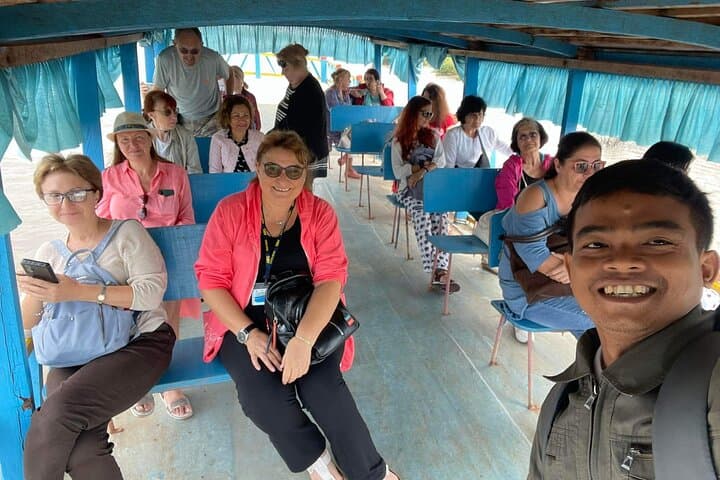
A sensible pace pairs sunrise at Angkor Wat with mid-day rest at your hotel, then late-afternoon visits to quieter temples or a Tonle Sap boat ride when light sharpens the village scenes. This itinerary balances iconic photo moments with local cultural encounters.
moderate.
4 days.
Light-to-moderate fitness: able to walk several hours a day on uneven ground and climb temple steps.
Yes—Angkor Archaeological Park requires a pass for entry; passes (1-, 3-, or 7-day) are purchased at the official ticket center near the park.
Sunrise viewing commonly begins before 5:30 AM depending on season; allow time for transfer from hotels and lines at viewpoints.
Most temples are low-elevation but include uneven surfaces and steep stairs—mobility limitations may restrict access to some areas.
Organized boat trips with licensed operators are generally safe; life jackets and local guidance are standard—avoid informal boats during high water or storms.
Angkor was the capital of the Khmer Empire; the park’s monuments represent centuries of Hindu and Buddhist architectural evolution centered on Mount Meru cosmology.
Visitor pressure has prompted conservation measures including managed visitor routes, entrance fees that fund preservation, and guidelines to minimize wear on fragile bas-reliefs.
Indochina Tour operates guided outdoor trips and adventures with an emphasis on safety, stewardship, and memorable experiences.

Morning light thins over the Angkor moat and the first silhouette of Angkor Wat rises from the mist — stone, shadow and silence broken only by the murmur of guide commentary and distant birdcall.
Morning light thins over the Angkor moat and the first silhouette of Angkor Wat rises from the mist — stone, shadow and silence broken only by the murmur of guide commentary and distant birdcall.
Over four days the route moves from the colossal bas-reliefs of Angkor Wat to the smiling faces of Bayon, the root-swathed galleries of Ta Prohm and the floating villages of Tonle Sap. These sites were forged during the Khmer Empire (9th–15th centuries) and sit on flat alluvial plains where laterite and sandstone were quarried and sculpted into temple cities that mapped cosmology onto landscape.
Siem Reap’s older quarters and nightly markets reveal contemporary culture: Apsara dance preserves classical court performance while local markets trade rice, fish paste and street snacks. Tonle Sap’s seasonal flood pulse reshapes livelihoods—floating houses rise and fall with the lake, a living adaptation to hydrology.
Practically: expect early starts for cooler light and fewer crowds, flat walking but uneven temple stones and many stairs; temple passes are required for Angkor and are typically purchased before entry. Dress respectfully—shoulders covered and knees mostly covered—carry water, sun protection and insect repellent. Sightseeing is mostly low elevation (near sea level), but humidity and heat can make half- and full-day exploration strenuous. Small-group logistics include air-conditioned transfers and three breakfasts, with comfortable four-star hotel nights.
A sensible pace pairs sunrise at Angkor Wat with mid-day rest at your hotel, then late-afternoon visits to quieter temples or a Tonle Sap boat ride when light sharpens the village scenes. This itinerary balances iconic photo moments with local cultural encounters.