THE ADVENTURE COLLECTIVE® · Independent discovery and booking for outdoor travel

Walk the mud-brick alleys of Diriyah with a local guide, then settle into a traditional Najdi dinner beneath courtyard lights. This three-hour tour combines UNESCO-listed history, regional architecture, and authentic cuisine for a compact cultural evening near Riyadh.
Walk the mud-brick alleys of Diriyah with a local guide, then settle into a traditional Najdi dinner beneath courtyard lights. This three-hour tour combines UNESCO-listed history, regional architecture, and authentic cuisine for a compact cultural evening near Riyadh.
Sunlight strips across weathered mud-brick walls as a local guide threads a slow puzzle of alleys in Diriyah, the original seat of the Saudi state. The air carries the dry warmth of the Najd plateau; date palms at the edge of the old town rustle like a quiet audience while guests move between restored palaces and open courtyards.
Verified experiences and guided adventures in the surrounding area.
Sunlight strips across weathered mud-brick walls as a local guide threads a slow puzzle of alleys in Diriyah, the original seat of the Saudi state. The air carries the dry warmth of the Najd plateau; date palms at the edge of the old town rustle like a quiet audience while guests move between restored palaces and open courtyards.
The walk centers on At-Turaif, an 18th–19th century stronghold and UNESCO site where the carved wooden balconies and thick gypsum plaster reveal both civic power and vernacular skill. Geologically, Diriyah sits on the Riyadh plateau—flat, sandy plains punctuated by the shallow channel of Wadi Hanifa to the south—so views sweep low and broad rather than vertical. Culturally, the tour is a primer on Najdi life: tribal governance, the rise of the First Saudi State, and contemporary efforts to revive traditional crafts and cuisine.
Practical guidance is straightforward: expect three hours of mostly flat walking on compacted earth and paved sections. Modest, breathable clothing suits the local customs; comfortable, closed shoes handle dust and occasional loose stone. Timing matters—late afternoon cools the sun and improves light for photos. The evening portion presents a multi-course traditional dinner—dates, spiced rice dishes, slow-roasted meats, Arabic coffee—served in a tented courtyard that emphasizes communal eating customs.
Visitors should carry water, sunscreen, and a scarf for sudden gusts of sand or to cover when visiting sensitive cultural spots. Guides generally allow photography but advise asking before shooting people. The experience blends history, approachable archaeology, and sensory dining—an accessible evening that links the plains outside Riyadh to the deep roots of the region.
moderate.
3 hours.
Light to moderate fitness; ability to walk on uneven surfaces for up to 90 minutes at a stretch
The full experience runs about three hours, typically combining a walking tour of At-Turaif and a seated traditional dinner.
Yes—paths are mostly flat, but mobility issues may require assistance on uneven sections; children should be supervised near stairs and courtyards.
Restrooms and shaded seating are available at visitor areas and dining courtyards, though facilities vary by venue and time of day.
Smart-casual and modest attire is appropriate; avoid shorts in public heritage areas and opt for breathable fabrics.
Diriyah was the capital of the First Saudi State in the 18th and early 19th centuries; At-Turaif is now a UNESCO World Heritage site celebrating Najdi architecture and state formation.
Restoration follows a managed plan balancing tourism and preservation; visitors are encouraged to stick to marked paths and avoid touching fragile plaster and wooden elements.
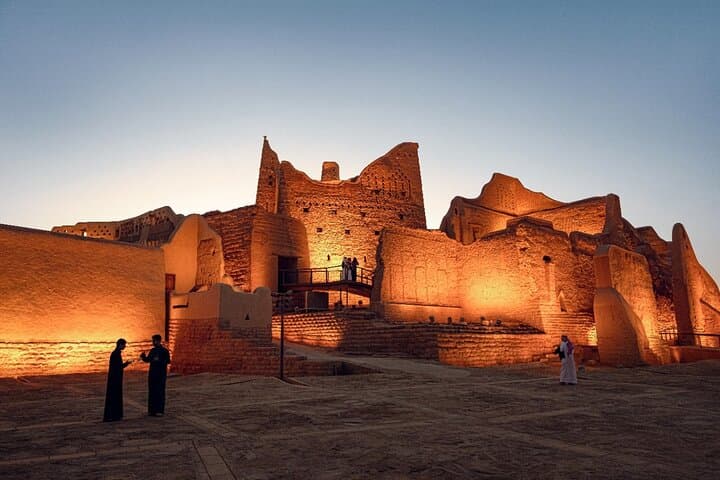
Sunlight strips across weathered mud-brick walls as a local guide threads a slow puzzle of alleys in Diriyah, the original seat of the Saudi state. The air carries the dry warmth of the Najd plateau; date palms at the edge of the old town rustle like a quiet audience while guests move between restored palaces and open courtyards.
Sunlight strips across weathered mud-brick walls as a local guide threads a slow puzzle of alleys in Diriyah, the original seat of the Saudi state. The air carries the dry warmth of the Najd plateau; date palms at the edge of the old town rustle like a quiet audience while guests move between restored palaces and open courtyards.
The walk centers on At-Turaif, an 18th–19th century stronghold and UNESCO site where the carved wooden balconies and thick gypsum plaster reveal both civic power and vernacular skill. Geologically, Diriyah sits on the Riyadh plateau—flat, sandy plains punctuated by the shallow channel of Wadi Hanifa to the south—so views sweep low and broad rather than vertical. Culturally, the tour is a primer on Najdi life: tribal governance, the rise of the First Saudi State, and contemporary efforts to revive traditional crafts and cuisine.
Practical guidance is straightforward: expect three hours of mostly flat walking on compacted earth and paved sections. Modest, breathable clothing suits the local customs; comfortable, closed shoes handle dust and occasional loose stone. Timing matters—late afternoon cools the sun and improves light for photos. The evening portion presents a multi-course traditional dinner—dates, spiced rice dishes, slow-roasted meats, Arabic coffee—served in a tented courtyard that emphasizes communal eating customs.
Visitors should carry water, sunscreen, and a scarf for sudden gusts of sand or to cover when visiting sensitive cultural spots. Guides generally allow photography but advise asking before shooting people. The experience blends history, approachable archaeology, and sensory dining—an accessible evening that links the plains outside Riyadh to the deep roots of the region.